Several issues regarding the training of political officers to meet the requirements of building a modern Army
The building of a modern Vietnam People’s Army (VPA) poses increasingly high demands on the officer corps in general, and political officers in particular, necessitating fundamental and uniformed innovation in training. Therefore, there should be further studies and discussions to improve training quality and meet the practical requirements of building the Military in the new phase.
Political officers play a vital role in advising, organising, and conducting Party and political work, contributing to preserving the revolutionary nature and combat power of our VPA, ensuring the absolute and direct leadership of the Party over the Military in all aspects.
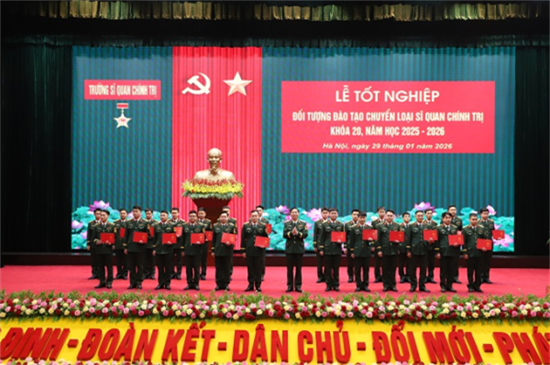 |
| A graduation ceremony at Political Officer College |
In recent years, under the leadership and direction of the Central Military Commission and the Ministry of National Defence, alongside the guidance of the General Department of Politics of the VPA, the training of political officers has seen numerous innovations, resulting in many positive results, gradually meeting the requirements of building the Military in the new stage. Training institutions, with the Political Academy and the Political Officer College as the core, have strictly, uniformly, and comprehensively performed education and training work. They have proactively innovated training processes, content, and programmes with the motto: “The training quality of the school translates into the combat readiness capacity of the unit”. The contingent of instructors and educational managers is gradually being standardised and comprehensively developed, particularly in terms of professional qualifications, pedagogical capacity, scientific research ability, and training management. The majority of graduates possess political steadfastness, good moral qualities, and fundamental knowledge and capacity to carry out Party and political work during missions.
Entering the new era, the 14th National Party Congress identified the building of a “revolutionary, regular, elite, modern” VPA. This places new demands on political officers, requiring them to have political steadfastness, sharp thinking, comprehensive capacity, systematic working methods, deep military knowledge, mastery of digital skills, and the effective application of science and technology in Party and political work, especially under the conditions of modern combat and a multidimensional information environment. Consequently, this necessitates appropriate training and professional development solutions to ensure that political officers fully meet the requirements of building a modern VPA.
First, learning outcomes and job title requirements. Reality shows that “the development of learning outcomes for training programmes has yet to be timely or uniform”; training programmes “have content that has yet to keep pace with practice, especially in response to the conditions of modern warfare”. The above assessments reflect the overall status of training work in the Military, including the training of political officers. This is a crucial bottleneck, as learning outcomes serve as the direct basis for determining the objectives, content, and results to be achieved according to job title requirements. When learning outcomes are not fully or specifically defined, it is difficult for training programmes to accurately identify the qualities and capacities that need to be formed, especially the practical capacity to conduct Party and political work. Therefore, it is important to perfect learning outcomes and consider this the foremost step to uniformly innovate training work.
In our view, the core issue is the need to clearly define learning outcomes for each target group, level, and type of training, based on concretising the qualities, capacities, and requirements for fulfilling the duties of political officers of a modern VPA. Learning outcomes must truly become a consistent basis for developing training programmes, selecting training content and methods, organising the training process, and ensuring the building of a contingent of political officers with “political steadfastness, pure moral qualities, good working capacity, and absolute loyalty to the Fatherland, the Party, the State, and the People”, capable of maintaining principles, proactively handling situations, and responding to rapid, complex, and unexpected developments in the modern combat environment. On that basis, it is essential to continue reviewing and standardising training programmes towards being compact, interconnected, and modern, enhancing integration and interdisciplinary aspects, linking basic training with job title training, and overcoming overlapping and duplication between training modules and academic levels. Training content needs to be updated promptly in response to emerging issues regarding military art, combat methods, science, technology, digital transformation, cyberspace, and fields directly impacting Party and political work, thereby ensuring the preservation of the political theoretical foundation and increasing practicality, openness, and adaptability to the modern combat environment.
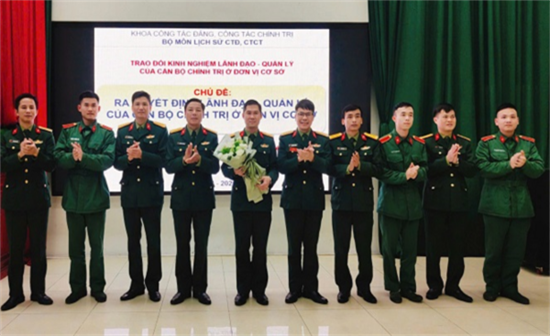 |
| Exchange of leadership and management experience gained by grass-roots political officers |
Second, the integration of political steadfastness and operational capacity in a modern military environment. Building a modern VPA must, first and foremost, relies on a solid political foundation. The more advanced the organisation, weaponry, and combat methods become, the higher the requirements are to maintain the Military’s revolutionary nature, combat objectives and ideal, resolve, and discipline. Therefore, political steadfastness remains the foundation, playing a decisive role for political officers. However, under the new conditions, political steadfastness cannot solely manifest through steadfast political awareness and attitude; it must be transformed into the capacity to accurately assess and correctly handle newly emerging practical issues.
A modern VPA places political officers in vastly different operational environments. Each type of unit, such as the air defence and air force, navy, signal, electronic warfare, cyber warfare, or technical support, has its own specific characteristics regarding task requirements, force organisation, professional qualifications, troops’ operational intensity, and psychological pressure. These factors directly impact the ideology, psychology, relationships, and capacity of military personnel to accomplish their tasks. Consequently, political officers must understand their duties and the characteristics of their operational environment. They must possess necessary military knowledge, systemic thinking, skills in organising human resources, and the adaptability to changing tasks. Furthermore, they must have the capacity to apply technology and exploit relevant information and data to serve the monitoring, management, and orientation of troops’ mentality. Training objectives, therefore, must transcend the narrow requirement of merely being “proficient in political work”, aiming to achieve the criterion of being “both red and expert” at a higher level. Being “red” entails more than having a steadfast stance; it must be reflected in conviction, responsibility, moral qualities, and the ability to uphold principles amid complex influences. Being “expert” is not merely about professional proficiency; it must be demonstrated in the thinking, knowledge, skills, working methods, and capacity to fulfil duties and responsibilities under new conditions. This is the core requirement for political officers to be truly capable of serving as the key force in building a politically strong VPA during the construction of a modern VPA.
Third, the gap between acquired knowledge and the capacity to perform duties. The building of a modern VPA requires all political officers to possess the capacity to handle complex and unexpected situations that directly impact the unit’s political strength and morale, to conduct Party and political work during specific and urgent missions, to proactively detect and address the risks of flashpoints regarding ideology, discipline, and internal unity, to orientate perception, and to combat false and distorted information alongside negative impacts from cyberspace. In particular, they must be capable of maintaining and consolidating the political and ideological front under the conditions of information scarcity, rapidly changing tasks, dispersed forces, massive psychological pressure, and the simultaneous impact of military, political, ideological, social, and technological factors.
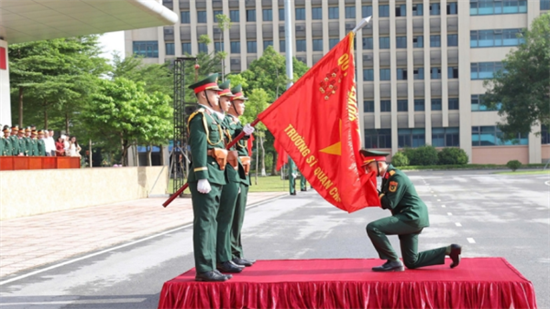 |
| Oath-taking ceremony for graduates from Political Officer College |
These requirements cannot be fully developed through learning methods heavily inclined towards rote memorisation and knowledge reproduction. Instead, learners must be placed in professional scenarios to self-analyse, select, and adopt appropriate solutions, and take responsibility for their decisions. Therefore, training innovation must shift strongly towards simulations, exercises, situational management, debates, staff work practice, practical Party and political work, case studies, and unit-level realities. Testing and assessment also need to change accordingly: alongside knowledge testing, there must be an evaluation of the ability to apply knowledge, independent thinking, advisory capacity, organisational skills, and problem-solving capabilities.
Consequently, training quality must be assessed based on the officer’s capacity to fulfil their responsibilities after returning to their unit, rather than solely relying on their academic results at the institution. This clearly reflects the motto: “The training quality of the school translates into the combat readiness capacity of the unit”.
Fourth, post-training evaluation and training quality assurance. Practical experience shows that current evaluation work still largely stops at determining the learner’s academic results upon completing the training course, and is not yet closely linked to the evaluation of the officer’s task performance after graduation. The monitoring, collection, and feedback of work performance at units to training institutions have yet to be conducted regularly, which limits the practical basis to verify the quality and suitability of learning outcomes and training programmes against job title requirements. This is a gap that needs to be bridged in the training of political officers.
Therefore, it is necessary to perfect the quality assurance mechanism towards making post-training evaluation a stage within the training quality assurance system, conducted periodically with specific criteria. Training institutions must enhance coordination with units to monitor the task performance of officers after graduation, while gathering feedback from Party committees, commands, political agencies, and the trained officers themselves regarding the programme’s suitability to practical requirements. The collected results must be synthesised, analysed, and cross-referenced with the institution’s internal evaluation results to identify limitations, arising issues, and training content that does not closely align with requirements. On that basis, post-training evaluation results should be used as a basis to review and adjust training programmes, content, methods, and conditions, thereby creating a seamless connection between result evaluation, practical verification, and training improvement. Simultaneously, the application of digital technology in managing and analysing evaluation data must be promoted to gradually improve the effectiveness of quality monitoring, programme improvement, and the close linkage between schools and units.
Innovating the training of political officers is an objective requirement derived from the process of building a modern VPA. The issues discussed above contribute to clarifying several requirements that need further study and complementation in the training and development of the contingent of political officers. Agencies, training institutions, and units need to apply these appropriately to real-life operations, aiming to gradually improve training quality and build a corps of political officers capable of meeting their task requirements in the new stage.
Sr. Col. NGUYEN DO PHU, PhD
Head of the Training Management Division
Political Officer College