Experience of the Gia Lai Provincial Border Guard in managing and safeguarding national territorial sovereignty and border security
Managing and safeguarding national territorial sovereignty and border security is a key and regular task of the entire Party, People, Military, and political system, with the Border Guard Force (BGF) playing a core and specialised role. Thoroughly grasping its functions and assigned tasks, the Provincial Border Guard (PBG) of Gia Lai has synchronously implemented measures for border management and protection.
Gia Lai province stretches from the Central Highlands to the South Central Coast. It shares its western border with Ratanakiri province of Cambodia and faces the East Sea to the east. These geographical characteristics give the province an important strategic position in terms of politics, economy, culture, society, defence, security, and external relations. However, they also place more demanding requirements on the task of managing and safeguarding national sovereignty over land, seas, and islands, as well as national border security.
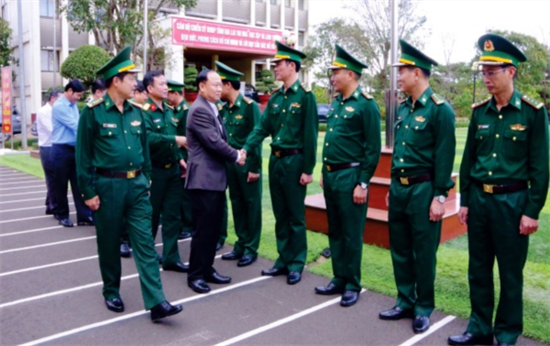 |
| Comrade Thai Dai Ngoc, Secretary of the Provincial Party Committee during his visit to the PBG |
Fully aware of this, in recent years, the PBG of Gia Lai has thoroughly grasped and strictly implemented resolutions, directives, and conclusions issued by higher echelons on safeguarding national sovereignty over land, seas, and islands, and national border security. It has coordinated with departments and sectors to give advice to the Provincial Party Committee, the Provincial People's Council, and the Provincial People's Committee on executing agreements, treaties, regulations, and memoranda of understanding between Vietnam and relevant countries. Border Guard units and stations have effectively carried out border defence tasks, maintaining political security and social order and safety in border areas, contributing to firmly safeguarding the Fatherland in all situations.
In the course of performing its assigned tasks, the PBG of Gia Lai has drawn several lessons, which also serve as key solutions for the coming period.
First, regularly conducting education and communication to raise awareness and a sense of responsibility among cadres, Party members, and the People regarding the protection of national sovereignty over land, seas, and islands, and national border security. The PBG Command has frequently coordinated with sectors, departments, and local Party committees and authorities to intensify education and communication, enabling cadres, Party members, and the People to gain a thorough understanding of the position, role, and importance of managing and safeguarding national territorial sovereignty and border security, the building of all-people border defence and the posture of all-people border defence, the mission of defending the Fatherland in the new development period, the schemes and tactics employed by hostile forces, thereby raising their awareness and sense of responsibility for managing and safeguarding border lines and markers. Education and communication work has been carried out comprehensively, with clear priorities and a focus on the Party’s resolutions, directives, and conclusions on Fatherland construction and protection, border defence work, and the tasks of managing and safeguarding national territorial sovereignty and border security.
In education and communication, the PBG Command has flexibly and creatively applied various forms and methods suited to different target groups and local characteristics. In addition to education through briefings, meetings, collective study sessions, and activities of village-level Party cells, it has coordinated with central press agencies based in the locality and the province’s newspaper, radio, and television to develop dedicated pages and programmes on border defence work, the building of all-people border defence, and the protection of national territorial sovereignty and border security. At the same time, educational content has been incorporated into cultural and artistic activities and traditional festivals suited to the customs and practices of ethnic minority communities. In 2026, the PBG organised 153 communication sessions for a total of 118,472 participants, conducted 57 mobile communication sessions, and distributed 1,227 QR codes, 220 legal handbooks, and 2,500 leaflets.
Second, exercising strict management of border gates, seaports, entry, and exit, intensifying the fight against crime to maintain political security and social order in border areas. The PBG Command has directed its agencies, units, and professional forces to closely monitor developments in domestic and cross-border areas, promptly report the situation, and advise Party committees and commands at all levels on appropriate measures. It has regularly coordinated with relevant agencies and the border protection force of Cambodia’s Ratanakiri province to promptly address incidents related to defence and security and prevent smuggling and the illegal transportation of goods across the border. In addition, it has effectively implemented Decision 133/QD-UBND, dated 1 April 2024, by the Provincial People's Committee on the process for managing Fulro-related individuals in the community, thereby contributing to maintaining political stability and social order and safety in the locality.
Furthermore, the PBG has coordinated with relevant agencies, with the police and the Coast Guard acting as the core forces, to strengthen the management of border areas, border gates, and seaports. Due attention has been paid to monitoring foreign-invested enterprises, collecting information, conducting investigation, and compiling dossiers on individuals displaying suspicious behaviour, and placing them under surveillance. On this basis, specialised operations and professional plans have been developed to combat various types of crime, particularly drug-related offences, smuggling, and trade frauds. The PBG Command has directed its units to step up patrol and inspection of vessels operating in river mouths, estuaries, and maritime areas under their responsibility, strictly manage people, vehicles, and goods transported through border gates, trails, and informal crossing points, and promote the application of information technology and electronic border guard procedures to improve the effectiveness of border management and control. At the same time, it has brought into play its core role in combating illegal fishing activities. In 2026, it took the lead in detecting, investigating, and handling 74 cases involving 125 individuals, completed dossiers and initiated criminal proceedings in three cases involving five individuals, handled administrative violations in 46 cases involving 70 individuals, and controlled nearly 36,000 fishing vessels entering and leaving ports.
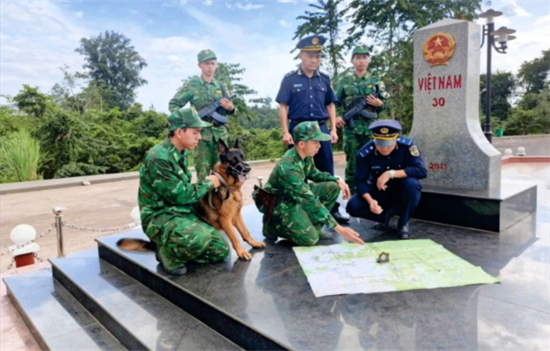 |
| Working with Cambodia’s security force to implement a border protection project |
Third, building strong all-people border defence and a firm “posture of people's hearts and minds”. The PBG Command has regularly coordinated with departments and sectors to give advice to the Provincial Party Committee and the Provincial People's Committee on directing relevant forces to grasp and realise the Politburo’s Conclusion 99-KL/TW, dated 17 October 2024 on the Project entitled “Building all-people border defence and the posture of all-people border defence within all-people national defence and the posture of all-people national defence, in association with the people's security and the posture of people's security in border areas”, the Secretariat’s Conclusion 68-KL/TW, dated 5 February 2020 on “two years of implementing the pilot policy of deploying more border guard station cadres as members of district-level party committees in border areas”, and the policy of assigning Party members from border guard stations to participate in the activities of Party cells in border villages and hamlets. The PBG has actively participated in building a strong grass-roots political system and executing provincial programmes and projects to promote economic, cultural, and social development in conjunction with defence and security in border areas. These efforts have been carried out via the assignment of Party members to participate in all-level people's councils, attend activities of village-level Party cells, and take responsibility for assisting households.
Additionally, the PBG has promoted the role of village elders, village heads, prestigious individuals, religious dignitaries, and unions in encouraging the People to observe the law, participate in safeguarding border lines and border markers, and maintain security and order. In particular, officers and soldiers have persistently stayed close to the People, gaining a thorough understanding of local customs and practices, as well as the thoughts and aspirations of ethnic communities, actively taking part in economic, cultural, and social development, helping local residents eliminate hunger and reduce poverty. The PBG has effectively implemented programmes such as “supporting children’s schooling”, “border guard station’s adopted children” and “warm spring in border villages”, as well as models including “compassionate kitchens”, “accompanying semi-boarding pupils”, and “helping one poor household in border areas every week". These activities have helped consolidate the “posture of people's hearts and minds”, strengthen military - civilian solidarity, and bring into play the People's strength in border management and protection and in building strong all-people border defence. In 2026, the PBG donated more than VND 200 million through the Provincial Vietnam Fatherland Front Committee, presented 100 gifts worth VND 20 million to policy families, and provided nearly VND 1.5 billion in support to 193 pupils under the Project entitled “military officers and soldiers support children’s schooling”.
Fourth, stepping up border defence external relations. The PBG Command has regularly coordinated with relevant agencies, with the Department of External Relations and the Provincial Public Security playing the core role, to advise the Provincial Party Committee, the Provincial People's Committee, and the BGF Command on effectively implementing the Secretariat’s Directive 25-CT/TW, dated 8 August 2018 on “promoting and elevating multilateral foreign relations towards 2030”, as well as high-level cooperation agreements between Vietnam and Cambodia. The PBG has intensified the implementation of twinning programmes between residential clusters on both sides of the border, attaching importance to building solidarity, mutual understanding, and trust between the border protection forces and People of the two countries.
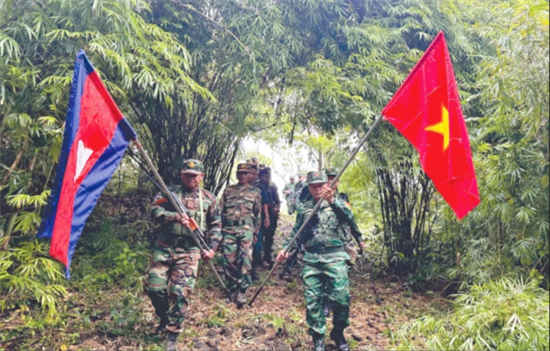 |
| A joint patrol with Cambodia’s border protection force |
At the same time, the PBG has closely worked with Cambodia’s border protection force to strictly maintain regular and irregular talks, exchange relevant security information, conduct joint patrols, and coordinate the management and protection of border lines, border markers, and border gates. Any incidents arising have been promptly addressed in a spirit of friendship and respect for each country's independence and sovereignty, in strict compliance with signed treaties and agreements. Visits and greetings have been frequently maintained on the occasions of festivals, traditional New Year celebrations, anniversaries, and National Days of the two countries.
Border guard stations have coordinated with relevant forces to intensify communication and encourage people on both sides of the border to strictly comply with border-related agreements. They have also raised public vigilance against schemes and tactics aimed at undermining the solidarity and friendship between the two nations. Regarding foreign vessels violating the maritime areas under the province's management, the PBG has coordinated with the Coast Guard to handle such violations in accordance with Vietnamese and international laws, ensuring consistency with relevant agreements and the friendly and cooperative relations between Vietnam and other countries. In 2026, it organised 20 joint patrols involving 200 personnel along demarcated and marked sections of the land border, held 44 meetings and exchange activities involving 523 participants, and conducted 16 coordination briefings between Vietnamese and Cambodian border guard stations.
Building on the recorded achievements and experience, the PBG of Gia Lai will continue to renew its work content and methods and improve the effectiveness of managing and safeguarding national sovereignty over land, seas, and islands, thereby contributing to firmly defending the Fatherland in the new situation.
Sr. Col. TRAN TIEN HAI
Deputy Commander of the Provincial Military Command and Commander of the PBG Command