Over its 80 years of construction, combat, victory, and development, Signal Brigade 603 has always attached importance to building itself into a politically strong unit as a solid foundation for improving its overall quality, combat power, and task performance.
On 25 November 1946, Signal Team of War Zone 3, the predecessor of Signal Brigade 603 under Military Region 3, was established. In different periods, the Brigade’s organisational structure has been gradually consolidated. Its capacity to ensure communications has improved to meet the requirements of leadership and command over the Military Region’s armed forces.
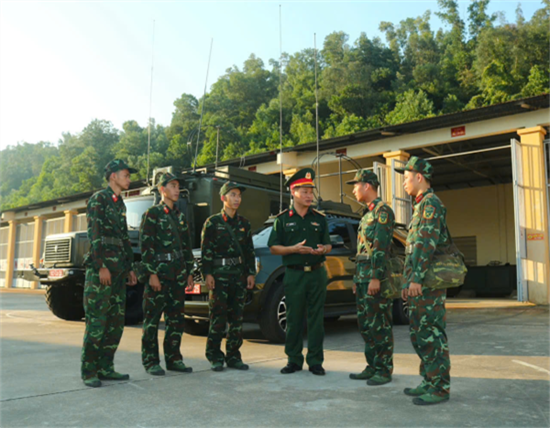 |
| Encouraging signal troops of the Brigade prior to their service for an exercise |
Over the past 80 years, political and ideological strength has always served as a solid foundation for the Brigade’s officers and soldiers to maintain their political steadfastness, raise their sense of responsibility, promote solidarity and self-reliance, overcome hardship, fulfil their assigned tasks, and foster the glorious tradition of “solidarity, courage, creativity, self-reliance, surmounting difficulties, accomplishing missions”. In recognition of its achievements, the Brigade has been given 4 Fatherland Protection Orders and 3 Feat-of-Arms Orders by the Party and State; 6 units under the Brigade were presented with Feat-of-Arms Orders, along with numerous awards from the Government, Ministry of National Defence, Military Region 3’s Command, sectors, and localities.
The Brigade is tasked with ensuring communications for leadership, command, and direction over the Military Region’s armed forces in training, force building, combat readiness, and other missions. Its forces are stationed at 19 locations across 2 provinces and 1 city, with personnel dispersed among battalions, companies, stations, and mobile teams, maintaining continuous operations around the clock. The characteristics of its missions and force organisation place demanding requirements on troops’ political steadfastness, sense of responsibility, and discipline. Hence, the Brigade has advocated conducting political education and ideological management tailored to target groups and tasks, especially communications assurance. All-level party committees and commands have regularly kept abreast of soldiers’ ideological developments, particularly those at independent locations far from their direct commands, in order to promptly give guidance and address emerging issues.
Educational content has been closely linked to the specific responsibilities and requirements of each duty shift, equipment operation, communications assurance, and the performance of unexpected tasks, thus enabling soldiers to raise their sense of responsibility and strictly observe working procedures and communications discipline. Signs of wavering resolve, complacency, reluctance to face difficulties, and avoidance of duties have been promptly detected and handled via a combination of measures of education, persuasion, management, and training. Party work and political work regulations and routines have been carried out in a manner suited to the Brigade’s dispersed force disposition, thereby ensuring consistent, continuous ideological leadership, direction, and management throughout the entire unit. As a result, 100% of the Brigade’s officers, employees, and soldiers have demonstrated political steadfastness and a high sense of responsibility to overcome difficulties and stand ready to receive and successfully accomplish all assigned tasks.
Building a politically strong unit requires unity between line of leadership, implementation process, and responsibility of every cadre and Party member. In response to this requirement, the Brigade has linked the building of party committees with the development of a contingent of cadres and promoted the exemplary role of cadres, particularly the key ones. Cadres have been trained in accordance with the principle of “learning first and taking action first”. They have been required to stay close to grass-roots level, willingly undertake difficult tasks, “dare to think, speak, take responsibility, innovate, confront difficulties and challenges, and act for the common good”, and set examples through concrete actions; work results, tangible achievements, and the ability to resolve assigned tasks have been seen as the criteria for assessing their competence and sense of responsibility.
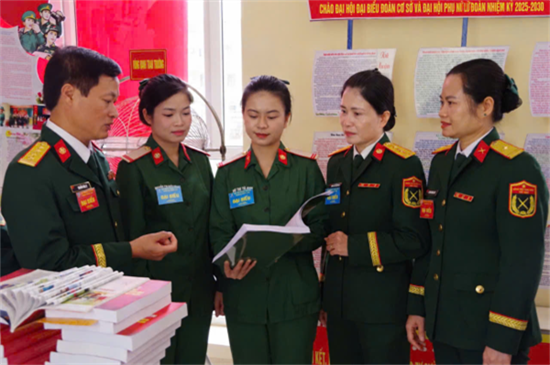 |
| Brigade Commander talks with delegates at the Brigade Women’s Union Congress for the 2025 - 2030 tenure |
In meetings of party committees and party organisations, cadre assessments have always been associated with the results of leadership and direction and their sense of responsibility, organisational capabilities, and ability to address issues arising from practice. Cadres have directly engaged with their assigned tasks and soldiers to promptly provide guidance and tackle difficulties. They have proactively settled matters within their authority, while reporting and proposing solutions to issues beyond their authority. Those who avoid or shift responsibility or fear being held accountable have been criticised and handled under regulations. Emphasis has been placed on matching words with action, seeing tasks through to completion, and taking responsibility for work results. During the 2020 - 2025 tenure, 97.79% of Party organisations within the Brigade Party Organisation and 98.08% of party members successfully or excellently fulfilled their duties; 98.3% of cadres fulfilled their duties, with 80.6% successfully or excellently fulfilling their duties.
The building of a politically strong unit must be linked to task performance and consolidated via soldiers’ training and capacity to accomplish their missions. Therefore, the Brigade has regarded training, particularly under difficult and demanding conditions, as an environment for consolidating troops’ political steadfastness. The requirements concerning political steadfastness, determination, discipline, and the ability to handle situations have been concretised in each training subject and scenario, with importance attached to difficult and complex scenarios to enhance soldiers’ ability to overcome difficulties, maintain the initiative, and coordinate responses. In each training scenario, soldiers have been required to deal with tasks on their own, thereby enabling them to foster and showcase their political steadfastness, willpower, and observance of regulations, especially in independent positions.
Via exercises, competitions, and mobile tasks, soldiers’ political steadfastness, willpower, sense of discipline, and capability to handle situations have been put to the test under real-life conditions, particularly difficult working conditions and intense pressure. After each training subject and period, the Brigade has drawn lessons, compared actual results with established requirements, and identified both progress and weaknesses in order to adjust training content and methods properly. Training results have been associated with soldiers’ ability to surmount difficulties, observe discipline, maintain coordination, and deal with situations as a basis for improving their capacity to accomplish assigned missions. Since 2021, the Brigade has organised and participated in 31 exercises and 22 competitions, achieving good results and maintaining its title of “Excellent Training Unit”.
Alongside the mastery of equipment, the development of communications systems and digital transformation have placed increasingly high requirements on information safety and confidentiality. Therefore, the Brigade has linked information security with the political responsibility of every officer and soldier, regarding strict compliance with regulations on information confidentiality, cybersecurity, and data security as a concrete manifestation of political steadfastness and sense of discipline and responsibility for assigned missions. It has resolutely addressed the mindset that information security is solely the responsibility of specialised forces by incorporating security requirements into regular education, management, inspection, and supervision, particularly for personnel directly operating systems and exchanging information. Educational content has focused on regulations directly related to each position, while inspections have been centred on specific operations and behaviours, ranging from equipment use and account management to compliance with procedures for transmitting, receiving, and processing data.
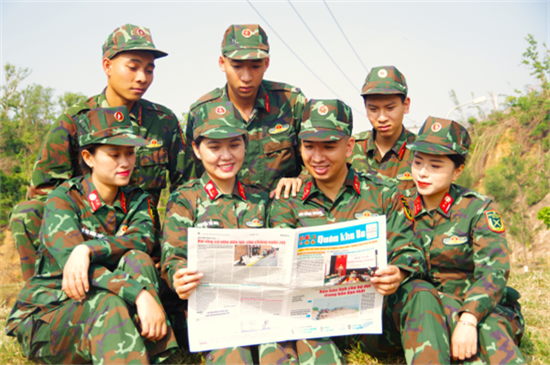 |
| Break time on the training ground |
Building on the enhanced responsibility of every individual, the Brigade has concentrated on maintaining strict control over the security of the entire communications system. It has regularly reviewed, inspected, and assessed the cybersecurity of its information technology systems, paying attention to detecting and promptly addressing loopholes and shortcomings in system management and operation. The collection, management, and use of digital data have been conducted in accordance with regulations to prevent State secrets, military secrets, and military data from being disclosed or leaked. Issues detected via inspections have been assigned to specific individuals and units for rectification; subsequently, guidance and follow-up inspections have been provided to avoid complacency and disregard for security requirements. To date, the Brigade has completed 100% of its digital transformation targets. Since 2023, 100% of its documents have been transmitted and received via the military data transmission network. As a result, cybersecurity, information confidentiality, and data security have gradually become routine practices and duty of every officer and soldier, contributing to the security of the entire system and the maintenance of the Brigade’s political and ideological stability.
For signal units, their missions require a high degree of coordinated action and continuity throughout the entire system. Therefore, the Brigade has attached importance to building internal solidarity in association with unity in task performance. It has seriously maintained its routines, promoted democracy and the role of mass organisations, and created favourable conditions for officers and soldiers to participate in building their collectives, give feedback on issues arising at grass-roots level, and work together to find solutions. During meetings and tasks, differing opinions have been discussed frankly in accordance with established principles. Issues falling within the responsibility of a particular level have been resolved at that level, ensuring that democracy goes hand in hand with maintaining discipline. In working relationships, the Brigade has emphasised coordination among its agencies and units, between personnel directly responsible for communications assurance and command, technical, and mobile forces. All difficulties and problems have been discussed and addressed through agreed solutions, with clear responsibility assigned to each component to minimise the shifting of responsibilities in task performance.
In addition, party committees and commands at all levels have regularly paid due regard to soldiers’ living conditions, working environments, and aspirations, particularly those in difficult and independent positions, promptly commending collectives and individuals showing a high sense of responsibility for assisting their comrades in task execution. The Brigade has coordinated with local party committees, authorities, and people in its stationed areas to effectively conduct mass mobilisation work and build close relationships, thereby allowing troops to keep their mind on their work. From each centre, station, and cable route to the entire Brigade, solidarity and unity have generated the collective strength of the whole system, contributing to the maintenance of continuous, accurate communications and the consolidation of the Brigade’s political foundation.
In the coming time, Signal Brigade 603 will continue to uphold its tradition, proactively pursue innovation, and improve the quality of building a politically strong unit in line with its mission requirements. It will focus on fostering political steadfastness, willpower, and a strong sense of responsibility and discipline among its personnel. It will also proactively adapt to advances in science and technology and modern methods of warfare, master communications systems, and enhance awareness of cybersecurity, information confidentiality, and data security.
On such a solid foundation, the Brigade will continue to improve its combat power and overall quality to ensure smooth, accurate, timely, safe, and secret communications.
Sr. Col. NGUYEN VAN TU
Political Commissar of the Brigade