3. Waters in the Southeast region
- Zones where maritime activities are prohibited: a total area of about 2.3 thousand hectares, including 10 zones where maritime activities are prohibited for the purpose of marine conservation and backup zones.
Zones where maritime activities may be performed under statutory conditions: a total of about 361 thousand hectares, including 4 zones where maritime activities may be performed under statutory conditions for conservation and protection purposes; and 11 zones where maritime activities may be performed under statutory conditions for other purposes.
- Areas that are given special protection: a total area of about 6 thousand hectares, including 17 areas.
- Areas where maritime activities are incentivised:
+ Areas where maritime activities are prioritised and incentivised: a total area of 73 thousand hectares, including 04 areas where tourism is prioritised and incentivised and 02 areas where port services are prioritised and incentivised.
+ Potential areas for exploitation and development: a total area of about 11.316 thousand hectares, including potential areas for exploitation of oil and gas, methane clathrate, building materials, placer deposits, metals in deep sea, and wind power.
+ Areas used for multiple purposes: an area of about 5.810 thousand hectares.
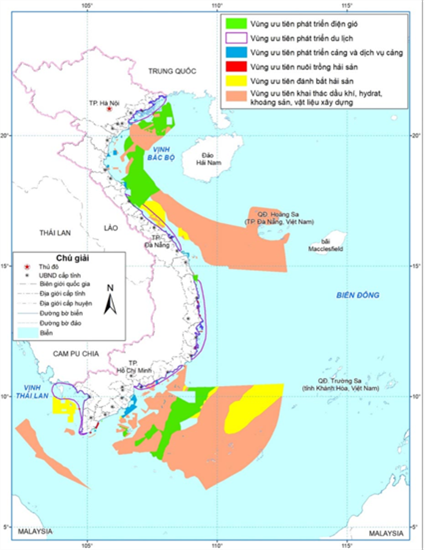 |
| The National Marine Spacial Planning Map (Photo: tapchikientruc.com.vn) |
4. Waters in the Southwestern region
- Zones where maritime activities are prohibited: a total area of about 15 thousand hectares, including 22 zones where maritime activities are prohibited for the purpose of marine conservation and 08 backup zones.
- Zones where maritime activities may be performed under statutory conditions: a total area of about 1.128 thousand hectares, including 23 zones where maritime activities may be performed under statutory conditions for conservation and protection purposes and 51 zones where maritime activities may be performed under statutory conditions for other purposes.
- Areas that are given special protection: a total area of about 112 thousand hectares, including 33 areas.
Areas where maritime activities are incentivised:
+ Areas where maritime activities are prioritised and incentivised: a total area of 416 thousand hectares, including 03 areas for tourism, 11 areas for port services, and 28 areas for wind power.
+ Potential areas for exploitation and development: a total area of about 2.400 thousand hectares, including potential areas for exploitation of oil and gas, building materials, placer deposits, and wind power.
+ Areas used for multiple purposes: an area of about 10.313 thousand hectares.
5. Areas need further research for planning
These include a portion of the historical waters between Vietnam and Cambodia, continental shelf areas extending beyond 200 nautical miles, and the maritime zones surrounding the islands of the Paracel and Spratly archipelagos. As of islands affiliated to Hoang Sa archipelago and Truong Sa archipelago, continue study and determination of marine protection and conservation areas, fishing, search and rescue, and maintenance of national defense and security. To be specific: with regard to conservation, conduct study and determine Nam Yet marine conservation zone with a total area of about 23 thousand hectares, Thuyen Chai marine conservation zone with a total area of about 83 thousand hectares, Song Tu marine conservation zone with a total area of about 14 thousand hectares; with regarding to fishing: conduct study and determine fishing grounds for fishing.
The zoning of marine space for national maritime areas constitutes a key component of the National Marine Spatial Plan for the 2021 - 2030 period, with a vision toward 2050. This serves as a legal framework guiding the management, exploitation, and utilisation of marine space, aimed at fostering sustainable marine economic development. It is intrinsically linked to ensuring national defence and security, safeguarding national sovereignty and interests at sea, and building and developing Vietnam into a strong maritime nation in line with Resolution No. 20-NQ/TW, dated 28 July 2026, of the Third Plenum of the 14th Party Central Committee, thereby contributing to the nation’s development in this new era.
Pham Binh