Defence and security education plays an important role in building increasingly strong all-people national defence and the posture of all-people national defence in association with the posture of people's security. Fully aware of this, Vinh Long province has always attached importance to adopting a range of comprehensive and effective measures to perform this vital work.
Vinh Long province has 124 communes and wards, including 30 communes mainly inhabited by ethnic minority communities, and a population of nearly 4.2 million, (more than 30% of the population are religious believers).
In recent years, thanks to the regard of the Party and State, together with the tireless efforts of the Party organisation, authorities, armed forces, and People, the province has achieved many positive results in socio-economic development and defence and security consolidation. However, living conditions remain difficult for some sections of the population, particularly in remote and isolated areas. Unlawful religious activities continue to harbour potentially complicated factors; hostile forces continue to exploit ethnic and religious issues to distort and undermine the great national unity bloc.
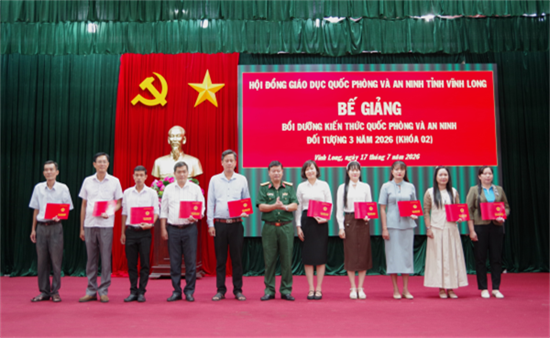 |
| Graduation ceremony of defence and security education course for cadres in Category 3 |
Alongside efforts to foster socio-economic development, the reorganisation of administrative units, the adoption of a two-tier local government model, and the promotion of science, technology, innovation, and digital transformation have placed more demanding requirements on defence and security work. Therefore, the province has identified defence and security education as an important and regular task contributing to raising awareness and a sense of responsibility among all levels and sectors and the entire population for the cause of Fatherland construction and protection, cementing the great national unity bloc, building a firm “posture of people's hearts and minds”, and creating favourable conditions for rapid and sustainable development.
Raising awareness and a sense of responsibility among Party committees, authorities, departments, sectors, and unions is an important prerequisite that determines the quality and effectiveness of defence and security education. On the basis of thoroughly grasping legal documents on defence and security education, the Provincial Military Command (PMC), in its capacity as the standing agency of the Provincial Council for Defence and Security Education, has coordinated with departments, agencies, and sectors to advise the Provincial Party Committee and the Provincial People's Committee on concretising higher-level resolutions and directives into a system of documents and action plans in a rigorous, serious manner, suited to localities’ characteristics and task requirements.
The province has placed emphasis on promoting the responsibility of Party committees, leaders, and commands at all levels, especially those holding key positions, taking the results of defence and security education as the criteria for evaluating leadership and management capacity, as well as for reviewing emulation and commendation work of departments, agencies, sectors, and localities. As a result, defence and security education work has been performed consistently at all levels, with the synergy of the entire political system being mobilised and the effectiveness of State management and the responsibility of the entire people being enhanced in the process. Inspection and supervision, ranging from reviewing and managing target groups following the merger to formulating and coordinating plans, have been conducted systematically and properly.
The operational capacity of defence and security education councils at all levels plays a leading role in the overall quality and effectiveness of this important task. Following the merger and the adoption of the two-tier local government model, personnel changes occurred in councils at various levels. In response, the PMC has coordinated with departments, agencies, and sectors to give advice on promptly issuing decisions to consolidate the Provincial Council and its Standing Board, Secretariat, and Working Regulations. The PMC has also focused on giving advice on consolidating or establishing defence and security education councils in all 124 communes and wards, ensuring adequate membership and the correct organisational structure in accordance with Decision 405/QD-TTg, dated 9 March 2026, by the Prime Minister. As a result, this work has been carried out regularly, smoothly, effectively, and consistently, without disruption due to the merger.
Apart from organisational consolidation, the province has directed councils at all levels to review and supplement their working regulations in accordance with their functions and tasks, target groups, and local characteristics, ensuring suitability to the post-merger administrative structure, maintaining the leadership of Party committees and the administration of local authorities, clearly defining the responsibilities of each member and working schedules. At the same time, the PMC has provided training and support to commune-level defence and security education councils, particularly those in communes and wards formed through the merger of previously divided administrative units, such as Cai Nhum, Tan Long Hoi, Nhon Phu, and Long Ho. This has enabled them to gain a thorough understanding of their respective areas and target groups, actively give advice to local Party committees and authorities on reviewing and identifying the number of people in each target group, as well as formulate and implement plans for defence and security education in accordance with their assigned responsibilities.
Inspection and supervision have been strengthened to thoroughly address manifestations of neglect, the skipping of steps in reviewing target groups, the copying and mechanical reproduction of plans, and the reduction or omission of prescribed programmes. Regulations on preliminary and final reviews have been strictly maintained, thereby enabling shortcomings and limitations to be promptly addressed and ensuring that this work develops in greater depth and achieves sustainable results.
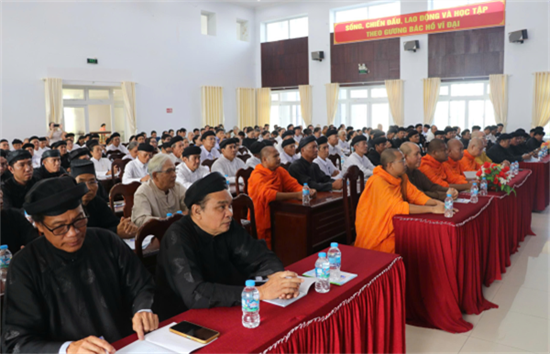 |
| Defence and security education course for religious dignitaries |
Providing defence and security knowledge training for target groups is a central task of defence and security education. Accordingly, the province has directed the PMC to closely coordinate with departments, agencies, sectors, and commune-level defence and security education councils to review and classify target groups in accordance with regulations as the basis for formulating plans and organising training, education, and dissemination activities in a rigorous manner and at the appropriate levels of responsibility. In the process, due attention has been paid to areas of strategic importance to defence and security, localities with large religious and ethnic minority populations, and areas where complicated security and order issues may arise. In addition to fully implementing prescribed programmes, the province has directed the selection and supplementation of topics closely reflecting local socio-economic development and defence and security tasks. New developments in border, maritime, and island areas has been updated. Participants have been trained to identify and combat wrongful, hostile viewpoints in cyberspace and distortions of ethnicity, religion, democracy, and human rights. To enhance practical relevance and link theory with practice, localities have organised visits for learners to defensive zone, forest fire prevention and control, and search and rescue exercises.
Since the beginning of 2025, in addition to sending Category 1 and Category 2 cadres to attend training courses held by Military Region 9, the province has organised five training courses for 4,212 cadres and Party members in Category 3 (at the PMC) and Category 4 (in clusters of five to seven communes and wards). These results demonstrate the regard paid by local Party committees and authorities for defence and security knowledge training. Through these courses, participants have enhanced their awareness and sense of responsibility towards defence and security tasks, becoming more active in building and consolidating all-people national defence and the posture of all-people national defence in association with the posture of people's security at grass-roots level.
Vinh Long currently has 106 educational institutions, with more than 100,000 pupils and students enrolled annually. In the context of digital transformation and intensive international integration, pupils and students have more opportunities to access new knowledge. However, they are also exposed to the adverse effects of the market economy, social evils, harmful and malicious information on social media, and attempts by hostile forces to entice and incite them. In response to this situation, the PMC has directed Infantry Regiment 890 to coordinate with universities and colleges in providing defence and security education for students in accordance with current prescribed programmes. At high schools, educational content has been delivered in accordance with the academic year plans and regulations of the Ministry of Education and Training. At the same time, due attention has been paid to incorporating local revolutionary traditions into training programmes and organising visits to historical sites to enhance educational effectiveness.
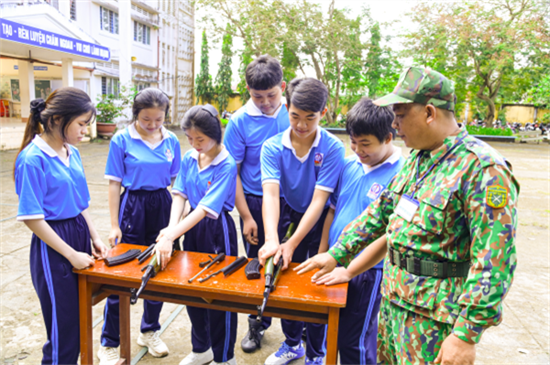 |
| Training high school students on how to assemble and disassemble rifles |
Additionally, the PMC has closely coordinated with the Department of Education and Training to hold the 1st Defence and Security Education Sports Festival for high school students in 2026, participate in the 4th Nation-wide Defence and Security Education Sports Festival in 2026, winning third prize in the overall team standings, and successfully organise “Military Semester” activities. These efforts have not only raised students' awareness of the Party's lines and the State's laws and policies on defence and security, but also helped them recognise hostile forces’ schemes and tactics, equipped them with essential military knowledge and skills, and contributed to their character development, collective living habits, and discipline in daily life and study. Furthermore, doing so have helped nurture patriotism, love for their homeland and country, and a sense of readiness to fulfil civic duties and defend the Fatherland among students.
Dissemination of knowledge of defence and security for the entire population has been closely directed and carried out consistently via various appropriate forms by the province. The PMC has coordinated with the Provincial Party Committee's Commission for Information and Education, Provincial Police, Department of Culture, Sports, and Tourism, and Vinh Long Newspaper, Radio, and Television to maintain the programmes “All-People National Defence” and “For National Security”. At the same time, the advantages of the Internet and social media have been brought into play to publish concise, visually accessible, and easy-to-understand infographics on defence, security, borders, seas, and islands. In the first nine months of 2026 alone, Vinh Long Newspaper, Radio, and Television broadcast 601 reports and 1,857 news items and articles related to defence and security work. Agencies and units at various levels organised 1,182 knowledge dissemination and education sessions, attracting 64,512 participants. The content focused on clarifying the Party's lines and the State's laws and policies on defence and security, the task of safeguarding sovereignty over borders, seas, and islands, cybersecurity, the fight against “peaceful evolution”, and patriotism and national pride.
Information dissemination has also been flexibly incorporated into activities of the armed forces, residential community gatherings, cultural and artistic activities, physical training and sports, traditional festivals, military recruitment operations, and movements launched by the Vietnam Fatherland Front and unions. In areas with large ethnic minority and religious populations, the province has attached importance to direct communication through a network of information officers, prestigious individuals within ethnic communities, hamlet heads, and religious dignitaries to make the content and methods of communication relevant to local cultural characteristics and customs. As a result, knowledge of defence and security has gradually become part of everyday life, while citizens' awareness and sense of responsibility for the task of defending the Fatherland have continued to improve. People have also become increasingly active in maintaining political security and social order and safety in their localities.
With comprehensive measures and the active participation of the entire political system, defence and security education in Vinh Long province has increasingly achieved substantive results. This has contributed to building strong political and spiritual potential for the defensive zone and meeting the requirements of defending the Fatherland “early and from afar”.
Maj. Gen. PHAM VAN THANH
Member of the Provincial Party Committee Standing Board
Commander of the PMC
Standing Vice Chairman of the Provincial Council for Defence and Security Education