The art of establishing the operational disposition in the opening decisive battle of the 1972 Northern Central Highlands Campaign
The assault on the Dak To-Tan Canh strongpoint complex was the decisive opening battle of the 1972 Northern Central Highlands Campaign. Through the art of establishing a firm, advantageous and flexible offensive disposition, our forces gradually created favourable positions and strength, exploited weaknesses in the enemy defensive system and achieved an important victory that opened opportunities and favourable conditions for the Campaign to develop.
From early 1972, anticipating an attack on the Central Highlands from the north, the enemy deployed additional forces and equipment and established battalion-sized strongpoints to hold commanding heights and control important transport routes, particularly Routes 14 and 18, while protecting the area west of the Pô Kô River. By late February 1972, the enemy disposition in the Northern Central Highlands comprised three strong defensive complexes: Dak To-Tan Canh, Kon Tum town and Pleiku. This arrangement gave the enemy certain advantages in firepower, fortifications and mutual support, creating what it regarded as an “invincible” defensive posture.
On our side, following the strategic determination of the Politburo, the Party Committee and Command of the Central Highlands Front decided to launch the Northern Central Highlands offensive campaign to destroy a significant portion of the opposing main forces, break the enemy defensive system and advance the strategic offensive throughout the South. Following a comprehensive assessment of the enemy, terrain and our combat capabilities, the Campaign Command selected the assault on the Dak To-Tan Canh strongpoint complex as its decisive opening battle.
Through ingenuity, courage, firm determination and flexible tactics, our troops and people won the battle of Dak To-Tan Canh, producing a clear operational effect and demonstrating distinctive features of Vietnamese military art, most notably the art of establishing an operational disposition.
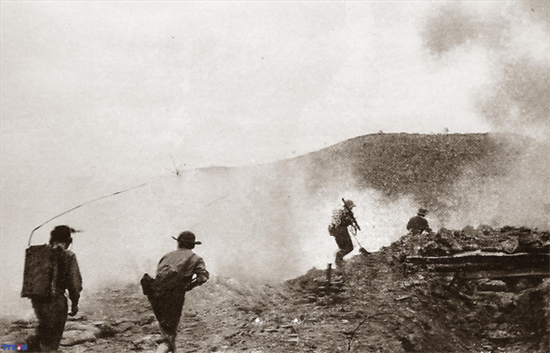 |
| VPA troops attacked the Dak To - Tan Canh strongpoint (Photo: VNA) |
Firstly, to select an attack objective consistent with available capabilities to ensure victory. The Northern Central Highlands Campaign was an important supporting direction for the principal strategic offensive in Tri-Thien. The opening battle, therefore, had to secure victory and create favourable conditions for the Campaign and the strategic offensive throughout the South. Of the three enemy defensive complexes in the Northern Central Highlands, Kon Tum town was the strongest, while Pleiku lay deep within the enemy rear. Attacking either would require breaking through strong defensive centres and facing counterattacks from several directions. Kon Tum, in particular, contained the enemy’s strongest and most strategically important forces; its capture could rapidly dismantle the interconnected defensive system in the Northern Central Highlands. Nevertheless, an assault there would entail heavy losses and risk counterattacks and relief operations by enemy forces moving from Pleiku and Dak To-Tan Canh, reducing the likelihood of victory. Moreover, attacks on these two complexes would place our combat formations far from the campaign rear, making logistical and other support difficult.
After analysing these factors comprehensively, the Campaign Command selected Dak To-Tan Canh as the objective for the decisive opening battle. It was also a strong and strategically important defensive complex within the enemy system in the Northern Central Highlands. Capturing it would break the interconnected defences, produce a chain reaction and facilitate a subsequent offensive towards Kon Tum town. Because the enemy defences were organised in depth, they were vulnerable to division and isolation. Moreover, the objective was close to our strategic and campaign rear areas, facilitating force organisation and support, particularly logistics and technical services. Through sharp military judgement, the Campaign Command selected the appropriate breakthrough point and established a favourable operational disposition. As a result, our forces gained control of the entire Dak To-Tan Canh complex after approximately ten hours of attack.
Secondly, to establish a firm offensive disposition and conduct encirclement and operational interdiction. Within the Dak To-Tan Canh complex, Base 42-Tan Canh occupied a pivotal position as the command centre for the complex and surrounding strongpoints. The Campaign Command therefore decided to concentrate forces and equipment against Base 42-Tan Canh while besieging the remaining objectives to prevent enemy relief. Under the campaign plan, Regiment 66, reinforced by Commando Battalion 37, Tank Company 7, Self-Propelled Anti-Aircraft Artillery Company 53, Anti-Tank Missile Company 29 (B72) and other specialist units, attacked Base 42-Tan Canh from four directions: east, northwest, southeast and southwest. Regiment 1 (minus elements), reinforced by Commando Battalion 10 of Division 2, attacked Dak To 2 Base. Regiment 141 attacked the Đắk Tô district headquarters, while Battalion 40 of Regiment 1 served as reserve. Artillery was organised into three groupings on three axes to support infantry and tanks. This was the first use of tanks and heavy artillery in combat in the Central Highlands theatre, exploiting combined-arms strength, especially tank shock action, to establish a firm offensive disposition capable of penetrating successive enemy defensive lines.
A distinctive feature of our operational disposition was the simultaneous establishment of encirclement, interdiction and isolation over a broad area. Before the Campaign, the enemy had deployed Airborne Brigade 2 to defend the line of heights 1049 and 1015 west of the Po Ko River, forming a long, narrow, interconnected defence in depth. The Campaign Command therefore decided not to attack the principal objective immediately, but first to sever and isolate Dak To-Tan Canh from other positions, progressively disrupting the enemy’s strong interconnected defensive system.
To implement this intention, the Campaign employed Regiments 28 and 95 to cut and control traffic on Route 14 at two levels. The first cut Route 14 between northern Kon Tum and Tan Canh (at Vo Dinh), preventing overland relief when our forces attacked Dak To-Tan Canh. The second cut Route 14 between northern Pleiku and southern Kon Tum (the Chu Thoi section), tying down Division 23 in Pleiku. In particular, the Campaign Command directed Division 320 to “pierce” the defensive line on heights 1049 and 1015, placing direct pressure on Kon Tum town and forcing the Airborne Division - the force capable of directly relieving Dak To-Tan Canh - to contract into defensive positions, limiting its mobility and relief capability. Our offensive disposition thus combined the encirclement of the principal objective, interdiction along other approaches and the disruption of connections within the enemy’s integrated defences, culminating in the isolation of Dak To-Tan Canh.
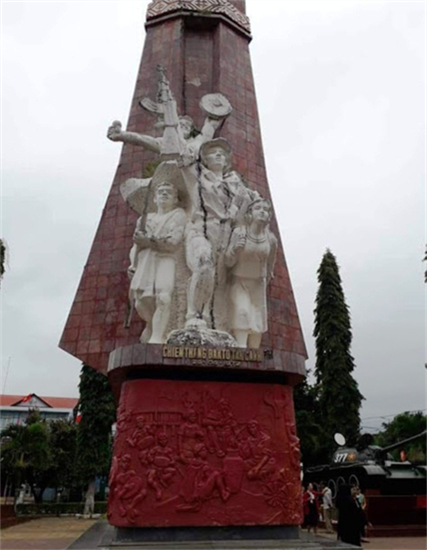 |
| The Dak To - Tan Canh Victory Monument |
At the same time, in the Quang Tri theatre, our forces broke the enemy outer defensive line and liberated Gio Linh and Cam Lộ. Realising that Tri-Thien was our principal strategic offensive direction, the enemy hastily moved troops from multiple locations to reinforce it, including most of the Airborne Division’s forces (which had been moving from Kon Tum town towards Bình Long) to strengthen the Quang Tri front. This left the Dak To-Tan Canh complex completely isolated, without relief forces. It was the most favourable moment to launch the decisive attack.
Thirdly, to actively employ deception to achieve operational and tactical surprise. Deception is a combat activity used alongside other measures to mislead the enemy about force strength, dispositions, attack directions and objectives, causing incorrect assessments and consequently mistaken actions. In the attack on Dak To-Tan Canh, our forces applied deception flexibly, creatively and effectively, leading the enemy to misjudge the principal attack direction and expose weaknesses in its defences. Before the attack, the Campaign Command ordered the construction of two roads, partly genuine and partly deceptive, for motor vehicles northwest of Kon Tum town, linking the border area across the mountains west of the Po Ko River to Route 14. This led the enemy to believe that Kon Tum town would be attacked first. Based on this serious misjudgment, it deployed two airborne brigades from its strategic general reserve and Ranger Group 22 to block the anticipated attack, concentrating its defences towards Kon Tum and leaving the Dak To-Tan Canh direction exposed.
On the Dak To-Tan Canh axis, the enemy assessed that “the Viet Cong will attack along Route 18 from Plei Cần; only by this route can they bring in tanks”. It believed that its strongpoints controlled other approaches and that the very high Ngoc Linh range to the east made it impossible for our forces to deploy tanks and artillery there. It therefore designated the north and northwest as its main defensive directions. The Campaign Command accordingly ordered Division 2 engineers to rebuild the Dak Mot bridge on Route 18. It also organised attacks on outer strongpoints, particularly along the Ngoc Tu range, to attract attention and reinforce the enemy’s mistaken assessment. The enemy became increasingly complacent, concentrating most of its forces against an attack from the west and northwest and neglecting other directions. Through flexible and creative deception, our forces led the enemy from mistaken judgement to mistaken action, creating the opportunity to construct Route 50K rapidly and secretly along the eastern slopes of the Ngọc Linh range and move the main forces, tanks and artillery around to the east of Base 42-Tan Canh. The surprise attack from the unexpected eastern direction then rapidly defeated the enemy and liberated Dak To-Tan Canh.
The assault on the Dak To-Tan Canh strongpoint complex successfully fulfilled its role as the decisive opening battle of the 1972 Northern Central Highlands Campaign, creating favourable conditions for the Campaign to advance southwards towards Kon Tum town. The lessons learned from preparing and conducting this battle should continue to be studied and creatively applied in the new context of people’s war to defend the Fatherland.
Senior Colonel HO QUOC THANG, MA, Head of the Combined Arms Department, Military School of Military Region 1