Air Defence Brigade 71 focuses on regularity building, discipline management, and safety assurance
Regularity building, discipline management, and safety assurance are factors that directly determine a unit’s overall quality, combat power, stability, and strength. As for Brigade 71, a key air defence artillery unit tasked with safeguarding strategically important airspace, these requirements are even more urgent. Hence, the Brigade’s Party Committee and Command have consistently attached importance to leading and directing this vital work through a range of coordinated and appropriate measures to achieve sustainable results.
Air Defence Brigade 71 under Army Corps 34 is tasked with training and combat readiness to protect the airspace over southeastern Vietnam. Its units are stationed at various locations characterised by a large number of industrial parks and rapid urbanisation.
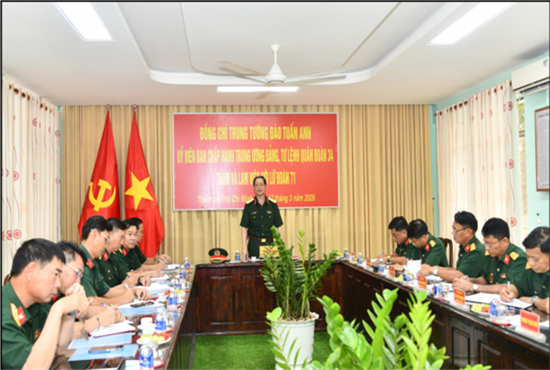 |
| Army Corps 34 Command’s working visit to the Brigade in March 2026 |
In the course of performing its missions, the characteristics of the area also present considerable difficulties for managing, educating, and training personnel, particularly given the negative impacts of the market economy and social evils on the thoughts, psychology, and emotions of officers and soldiers on a daily basis, giving rise to complex issues. Meanwhile, a large proportion of officers and professional servicemen are working far from their families and facing various difficulties. Fully aware of this situation, the Brigade has identified “improving the quality of regularity building, discipline management, and safety assurance” as one of its key breakthrough areas, with a view to bringing about fundamental and comprehensive changes across all aspects of its work.
Thanks to close leadership and direction, together with the coordinated implementation of various measures, the Brigade has achieved important results: regularity has been strictly maintained with a high degree of consistency and absolute safety; there have been no cases of desertion, unauthorised absence, serious violations of the law or military discipline, or safety incidents; the rate of ordinary disciplinary violations has remained below 0.2%; the Brigade has been recognised as an “exemplarily, typically” comprehensively strong unit for many consecutive years.
To achieve these results, the Brigade has strengthened the leadership and direction of Party committees and commands at all levels. This is the decisive factor in ensuring that the work of regularity building, discipline management, and safety assurance could be carried out in a coordinated, systematic, and genuinely effective manner. Accordingly, the Brigade’s Party Committee and Command have focused on leading and directing the thorough dissemination and strict implementation of Directive 76/CT-BQP, dated 28 April 2026, issued by the Minister of National Defence on enhancing political education, ideological management, discipline maintenance, and safety assurance in the Vietnam People’s Army and Directive 2868/CT-BTL, dated 21 May 2025, issued by the Commander of Army Corps 34 on improving the quality of regularity building, observance of the law and military discipline, and safety assurance. These efforts have helped raise officers’ and soldiers’ awareness and sense of responsibility in performing their duties.
Notably, in order to maintain its status as a model unit in regularity building, discipline management, and safety assurance, as assigned by the Army Corps Command, the Brigade’s Party Committee issued Resolution 667-NQ/ĐU, dated 5 February 2025, on leading the building of a model unit in maintaining regularity and discipline in 2025 and Resolution 76-NQ/ĐU, dated 1 August 2025, on leading the building of an advanced exemplary unit in the work of regularity building, discipline management, and safety assurance for the 2025 - 2030 period and beyond. It has also directed Party committees and commands at all levels to translate these resolutions into specific measures suited to the task requirements of their respective agencies and units. The implementation process has been associated with the “seven dares” spirit, the content of “two steadfast commitments, two accelerations, and two preventions”, the “five pillars” motto, and “six clear requirements”. Importance has been attached to bringing into play the role of cadres, especially those holding leading and key positions, in leading, directing, inspecting, and urging the performance of these tasks.
Alongside these efforts, the Brigade has directed its affiliates to take the results of regularity building, discipline management, and safety assurance as one of the principal criteria for assessing task performance and emulation of Party organisations, cadres, Party members, and the masses, with a view to linking the responsibilities of each organisation and individual to the task performance and bringing about substantive changes in maintaining regularity, discipline, and safety in every agency and unit.
To foster proper motivation, self-awareness, and a strong sense of responsibility among officers and soldiers in regularity building, discipline management, and safety assurance, the Brigade has stepped up the renewal of educational content and improved the quality of political and ideological education, rendering all officers and soldiers fully aware that “discipline is the strength of the Military” and “safety assurance is an overarching objective” in all activities. In this regard, it has attached great value to strictly implementing plans and programmes for law dissemination and education, exploiting cultural institutions, regularly providing information on the security and public order situation in the area, and guiding personnel in identifying potential risks and proactively preventing violations of the law and military discipline. Political and ideological education has been combined with legal knowledge contests organised in the form of stage performances so as to make them more engaging and persuasive and raise personnel’s awareness of this important work. In addition, due attention has been paid to grasping the thoughts and aspirations of troops through the various stages of ideological work, maintaining regular democratic dialogues, promptly motivating troops, reinforcing their confidence, creating positive incentives, and opportunely resolving emerging difficulties and concerns to enable troops to voluntarily train themselves and strictly observe discipline.
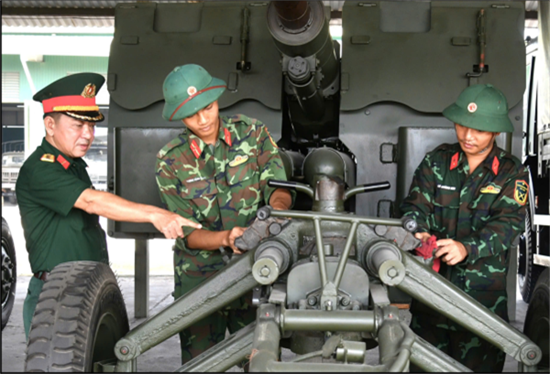 |
| Equipment preservation and maintenance |
Alongside ideological education and orientation, the Brigade has emphasised the exemplary responsibility of cadres at all levels in accordance with the motto “superiors set an example for subordinates, and agencies set an example for units”, particularly in observing working hours, military etiquette, and safety regulations. It has effectively maintained the “Legal Study Day” and the models of “One legal provision studied each week” and “One legal question each day”, while linking the task of regularity building, discipline management, and safety assurance with the Determined to Win Emulation Movement, peak and ad hoc emulation drives, the implementation of the “Year of Discipline”, and the Campaign to promote tradition, devote talent, and live up to the title of “Uncle Ho’s Soldiers” in the new era. At the same time, it has brought into play the roles of the Ho Chi Minh Communist Youth Union and Soldiers’ Council exercising grass-roots democracy, organising pioneering activities, and encouraging military personnel to register their commitments to observing the law and military discipline. These efforts have gradually transformed compliance from something driven by reminders and compulsion into a matter of self-awareness and self-motivated action among troops.
To bring about sustainable progress in building an “exemplarily, typically” comprehensively strong unit, alongside establishing consistent and coordinated regularity, including building “bright, green, clean, beautiful” barracks, warehouses, and facilities, the Brigade has consistently attached importance to maintaining regularity in training and combat readiness. Closely following the combat training directives of the Chief of the General Staff and the Commander of Army Corps 34, the Brigade has focused on developing, supplementing, and finalising its combat determination and plans for various contingencies, including plans for on-the-spot combat, manoeuvre, disaster prevention and mitigation, and search and rescue, ensuring consistency and coordination. At the same time, it has required officers and soldiers to observe command, headquarters, and combat readiness duty regimes, uphold discipline, develop a prompt and precise working style, become proficient in using all types of vehicles, weapons, and equipment, and voluntarily maintain good physical fitness and endurance to undertake long-distance marches, adapt to harsh conditions, respond effectively to alert drills and situation-handling tests, and ensure readiness to successfully accomplish all assigned missions.
In training, the Brigade has emphasised regularity at every stage of management, organisation, practice, exercises, and training support. It has intensified training courses to improve the professional competence of its cadres, strictly implemented the decentralised training system, and ensured adherence to the prescribed procedures and programmes. Due attention has been paid to developing tactical and technical skills and practising air defence combat plans in accordance with the principles of “basics, practicality, solidity”, making training “synchronous, specialised, closely aligned with actual combat conditions”. These activities have been closely combined with practising operational movements, strengthening determination and physical fitness, and imparting combat experience to officers and soldiers.
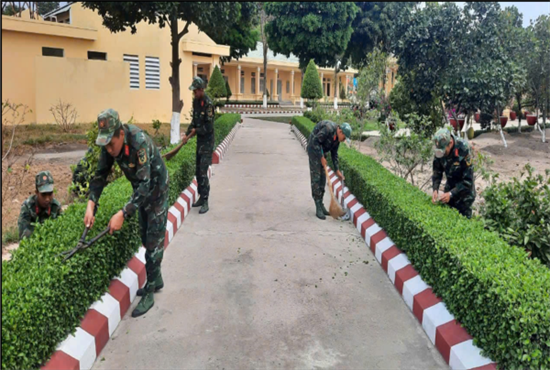 |
| Building green, clean, beautiful barracks |
In regularity building and discipline management, the Brigade has directed its agencies and units to synchronously take measures to manage compliance with the law, military discipline, and orders from superiors. Significance has been attached to clearly assigning responsibilities for managing personnel, weapons, equipment, and property. Party committees and commands at all levels have been required to regularly keep abreast of personnel’s ideological conditions, family circumstances, and social relationships, exercise comprehensive management over troops’ ideology, sense of responsibility, and personal relationships, and strengthen inspections to promptly detect and rectify early signs that could lead to violations. At the same time, the Brigade has strictly maintained regimes for managing weapons, technical equipment, vehicles, and personnel activities, particularly during days off and rest periods, and among small, independent elements. It has proactively forecast and identified potential risks, promptly resolving emerging issues at grass-roots level, preventing them from developing into complex incidents or negative behaviour. In particular, in the face of the rapid development of information technology and social media, together with tactics of enticement and incitement that negatively influence young soldiers' perceptions and behaviour, the Brigade has required Party committees and commands at all levels to strengthen the management of personnel in cyberspace, raise their awareness, sense of responsibility, and standards of conduct when using social media, and proactively detect, combat, and prevent harmful and toxic information, as well as degradation in ideology, morality, lifestyle, and behaviour, thereby maintaining ideological stability within itself.
The Brigade’s training and combat readiness are closely associated with the exploitation and use of vehicles, weapons, and technical equipment that have been in service for many years and whose compatibility and operational stability are relatively limited, potentially leading to safety risks. Therefore, strict observance of safety rules and procedures has been upheld. The Brigade has focused on improving personnel’s proficiency and skills in operating weapons, equipment, and technical systems. For officers and professional servicemen, emphasis has been placed on methods of inspecting, supervising, and guiding personnel in implementing safety procedures and regulations, as well as their ability to forecast and recognise signs of potential safety risks and handle arising situations. For soldiers, in addition to training in compliance with safety regulations, the Brigade has intensified task-specific training associated with concrete situations. Before each mission, the Brigade has directed the development of plans specifying safety requirements and the organisation of supplementary and refresher training and assessments to enable troops to master safety procedures. Consideration has been given to strictly observing regulations on the management and use of technical equipment, ammunition, and explosives. As a result, despite conducting intensive training and exercises and regularly participating in disaster response, search and rescue operations, the Brigade has consistently ensured absolute safety for its personnel, vehicles, weapons, and equipment.
The results achieved through the coordinated implementation of these measures have provided a solid foundation for Air Defence Brigade 71 to continue fulfilling its role as a model unit of Army Corps 34 in regularity building, discipline management, and safety assurance, as well as improving its overall quality and combat power and successfully accomplishing all assigned missions.
Sr. Col. NGUYEN XUAN LINH
Commander of the Brigade