During the Tay Ninh Campaign of 1966, the armed forces and people of the Southeastern region defeated Operation Attleboro, launched by US and puppet forces against our Duong Minh Chau base, safely protecting the regional headquarters. Victory of the Campaign marked a rapid development in our military art, particularly the art of conducting counter-offensive campaigns.
Having suffered heavy defeats in their first strategic counter-offensive, during the 1966 - 1967 dry season, the US and puppet forces mobilised a large number of troops and a massive amount equipment (comprising approximately 40% of the main US forces on the South Vietnam battlefield) to launch a second strategic counter-offensive directed at the Southeastern region, focusing primarily on our War Zones C and D.
With the ultimate objective of seeking out and destroying the Liberation Army’s main forces and the regional leadership and command structures, the enemy immediately reinforced their troops upon discovering several logistics depots and traces of our main forces’ activities. They deployed the 1st Division, the 25th Division (understrength), the 196th Brigade, and a battalion from the 173rd Airborne Brigade, alongside several Saigon puppet units, to launch Operation Attleboro into the Duong Minh Chau base (Northern Tay Ninh). This was aimed at executing their “search and destroy” strategy against Division 9 of the Liberation Army and “capturing” the regional leadership, thereby creating a favourable position for their strategic counter-offensive.
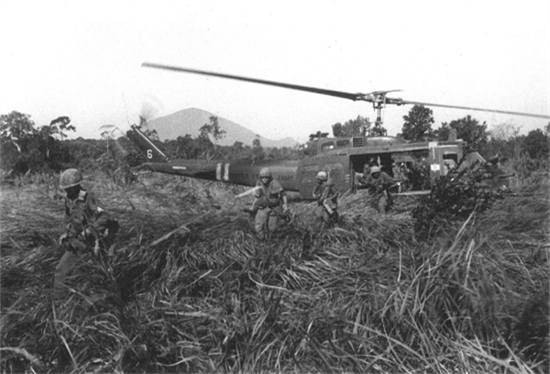 |
| US heliborne landing (file photo) |
Faced with the enemy’s devious plan, and acting upon the appeal of the Presidium of the Central Committee of the National Liberation Front: “Now more than ever, our armed forces and people in the South must make extraordinary efforts to smash the new counter-offensive plan of the US and their puppet forces, resolved to achieve a major victory in the Winter - Spring of 1966 - 1967... No matter how long and arduous the struggle is, our military and people are determined to fight and to win; nothing is more precious than independence and freedom”, the Regional Command decided to launch a counter-offensive campaign in Tay Ninh province - the Tay Ninh Campaign. With the “determination to fight and defeat the American invaders”, the armed forces and people of the Southeastern region proactively organised their combat posture, adopted appropriate combat methods, and shattered the enemy’s large-scale operation, thus firmly protecting the base, alongside the regional leadership, command structures, and logistics systems. The Campaign’s victory not only thwarted the enemy’s plans, but also left behind valuable lessons regarding the military art of conducting counter-offensive campaigns.
First, accurately predicting the enemy’s offensive plans and making early combat preparations. The prominent feature of a counter-offensive campaign is that we engage the enemy while they are in an offensive state; therefore, at the initial stage, the enemy holds the advantage in choosing the space, time, targets, directions of attack, and the deployment of forces. Under such conditions, accurately predicting the enemy’s schemes, manoeuvres, and especially operational intentions is of paramount importance. This provides the foundation to formulate appropriate counter-offensive plans, proactively make combat preparations, and gradually seize operational initiative. Accordingly, in mid-1966, when the Central Office for South Vietnam (COSVN), the Military Commission, and the Regional Command held a meeting to approve the resolution and operational plans for the 1966 - 1967 dry season, they assessed: “US forces will launch a second counter-offensive into the Duong Minh Chau base area”. Simultaneously, they anticipated that the enemy would deploy blocking forces in several areas to seal off the Vietnam - Cambodia border, such as Memot, Ca Tum, and Trang Ba Vung. The enemy would also conduct airborne assaults to seize advantageous terrain as a springboard, combined with manoeuvring forces from the South to deep thrusts along major routes. Afterwards, they would manoeuvre along multiple directions and prongs to encircle, cut off, and penetrate each area, attempting to “capture” our regional leadership and “search and destroy” our main forces. In reality, the development of Operation Attleboro unfolded essentially in accordance with our predictions. The enemy deployed artillery groups in Suoi Da and Loc Ninh to support the 2nd and 3rd Brigades of the US 1st Division as they landed in Cha Do and Trai Den areas, advancing along Route 22 and Route 785 into Duong Minh Chau base.
Based on closely studying and accurately assessing the situation, the Campaign Command adopted the tactic of drawing the enemy out to destroy them. At the same time, the Campaign Command organised forces to conduct deep penetration and attack the enemy’s rear bases, proactively creating a favourable posture and the opportunity to stand ready against enemy sweep operations according to two plans. Plan 1 involved using small units to attack the system of outposts, garrisons, and strategic hamlets to support local movements, create a strong deterrent, and stand ready to fight enemy counter-attacks. Plan 2 involved proactively attacking the enemy when they advanced into our base, considering this a prime opportunity to concentrate forces to annihilate them. According to the established operational plans, the Campaign Command selected the main counter-offensive areas and targets from Bau Co to Ka Tum on Route 14, the areas of Cha Do, Dong Rum, and Bo Tuc, as well as Soc Con Trang, Ba Chiem, and Suoi Ngo. These were areas of treacherous terrain where the enemy vulnerabilities would be exposed easily; here, we had the conditions to deploy forces and equipment, combining local forces with main forces to engage the enemy from an advantageous position. Simultaneously, logistics units were ordered to urgently stockpile logistics and technical materials and complete the logistics arrangement to be ready to support mobile units engaging the enemy, etc. Thanks to the accurate predictions about the enemy’s intentions and directions of attack, the Campaign Command proactively made excellent operational preparations early on, forming a continuous and solid counter-offensive posture capable of rapid transformation, seizing the operational initiative.
Second, flexibly, creatively organising and employing forces. Duong Minh Chau base was located in a vast, mountainous, sparsely populated forested area; our on-site forces here were thin and consisted primarily of the agencies of the COSVN and the Regional Command. As the enemy held superiority in troop numbers, firepower, and mobility, relying solely on our main forces would make it difficult to break their large-scale offensives. Against that backdrop, the Campaign Command advocated the principle that “every agency, depot, and unit is a fighting fortress”, turning the cadres, staff, and soldiers of COSVN and Regional Command agencies into on-the-spot combat forces. This was a creative and flexible measure in force employment, transforming the very agencies requiring protection into a crucial component of our counter-offensive disposition. Thereby, it established and consolidated the people’s war posture, directly creating a battle array that forced the enemy to disperse their units and halt when facing disadvantageous terrain. The enemy was compelled to deal with our units across a vast area, which significantly reduced their ability to concentrate troops and firepower on their primary targets.
After accurately anticipating the enemy’s primary and secondary offensive directions, the Campaign Command promptly adjusted the disposition of the main forces to ensure that our units could conduct both defensive and offensive operations, and coordinate with local forces to create a widespread, interwoven battle array. Accordingly, Regiment 1 was repositioned to northwest of Tay Ninh town (west of Route 22); Regiment 16 and Battalion 6 (Regiment 2) assembled northeast of Suoi Da (north and south of Route 13); Regiment 2 (understrength) was positioned in Long Nguyen area. With such deployments, the main forces were well-positioned to manoeuvre rapidly according to multiple plans, support local forces, and proactively select areas and targets for attack. This gradually established and transformed our counter-offensive posture from small and medium-scale skirmishes to large-scale engagements in the anticipated areas. As a result, a solid counter-offensive posture was set up through the combination of local forces, main forces, and allied units stationed in the area. This ensured that wherever the enemy advanced, they were met with fierce resistance; their strength was eroded, their forces dispersed, and their units were stretched thin as they had to deal with threats to their front, flanks, and rear, thereby failing to unleash their inherent offensive power. In practice, supported by the local forces, Regiment 16 inflicted heavy casualties on several units of the US 1st Division in the Route 13 area. This left the enemy bewildered and terrified; wherever they landed, they immediately huddled into defensive perimeters and dared not conduct sweep operations further afield.
Third, promoting the combined strength of all forces and seizing the opportunity to launch counter-offensive. To cope with a large-scale operation featuring elite enemy forces provided with modern weapons and equipment, the Campaign Command determined to fully utilise the combined strength of all forces, relying on the people’s war posture, closely combining the widespread actions of local forces with the mobile main forces, considering this the decisive factor in defeating the enemy’s offensive. At the same time, our units intensified combat activities in the rear and outer perimeters of the enemy to break their initial offensive posture, forcing them to disperse and stretch themselves thin to deal with our manoeuvres; once they were sufficiently weakened, our units would be ready to seize the opportunity to conduct counter-offensive operations. In practice, as Regiment 1 attacked the enemy in Trang Lon and Trang Sup, and Regiment 2 shelled the US 1st Infantry Division Headquarters in Dau Tieng, our local troops and guerrillas in the districts of Trang Bang, Go Dau, and Duong Minh Chau simultaneously stepped up ambushes, raids, the elimination of collaborators, the breaking of local puppet authorities, and the sabotage of transport routes, inflicting heavy losses on the enemy. The regional air defence and logistics units also actively engaged the enemy at all times and in all places. The combat operations of the local forces did not occur independently or disjointedly but were always closely linked to the main forces’ operations under a unified and strict plan. Widespread small-scale engagements of attrition and annihilation created the posture and opportunities for the mobile main forces to deliver “heavy blows” to wipe out large numbers of enemy troops. Conversely, the main units baiting the enemy’s “search and destroy” efforts also created favourable conditions for the local forces to conduct their small-scale engagements with great successes.
After continuous and heavy losses, the US 173rd Airborne Brigade and 11th Armoured Cavalry Regiment were forced to unexpectedly withdraw from Dau Tieng. Realising that the withdrawal of these two vital reserve units meant the enemy’s reserve support capability was no longer available, coupled with the weakening of their offensive power from various directions and prongs - a prime opportunity to launch a counter-offensive to annihilate the enemy - the Campaign Command directed Regiment 1 to immediately shell Ta Dat, Regiment 16 to raid the enemy artillery group at Suoi Da, and Regiment 2 to shell the US 1st Infantry Division Headquarters in Dau Tieng. Thanks to accurate situational assessments, the exploitation of opportunities, and resolute command, our main units simultaneously attacked key targets, catching the enemy completely off guard. Struck by staggering blows and suffering heavy losses in personnel and equipment, the enemy hastily relocated their troops to Bau Sinh, terminating their Operation without achieving a single objective.
The Tay Ninh Campaign of 1966 serves as a vivid practical example of campaign art in grasping the enemy’s situation and proactively establishing and transforming the combat posture. The Campaign’s victory provides us with valuable lessons on the organisation, preparation, and execution of counter-offensive operations, which should be studied, applied, and creatively developed in any (potential) war to defend the Fatherland.
Col. TRAN THAI BANG, PhD
Faculty of Operational Study
National Defence Academy