The development of defence-economic zones represents a strategic policy of the Party and State aimed at closely linking economic development with the strengthening of national defence and security; building an all-people national defence posture integrated with the people's security posture and a solid “people's hearts and minds posture” across strategic regions. Currently, given the increasingly high demands of the cause of national construction and defence, this vital task deserves greater attention.
Over 25 years of practical experience in developing defence-economic zones
The establishment of defence-economic zones represents a concrete application of the Party and State’s strategic thinking on combining the economy with national defence and vice versa to foster socio-economic development and strengthen national defence and security; build an all-people national defence posture integrated with the people's security posture across the country's strategic regions.
Implementing this policy of the Party, on 31 March 2000, the Prime Minister signed Decision No. 277/2000/QĐ-TTg, approving the Master scheme of the Military's participation in socio-economic development in extremely disadvantaged communes in far-flung and isolated areas, linked to the establishment of defence-security zones in strategic, border, and coastal regions. This was followed by the Prime Minister's Decision No. 43/2002/QĐ-TTg dated 21 March 2002, approving the supplementary Master plan for defence-economic zones. Under these decisions, the Military was tasked with developing defence-economic zones with the primary focus being on collaborating with local authorities to develop socio-economic infrastructure, make plan for resettlement, and establish a new strategic layout across key areas and strategic directions. At the same time, they are responsible for assisting local People in developing production and alleviating poverty, while conducting mass mobilisation work and building strong local political bases.
After more than two decades of implementation, the development of defence-economic zones has achieved its overall goals: supporting ethnic minority communities to practice settled farming and living and improve their living conditions. At the same time, it has fostered the creation of border residential clusters, forming “strongholds” for firmly defending the country; strengthened People’s trust in the Party, the State, and the Military; and fostered great national unity and built a solid “people's hearts and minds posture” along the border regions.
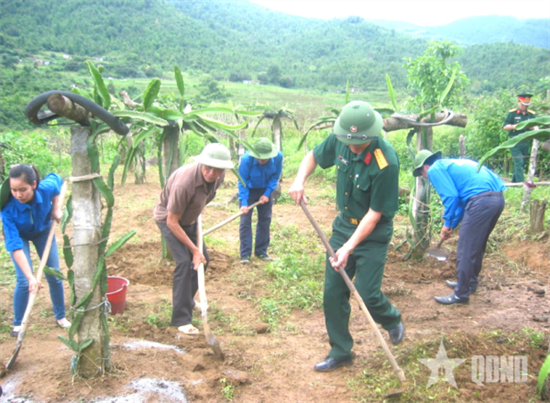 |
| Troops of Defence-economic Corps 327 (Military Region 3) and voluntary youths help the locals with farming (Photo: qdnd.vn) |
The development of defence-economic zones has fundamentally transformed the economic, cultural, social, and security landscapes of numerous strategic areas, particularly in the Northwest and Central Highlands. The establishment of border settlements, population stabilisation, the prevention of depopulation, and the building of strong local political bases have contributed to increasingly robust provincial-level defence zones and grassroots structures, thereby maintaining political stability and social order and safety in strategic areas. Notably, infrastructure projects within these zones serve both civilian needs and production growth while remaining adaptable for national defence purposes when required. Transportation networks, irrigation systems, and communication infrastructure not only drive economic and cultural development but also enhance force mobility and ensure the logistical and technical support necessary for military and defence missions.
It can be affirmed that defence-economic zones have yielded significant results in terms of socio-economic development as well as national defence and security. They serve as vital factors in hunger eradication and poverty alleviation, the implementation of policies regarding ethnic groups and religions, and the integration of socio-economic development with the strengthening of national defence and security.
In the current context of the Fourth Industrial Revolution, digital transformation, and extensive international integration, national borders are no longer limited to just geographical spaces, but included spaces for economic, cultural, and informational activity, as well as cyber-security. Rising non-traditional security challenges have imposed new demands on the mission of national construction and defence.
Therefore, the continued research and synchronised implementation of solutions to develop defence-economic zones serve not only foster socio-economic growth but also hold long-term strategic significance: securing the land and the population, safeguarding the borders, and building a solid “people's hearts and minds posture” along the nation's frontiers.
Key issues in the current development of defence-economic zones
Firstly, it is essential to elevate strategic awareness regarding the role and importance of defence-economic zones. In the new context, these zones must be approached with a strategic vision. They should not be viewed merely as models for socio-economic development, but rather as strategic institutions for safeguarding territorial sovereignty and securing the population, the land, and the borders proactively and from a distance. Borders, nowadays, encompass not only geographical space but also economic, cultural, and informational domains, as well as non-traditional security spheres. Therefore, the development of defence-economic zones must be aligned with the goal of building borders that are politically steadfast, economically prosperous, strong in defence and security, and deeply rooted in the people’s hearts and minds.
Based on this understanding, it is necessary to continue establishing and effectively implementing inter-sectorial coordination mechanisms between the Military and other departments, ministries, sectors, and local authorities in the development, management, and growth of these zones in a way that clearly stipulates functions and responsibilities, ensures synchronisation and consistency without overlap. At the same time, appropriate mechanisms and policies must be devised to effectively leverage social resources, particularly the participation of enterprises in the economic development of border, maritime, and island regions; establish medium- and long-term investment frameworks tailored to the specific characteristics of defence-economic zones, thereby laying the foundation for stable and sustainable long-term development.
Secondly, continue to vigorously innovate the methods of running defence-economic corps to enhance their effectiveness under new conditions. Defence-economic zones should not only provide administrative support or implement short-term programmes, but act as a “development locomotive” driving local resources. In the current context of a market economy and digital transformation, there should be mechanisms for these units to have more effective operations in local economic development, such as through infrastructure construction, border logistics, agricultural technical services, agricultural value chain integration, and support for cross-border e-commerce. Simultaneously, their structures should also be streamlined towards lean, effective, and efficient direction so that they can successfully perform their assigned functions and duties in accordance with the law.
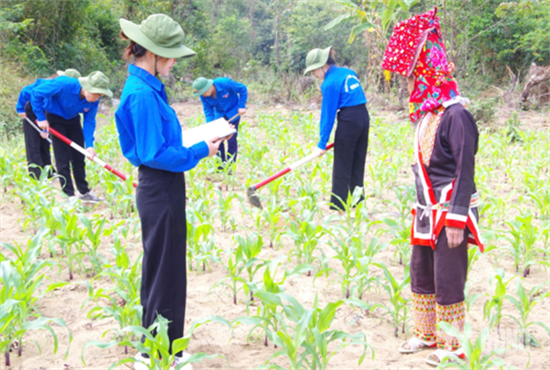 |
| Young voluntary intellectuals of the Defence-economic Corps 327 (Military Region 3) instruct the local farming technique (Photo: qdnd.vn) |
Thirdly, develop defence-economic zones basing on the orientation of “digital border” development. Amidst the push for national digital transformation and the emergence of cyberspace as a new strategic domain, the development of defence-economic zones should combine traditional infrastructure with digital infrastructure; gradually lay the groundwork for a digital economy and digital society while strengthening national defence and security capabilities in border areas. Accordingly, alongside continued, comprehensive investments in transport, electricity, water supply, schools, and healthcare facilities, special attention must be paid to developing digital infrastructure, promoting digital education, telemedicine, and online public services, as well as universalising digital skills for border residents to narrow the digital gap between these regions and more developed ones. Furthermore, given the rise in activities exploiting cyberspace to disseminate distorted information, incite opposition to the Party’s guidelines and the State’s policies and laws, and undermine the great national unity, the task of building a “people’s hearts and minds posture” must be expanded to encompass both physical and digital spaces which requires defence-economic units to integrate traditional mass mobilisation work with modern information and communication efforts.
Fourthly, promote the role of young volunteer intellectuals in the development of defence-economic zones. In the current context, young intellectuals must go beyond their professional duties to become a core vanguard force in the “Digital Mass Education” movement, gradually disseminating digital knowledge and skills to ethnic minority communities in border regions. Consequently, it is essential to refine mechanisms for attracting, utilising, and effectively promote their talents in these zones. Models such as “Digital villages” and “Border community technology teams” should be established, with young volunteers, alongside staff of the defence-economic zones, local youth union members, and Border Guard troops, serving as the core force. They will guide residents in using digital platforms, accessing online public services, applying technology to production, promoting local products online, recognising harmful or toxic information, and fostering a healthy digital cultural life in border areas. In addition, they should be allowed to participate more deeply in sectors such as digital education, telemedicine, digital agriculture, the development of population databases, and the preservation of ethnic cultures through digital technology, etc.
Fifthly, accelerate the development of defence-economic zones on islands and in maritime areas. This is a long-term strategic task aimed at establishing an integrated defence posture extending from the mainland to the islands, thereby firmly safeguarding the nation's sovereignty, sovereign rights, and maritime interests in the new situation. Accordingly, together with consolidating mainland defence-economic zones, it is necessary to research the development of models tailored to island and maritime conditions. This approach should be viewed as a strategic development direction essential for the successful implementation of Vietnam’s Strategy for sustainable marine economic development, while simultaneously ensuring the firm protection of the Fatherland's sacred maritime and island sovereignty.
Building marine-based defence-economic zones is not merely a matter of developing the maritime economy or providing livelihood support to fishermen; rather, it should be integrated into the overall strategy of building the “all-people national defence posture” linked with the “people's security posture” and the “all-people border defence posture” at sea. This effort must also align with development plans for fishery logistics centres, maritime service clusters, fishing port systems, storm shelters, and coastal fishing villages. Simultaneously, it is essential to further refine coordination mechanisms among defence-economic units and the Navy, Coast Guard, Border Guard, and maritime militia and self-defence forces in constructing the all-people national defence posture at sea.
Given the unique features of the marine and island environment, the development of defence-economic zones requires a clear definition of criteria regarding: strategic defence and security locations; the integration of marine economic development with defence-related logistics and technical support; the capacity of fishermen to maintain presence at sea; mobility and search-and-rescue capabilities; infrastructure for maritime information, observation, and surveillance; and the ability to transition from civilian to defence functions in the event of contingencies. Particular emphasis should be placed on building stable coastal and island communities with sustainable livelihoods, capable of long-term offshore operations and acting as “living markers” in safeguarding maritime sovereignty.
In the current context, the development of marine and island defence-economic zones must be linked to the creation of a “digital maritime space”. This involves the gradual modernisation of systems for communication, vessel tracking, natural disaster warnings, and search-and-rescue operations, alongside enhanced data connectivity and sharing for fisheries management. Simultaneously, it requires strengthening the capacity to combat illegal, unreported, and unregulated (IUU) fishing, protecting the marine ecosystem, and fostering a modern and sustainable marine economy.
Last but not least, there is a need to enhance the capacity to effectively respond to non-traditional security challenges and climate change, while preserving national cultural identity and strengthening the great national unity bloc. Current non-traditional security challenges and climate change are evolving in complex ways; issues such as transnational crime, drug trafficking, smuggling, trade fraud, and rural security risks necessitate that defence-economic zones be planned with a focus on sustainable development, the green economy, and the circular economy. At the same time, it is essential to enhance capabilities regarding disaster prevention and control, search and rescue operations, and ecological environmental protection, while maintaining security and public order in the locality.
In the context of globalisation, market economy, and the rapid growth of social media profoundly impact the cultural life of ethnic minority communities in border, coastal, and island regions, gradually eroding traditional cultural identities and weakening community cohesion, as well as the prevalence of superstitious practices and illegal religious proselytisation. Therefore, the development of defence-economic zones must be closely linked to the preservation and promotion of ethnic cultural identities; the cultivation of a new cultural lifestyle; the strengthening of national unity; and the promotion of the active role of ethnic minority communities in the management and firm protection of the Fatherland's sacred sovereignty and security over its borders, seas, and islands.
Major General, Assoc. Prof. Dr. TRAN TRUNG TIN, Former Director of the Department of Economics, Ministry of National Defence