Editorial note: Against the backdrop of epochal changes in the world, the cause of national construction and defence has both opportunities and challenges. To firmly safeguard the socialist Vietnamese Fatherland in the new period, the 14th National Party Congress has set the goal of building a revolutionary, regular, elite, modern Vietnam People’s Army (VPA) as the core force in firmly protecting the Fatherland in the new situation. This is a sound, strategic, breakthrough policy of our Party when it comes to the goal of “building a modern VPA”.
To shed more light on this issue, starting with the August 2026 Issue, the National Defence Journal respectfully introduces a series of articles entitled “Building a modern Army - a sound policy and strategic vision of the Party”, authored by Cao Thanh, Quang Hop, Thanh Tung, Ba Phu, Viet Vuong, and Van Vuong.
I. The Party’s thinking on VPA building - from the aspiration for independence to the era of national rise
The VPA was founded, led, educated, and trained by the Communist Party of Vietnam and President Ho Chi Minh. It performs the three functions of an army ready for fight, for work, and for production.
Over the course of its more than 80-year history, under the Party’s leadership and with the people’s affection, care, and support, our VPA has continued to mature and grow stronger. As the core force, our VPA has joined the entire people in defeating all aggressors, gloriously fulfilling the cause of national liberation and reunification, firmly safeguarding the socialist Vietnamese Fatherland. History has proved that the Party’s leadership is the determining factor in the growth and victories of our VPA.
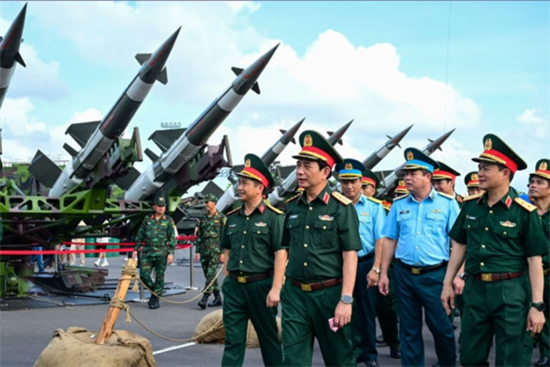 |
| Gen. Phan Van Giang inspects the exhibition area of the Ministry of National Defence during the Exhibition of 80-Year National Achievements (photo: qdnd.vn) |
The aspiration for independence - the driving force behind building a revolutionary army
Drawing on the historical experience of human society, Karl Marx and Friedrich Engels, great leaders of the international communist and workers’ movement, pointed out: “The history of all hitherto existing society is the history of class struggles”. In class struggle, any class seeking to seize and retain ruling power must organise armed forces and exercise firm leadership over them. Building on and developing the views of Marx and Engels under new conditions, when socialist revolution had become an immediate task, V.I. Lenin further affirmed that violence is the “midwife” of every revolution and “No revolution is worth anything unless it can defend itself”. To seize and retain power and build a new society, the working class, with the Communist Party as its vanguard, must organise a worker - peasant army and exercise firm leadership over it under all circumstances. This constitutes the most fundamental principle.
Faithfully adhering to and creatively applying Marxism - Leninism, inheriting and promoting the tradition of building and defending the country, and drawing on studies of the nature of imperialism and the practical experience of world revolutions, President Ho Chi Minh and our Party concluded that colonialism was, in itself, an act of violence. Independence and freedom could not be begged for. Therefore, “in the arduous struggle against the enemies of the class and the nation, revolutionary violence must be used to counter counter-revolutionary violence, seize power, and defend that power”. Revolutionary violence comprises both political and armed violence. Political struggle requires building political forces, while armed struggle necessarily requires building and exercising firm leadership over armed forces.
With that sound policy in place, from the very outset, the Party’s Brief Political Platform (February 1930) set the goal of “organising a workers’ and peasants’ army”. The Political Thesis (October 1930) called for “establishing a worker - peasant army” and “organising a worker - peasant self-defence force”. At its First Congress (March 1935), the Party adopted a separate resolution on the self-defence force, clearly stipulating that “the revolutionary worker - peasant self-defence force is placed under the unified command of the Central Committee and the Military Commission of the Communist Party” and that “the Party’s strict command over the standing self-defence force must always be maintained”. In line with the policy of the Party and President Ho Chi Minh, revolutionary armed units were successively established and steadily developed, providing effective support for the masses’ revolutionary struggle, including the National Salvation Self-Defence Force, Bac Son Guerrillas, Nam Ky Guerrillas, the 1st National Salvation Army, the 2nd National Salvation Army, the 3rd National Salvation Army, among others.
Notably, to prepare the armed forces for their role as the core of the General Uprising to seize power, on 22 December 1944, the Vietnam Propaganda Liberation Army Team - the VPA’s predecessor - was established, marking an important turning point in the Party’s thinking on building revolutionary armed forces. Since then, as the Vietnamese revolution has evolved, the Party’s thinking on VPA building has continued to be enriched in response to the requirements of each revolutionary period.
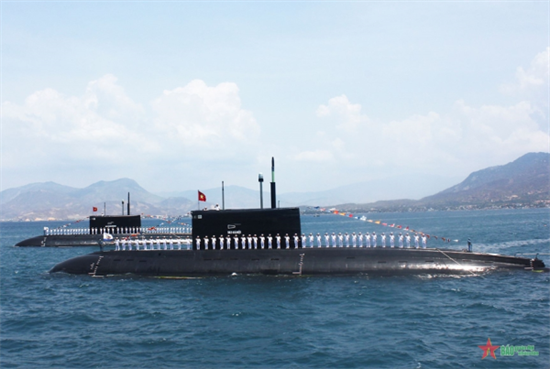 |
| Vietnam’s submarines at Cam Ranh Military Port (photo: qdnd.vn) |
Wars of liberation and the thinking on building a revolutionary VPA towards regularity and modernity
Following the success of the August Revolution of 1945, on 22 May 1946, President Ho Chi Minh signed Decree 71/SL on the National Army of Vietnam. This constituted a foundational legal document for building the main forces of an independent nation. As the resistance war against French colonialists entered a new stage, decisive victory could not be achieved through guerrilla warfare alone; small-, medium-, and large-scale combat had to be combined. Accordingly, main-force divisions capable of conducting large-scale campaigns were successively formed, beginning with Division 308 on 28 August 1949, followed by Divisions 304, 312, 320, 351, 316, 325, among others. This was an important development that demonstrated the Party’s strategic foresight in VPA building, with regular main-force formations possessing increasing mobility and interoperability. Such thorough preparation contributed directly to the historic Dien Bien Phu Victory of 1954, which “resounded throughout the five continents and shook the globe”, bringing the resistance war against French colonialists to a victorious end.
As the country entered a new stage, in the face of the US imperialists’ plot to invade Vietnam through neo-colonialism, the Politburo issued a resolution in September 1954 on the new situation and the Party’s new tasks and policies, which stated the need “to build the People’s Army into a revolutionary, regular, relatively modern army”. In March 1957, the Resolution of the 12th Plenum of the Party Central Committee (2nd tenure) on VPA building and national defence consolidation also called for “actively building a powerful Army that would gradually advance towards regularity and modernity”. In his letter to cadres and soldiers on the 14th founding anniversary of the VPA (22 December 1944 - 22 December 1958), President Ho Chi Minh clearly stated that: “We must strive to build our Army into a powerful people’s army, a revolutionary army advancing towards regularity and modernity, so as to preserve peace and defend the Fatherland”. The 3rd National Party Congress (1960) continued to affirm that: “It is necessary to strengthen and consolidate national defence and build the Army towards regularity and modernity”. This was an important milestone, laying the foundation for building our VPA towards regularity and modernity.
Implementing the policy of the Party and President Ho Chi Minh, during the resistance war against US imperialists for national salvation, our VPA made remarkable strides in force size, organisational structure, weapons and equipment, and methods of warfare. Along with the development of people’s war, the main forces expanded rapidly, from 170,000 personnel in 1958 to 300,000 in 1963, 700,000 in 1966, and one million in 1973. At the same time, services, arms, and specialised forces continued to develop, including the Air Defence - Air Force Service, Navy, Armoured Corps, Artillery, Commando, Engineering, and Signal forces. Main-force army corps with high mobility and combat power were also successively established, including Army Corps 1 (October 1973), Army Corps 2 (May 1974), Army Corps 3 (March 1975), and Army Corps 4 (July 1974). The Party’s sound policy and strategic vision for building a revolutionary VPA towards regularity and modernity made an important contribution to the great victories of the resistance war against US imperialists for national salvation, culminating in the complete liberation of the South and national reunification.
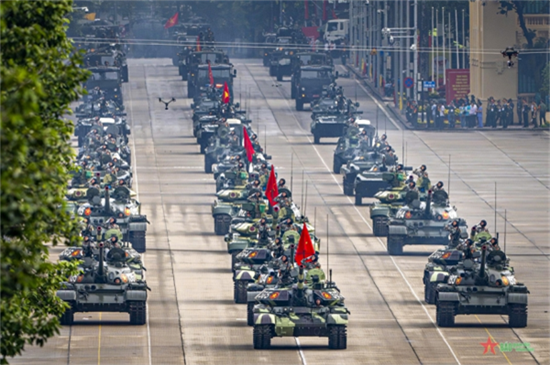 |
| The Tank and Armoured Force during the parade to celebrate the 80th anniversary of National Day (photo: qdnd.vn) |
Fatherland protection and the aspiration to rise - a breakthrough in the thinking on building a revolutionary, regular, elite, modern VPA
Following the complete liberation of the South and national reunification, the country entered a period of peace and national construction and defence, marking a new stage in VPA building. Against that backdrop, through its successive National Congresses, the Party continued to build on and develop its viewpoints and lines, integrating the goals and tasks of VPA building into the broader cause of national construction and defence and closely associating them with building strong all-people national defence. Accordingly, the 6th National Party Congress (1986) defined the task of “building the VPA into a regular and increasingly modern force with ever higher overall quality”. The 7th National Party Congress (1991) also set the goal of “building the VPA into a revolutionary, regular, elite, gradually modern force with an appropriate organisational structure and troop strength”. Since the 8th National Party Congress (1996), building a revolutionary, regular, elite, gradually modern VPA has become a consistent policy of our Party in leading military and defence work and safeguarding the Fatherland.
Particularly, as the 21st century unfolded, the rapid development of science and technology brought about many types of modern weapons as well as new forms of warfare and methods of combat. In the face of increasingly demanding requirements for Fatherland protection, the 12th National Party Congress continued to affirm the goal of building the VPA into a “revolutionary, regular, elite, gradually modern force, with priority given to modernising a number of services, arms, and forces, building a strong political foundation, enhancing overall quality and combat power, and maintaining absolute loyalty to the Fatherland, the Party, the State, and the people”. At the 13th National Party Congress, our Party clearly set out its approach to building a modern VPA, affirming that: “The VPA and the People’s Public Security are to be built into revolutionary, regular, elite, gradually modern forces, with a number of services, arms, and forces advancing straight to modernity; by 2025, the VPA and the People’s Public Security are to be basically built into adept, compact, strong forces as a firm foundation for striving to build revolutionary, regular, elite, modern VPA and People’s Public Security forces by 2030”. This guideline marked a clear shift from the orientation of “building a gradually modern VPA” to the goal of “building a modern VPA” with a defined roadmap and specific steps. It reflects our Party’s strategic vision in response to profound changes in the security environment, the country’s practical conditions, and the requirements of national construction and defence in the new situation.
Notably, after five years of implementing the Resolution of the 13th National Party Congress, particularly the Politburo's Resolution 05-NQ/TW on the organisation of the VPA for the 2021 - 2030 period and beyond, significant progress has been made in building the VPA towards being adept, compact, and strong. The force structure has been adjusted in a more coordinated and rational manner; overall quality and combat readiness have been increased; important achievements have been recorded in science and technology, innovation, digital transformation, and defence industry. Building on the country’s new position and strength after 40 years of Đổi Mới (Renewal), and in response to the increasingly demanding requirements of national construction and defence in the new period, the 14th National Party Congress has defined the goal of “Building the VPA and the People’s Public Security into revolutionary, regular, elite, modern forces in order to firmly safeguard the socialist Vietnamese Fatherland”. This represents the consistent development of the Party’s thinking on VPA building through different periods and constitutes a particularly important milestone, opening a new stage in building the VPA, strengthening national defence, and safeguarding the Fatherland.
It can be affirmed that our VPA's development journey reflects the continuous evolution of our Party’s theoretical thinking and its creative leadership in VPA building, national defence consolidation, and Fatherland protection.
Building on that sound policy, under the Party's clear-sighted leadership, with the people’s affection, care and support, and through the tireless efforts, dedication, and selfless sacrifice of successive generations of cadres and soldiers, our VPA has continuously grown in strength and maturity, excellently fulfilling every task entrusted to it by the Party, the State, and the people over the past more than 80 years.
As the nation enters a new era of development, the tasks of strengthening national defence and safeguarding the Fatherland entail new and increasingly demanding requirements. Accordingly, it is essential to firmly grasp the context, strategic orientations, and emerging issues. This provides the basis for translating the Party’s strategic policy of building a modern VPA into practice.
(Next issue: II. Building a modern Army - context, strategic orientations, and emerging issues)