Against the backdrop of intensifying strategic competition among major powers, further escalation of military conflicts and wars in several regions, and complex developments of non-traditional security challenges, the US has been steadily expanding its defence budget to preserve its military superiority, strengthen its deterrence capabilities, and reinforce its position as the world's leading superpower. This trend not only reflects significant adjustments in Washington's strategic thinking but also greatly impacts international security environment.
According to researchers, global defence spending has seen a significant increase in recent years since the end of the Cold War. One of the driving forces behind this trend is strategic competition among major powers, prolonged military conflicts in certain regions, and the rapid development of military science and technology.
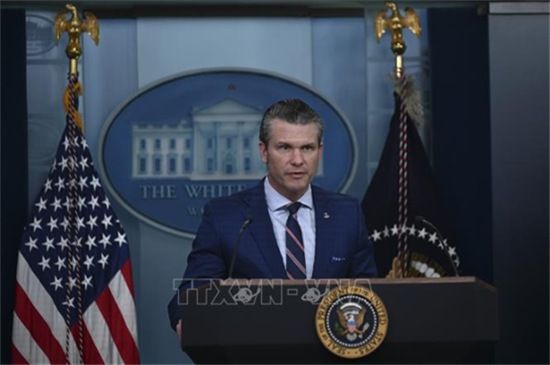 |
| US Secretary of Defence Pete Hegseth delivers a speech at the White House (photo: VNA) |
Analysis by the Stockholm International Peace Research Institute (SIPRI) shows that global defence spending in 2024 reached approximately $2.718 trillion, a 9.4% increase compared to 2023 - the highest rise since 1988. This trend is repeated in 2025, with total defence spending at $2.887 trillion, a 2.9% increase compared to 2024. Against this backdrop, the US remains the world's largest spender on defence. In 2025 alone, the US defence budget reached $954 billion, accounting for over 30% of total global defence spending. This adjustment not only meets immediate defence and security requirements but also reflects Washington's long-term strategic vision: preparing for future forms of warfare, maintaining the capacity to effectively respond to new security challenges, and safeguarding its leading role in military and technology.
The cycle of growing US defence budget
According to international scholars, throughout history, US defence spending has consistently been adjusted in response to changes in the international security environment and strategic priorities during different periods. Statistically, over the past five decades, US defence expenditure has, on average, accounted for 4.1% of GDP. However, when confronted with major security challenges, US defence spending tends to rise sharply. Particularly, it reached 11.4% of GDP in 1953 during the Korean War, approximately 5-6% of GDP before gradually declining to 3.1% of GDP throughout the Cold War. In 2001, US defence spending surged once again following the 11 September terrorist attacks and its launch of Global War on Terror under the administration of President George W. Bush. Between 2010 and 2012, US defence expenditure exceeded $800 billion. However, as a result of the Budget Control Act, spending declined to approximately $580-590 billion during the 2014 - 2016 period. This period also marked a turning point to a new cycle of increasing defence spending since 2017.
Researchers also point out that US defence budget has maintained a sustainable upward trajectory despite political and economic fluctuations as well as changes in administration. During President Donald Trump's first term, defence spending significantly increased to support the administration's objective of rebuilding US military strength and reinforcing the national position as the world's leading superpower. Over the four-year period, defence budget soared by more than 20%, from approximately $600 billion to over $700 billion, marking a clear reversal from the preceding period of budget reductions.
Under President Joe Biden, this trend was further accelerated to consolidate Washington's role in strategic competition with its rivals and to address the Russia - Ukraine conflict and other security hot spots. By 2024, total US defence spending exceeded $1 trillion including military assistance and expenditures related to overseas conflicts, accounting for more than one-third of global military expenditure. Although defence budget for fiscal year 2025 declined slightly due to debates over additional aid packages, international experts generally regard this as a short-term adjustment that does not alter the long-term trajectory of increasing defence investment. In fact, both the US Congress and the federal government demonstrate a high level of consensus on the objective of strengthening defence investment. US defence budget for fiscal year 2026, which surpassed $1 trillion, is widely viewed as a clear indication of a new era of escalating defence expenditures.
The US trend of increasing defence spending
According to many experts, annual US defence spending exceeding $1 trillion is likely to become stable in its defence budget policy in the coming years. Despite economic pressures, rising public debt, and domestic political debates, a substantial reduction in US defence budget in the near future appears unlikely. This expresses a growing consensus among US policymakers on the necessity of maintaining military superiority and enhancing the capacity for strategic competition.
In the medium and long term, strategic competition among major powers is expected as a primary driver of continued increases in US defence spending. In addition, regional conflicts and the requirements to sustain a global military presence, fulfil commitments to allies, and strengthen strategic deterrence are likely to force Washington to maintain a high level of defence investment. Moreover, not only the expanding size of defence budget but also the allocation of US defence resources is also undergoing significant adjustments. Analysts argue that future investment priorities will shift from expanding the size of the armed forces to improving force quality, operational effectiveness, and the ability to adapt to new forms of warfare. Accordingly, defence funding is prioritising the modernisation of the strategic nuclear force, the development of next-generation missile defence systems, the enhancement of multi-domain operational capabilities, and the integration of artificial intelligence, automation technologies, unmanned systems, and other advanced military technologies.
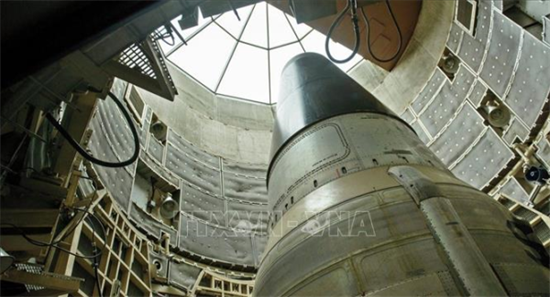 |
| US Titan II ICBM capable of carrying nuclear warhead (photo: VNA) |
This trend is clearly manifested in the Trump administration's proposed $1.5 trillion defence budget for fiscal year 2027. If approved, some experts estimate that US defence spending would account for more than 50% of total global military expenditure. The proposal earmarks approximately $17.5 billion for the Golden Dome missile defence system, $55 billion for autonomous systems and unmanned platforms, $71.4 billion for the modernisation of the strategic nuclear triad, and $100 billion for defence industry development. As the Pentagon expected, these investments represent a "multi-generational vision", laying the foundation for advancing strategic “proactive deterrence” measures, enhancing homeland defence capabilities, and reinforcing US military power on a global scale.
In addition to developing new warfighting capabilities, US policymakers have particularly emphasised defence industry development. According to many military experts, enhancing defence production capacity, securing military supply chains, and improving the ability to mobilise defence industry resources are essential to sustain US position as a military superpower and guarantee a rapid response to defence requirements amid an increasingly complex and unpredictable global security environment.
Implications for US domestic affairs and international security environment
The substantial increase in US defence spending not only indicates important adjustments in Washington's strategic thinking but also greatly impacts the US itself and the international security environment.
International scholars argue that, for the US, maintaining a high level of defence spending not only strengthens its military capabilities but also serves as a driving force of growth in its defence industry and high-tech sectors. According to economic analysts, a 15% increase in US defence budget for fiscal year 2026 could stimulate national economic growth by approximately 0.2 percentage points. Statistically, the five largest US defence contractors were given contracts worth a combined $771 billion by the Department of Defence during the 2020 - 2024 period, with Lockheed Martin on the top at approximately $313 billion. Through research, technological innovation, and military modernisation programmes, the US is strengthening its deterrence capabilities, securing its leading role in military science and technology, and preserving its ability to project power on a global scale. However, increase in defence spending also poses challenges for US fiscal policy as public debt and budget deficits continue to grow. In the long term, sustaining such a high level of military expenditure may constrain the allocation of resources to civilian sectors, including health care, education, infrastructure, and development assistance.
For related countries and regions, the rise in US defence spending has generated significant spillover effects. In Europe, many countries, including closest US allies, have continued to increase their military budgets and accelerate the modernisation of their armed forces in response to evolving security requirements. In the Asia-Pacific region, many states have likewise adjusted their defence policies, expanding military investment, fostering the development of new warfighting capabilities.
Beyond its impact on the scale of global military expenditure, the increase in US defence spending has also intensified competition in key military technology domains, including artificial intelligence, cyber warfare, outer space, unmanned systems, and hypersonic weapons. These are strong incentives for many countries’ research and development in defence technologies so as to adapt to emerging forms of warfare. Besides, US growth in military spending is contributing to a global wave of rising defence budgets. As strategic competition among major powers continues to be intense, and numerous security hot spots remain unresolved, the risk of an arms race still looms. This trend is likely to increase the complexity and volatility of the international security environment, while posing new challenges to peace, stability, and development across many regions of the world.
It is evident that the rise in US defence spending is not merely a domestic issue for Washington; it has played a pivotal role in shaping the global security landscape and the international strategic balance. In the current context, closely monitoring and analysing shifts in US defence policy and military strategy is crucial for grasping the evolving dynamics of the international security environment as well as for anticipating future transformations in the global power balance and structure of the international security order.
NGUYEN HONG QUANG, PhD
Department of the Americas
Ministry of Foreign Affairs