On promoting the role of military social sciences and humanities intellectuals in safeguarding the Party’s ideological foundation
Firmly safeguarding the Party’s ideological foundation is a matter of principle in Party building and rectification, and a vital, regular task incumbent upon every cadre and Party member. In the face of increasingly aggressive and direct sabotage schemes and tactics employed by hostile forces, it is imperative to further promote the role and responsibility of the entire political system, as well as of the whole people and the entire armed forces, in fulfilling this crucial task. Within this endeavour, the contingent of military social sciences and humanities intellectuals occupies a pioneering and vanguard position, and their role must be further strengthened and brought into full play.
The contingent of military social sciences and humanities intellectuals comprises those engaged in leadership, management, command, teaching, research and communication related to the fields of social sciences and humanities within academies, schools, units, research institutes, and institutions devoted to literary and artistic creation, publishing, journalism, radio and television; as well as cadres working in strategic agencies under the Ministry of National Defence. They possess profound theoretical grounding and professional expertise in the social sciences and humanities in general, and in military social sciences and humanities in particular.
In recent years, under the leadership and direction of Party committees and commanders at all levels, this contingent has made significant contributions to safeguarding the Party’s ideological foundation. They have actively participated in researching and developing theoretical issues concerning Party building; Party and political work; and the building of a politically strong Army under new conditions. Numerous scientific works, research projects, journalistic and media products have helped to clarify new issues arising from the practice of building the Army, consolidating national defence and safeguarding the Fatherland, thereby providing sound scientific arguments to inform the formulation, supplementation and development of the Party’s guidelines and policies in this crucial domain. At the same time, they have engaged with increasing proactivity and effectiveness in the struggle to refute erroneous and hostile viewpoints.
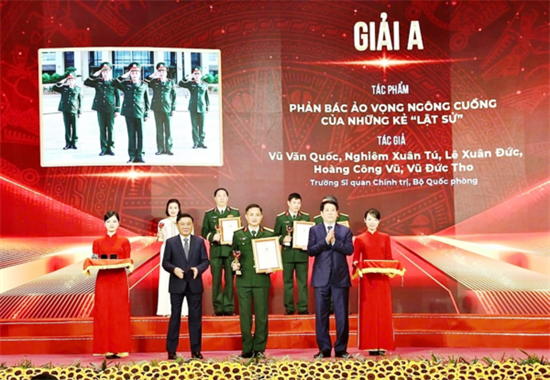 |
| The Political Officer College won top prize in a writing contest on the Party's ideological foundation in 2025 |
Through scholarly publications, journalistic outputs and theoretical forums, this contingent has helped to expose the reactionary and unscientific nature of distorted and tendentious arguments, while affirming the correctness, revolutionary character and scientific validity of Marxism-Leninism, Ho Chi Minh thought, and the Party’s renewal policy as well as its military and defence lines. Through teaching, research, academic supervision, management and advisory work, they also play a pivotal role in training and fostering cadres, particularly political officers at all levels, thereby directly enhancing the theoretical standards, political steadfastness and intellectual capacity of the officer corps within the Army. At the same time, they contribute to the building of an increasingly pure and healthy military cultural environment, creating a firm foundation for safeguarding the Party’s ideological stronghold within the Army from the grassroots level upwards.
Notwithstanding these positive results, in comparison with practical requirements, the awareness of some Party committees and leading cadres regarding the role of this contingent in safeguarding the Party’s ideological foundation has at times and in certain places not been sufficiently comprehensive; nor have there been fully developed mechanisms, policies or breakthrough solutions to maximise their contribution. Some research, communication and polemical outputs produced by military social sciences and humanities intellectuals still lack depth and persuasiveness, and do not yet display a sufficiently sharp and combative character.
At present, in light of the increasingly demanding task of safeguarding the Party’s ideological foundation and countering erroneous and hostile viewpoints, greater attention must be devoted to strengthening and further promoting the core and pioneering role of the contingent of military social science and humanity intellectuals. With that objective in view, this article proposes several solutions as follows:
First, continuously enhancing the awareness and sense of responsibility of military social sciences and humanities intellectuals with regard to the task of safeguarding the Party’s ideological foundation. Accordingly, Party committees and leading cadres of academies, schools, management bodies, research institutions and communication agencies in which this contingent works must continue to thoroughly grasp and strictly implement the Party’s resolutions and directives, particularly Directive No.23-CT/TW of 9 February 2018 issued by the Secretariat (12th Tenure) “On continuing to renew and improve the quality and effectiveness of the study, research, application and development of Marxism-Leninism and Ho Chi Minh Thought in the new situation”; and Conclusion No.89-KL/TW of 25 July 2024 issued by the Politburo (13th Tenure) “On continuing the implementation of Resolution No. 35-NQ/TW of 22 October 2018 of the Politburo (12th tenure) on strengthening the protection of the Party’s ideological foundation and combating erroneous and hostile viewpoints in the new situation”. Education and dissemination efforts must be intensified so that military social sciences and humanities intellectuals fully appreciate that safeguarding the Party’s ideological foundation is a vital task, contributing to the protection of the “incomparably immense and precious spiritual asset of our Party and nation”.
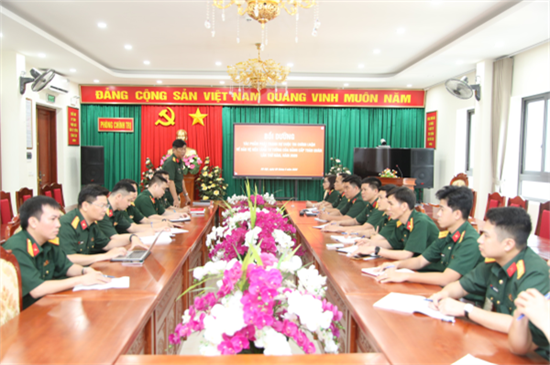 |
| A training on writing to protect the Party's ideological ground held by the Political Academy |
On that basis, this contingent must assume a pioneering role in directly conducting research, providing theoretical clarification and development, and supplying scientific grounds for orienting awareness and ideology. At the same time, they must actively participate in refuting erroneous and hostile viewpoints through rigorous argumentation, academic credibility and vivid practical experience drawn from military and defence realities. They should further consolidate their core role in researching, elucidating and disseminating Marxism-Leninism, Ho Chi Minh Thought and the Party’s line through tightly reasoned scientific arguments, clear language and persuasive evidence. In doing so, they will help to strengthen confidence and unity of thought within the Army, and to affirm the vitality, scientific value and contemporary significance of the Party’s ideological foundation in the face of distortions and denials.
Second, strengthening training and enhancing the knowledge and skills of military social sciences and humanities intellectuals in safeguarding the Party’s ideological foundation and in combating erroneous and hostile viewpoints. The rapid development of practice has posed numerous new issues for the tasks of building socialism and defending the Fatherland. Accordingly, Party committees, Party organisations and leading cadres in the institutions where this contingent works must thoroughly grasp the guiding principle that “the consistent guiding thought of our entire Party, people and armed forces is to steadfastly adhere to, apply and creatively develop Marxism-Leninism and Ho Chi Minh Thought”; and must pay due attention to educating, fostering proper motivation, attitude and responsibility, and encouraging and supporting this contingent in effectively conducting research, teaching and communication on Marxism-Leninism, Ho Chi Minh Thought and the Party’s line, in close conjunction with the struggle to refute erroneous and hostile viewpoints, particularly in cyberspace.
Regular training, refresher courses and the updating of specialised knowledge in political theory, professional expertise and digital transformation skills should be provided for lecturers, teachers, rapporteurs, propagandists, editors, journalists and specialised cyber operations forces, to meet task requirements in the new context. Coordination among management bodies, research institutions, creative agencies and academies and schools should be strengthened in the implementation of programmes and tasks. Greater investment should also be made in funding, infrastructure and information technology equipment to support the task of safeguarding the Party’s ideological foundation and combating erroneous and hostile viewpoints in cyberspace.
To fulfil their core and pioneering role, each military social sciences and humanities intellectual must proactively engage in continuous self-study and self-cultivation, constantly enhancing comprehensive and in-depth knowledge of Marxism-Leninism, Ho Chi Minh Thought, the Party’s line, national and military realities, and digital skills. They should regularly monitor, analyse and forecast developments, promptly identifying new sabotage schemes and tactics employed by hostile forces and opportunistic or disaffected elements; and proactively devise systematic response and countermeasures, with due emphasis on the application of information technology, artificial intelligence (AI), big data and the Internet of Things (IoT) in protection and struggle activities on social media, thereby maintaining the initiative and avoiding passivity or surprise.
Finally, continuing to renew and refine mechanisms and policies so as to further promote the role of military social sciences and humanities intellectuals in safeguarding the Party’s ideological foundation. It has been shown that appropriate mechanisms and policies will attract, motivate and effectively bring into play the strengths of this contingent; conversely, if such mechanisms and policies are inadequate or ill-suited, it will be difficult to attract and fully utilise their capabilities. Accordingly, Party committees, Party organisations and the Steering Committees 35 at all levels should continue to study and advise competent authorities on supplementing and improving regulations and provisions to ensure unified leadership and direction - from the Central Military Commission down to the grassroots level - in safeguarding the Party’s ideological foundation and combating erroneous and hostile viewpoints. At the same time, the advisory, coordinating, supervisory and inspection roles of the standing bodies of the Steering Committees 35 at each level should be strengthened. Particular attention should be devoted to researching, renewing and refining mechanisms and policies for building and promoting the core and pioneering role of military social sciences and humanities intellectuals in safeguarding the Party’s ideological foundation in the new period. In this regard, it is necessary to introduce sufficiently robust and distinctive policies to attract, value and effectively utilise social sciences and humanities intellectuals both within and beyond the Army, especially leading theoretical experts with profound practical insight, who can serve as the nucleus in guiding scientific research, summarising practice, and providing sound arguments for safeguarding the Party’s ideological foundation and countering erroneous and hostile viewpoints.
In parallel, regulations and policies aimed at attracting and nurturing talent should be regularly reviewed, supplemented and refined, and a favourable environment together with the necessary conditions should be created to encourage military social sciences and humanities intellectuals to pursue continuous professional development, actively engage in academic exchange, and share experience and methods of struggle. A close combination must be ensured between task assignment and encouragement, including financial and material support for relevant activities. Manifestations of complacency in study and research, aversion to difficulties or reluctance to engage in ideological struggle must be resolutely addressed and overcome.
Although the above-mentioned solutions are not exhaustive, it is the author’s sincere hope that they may offer additional perspectives for Party committees, Party organisations and competent bodies to consider and apply in practice, thereby further enhancing the role of military social sciences and humanities intellectuals in safeguarding the Party’s ideological foundation in the time ahead.
Senior Colonel, Associate Professor, PhD VU DINH DAC
Political Officer College