The art of fighting decisive key battle in the Route 9 - Southern Laos Campaign of 1971
The Route 9 - Southern Laos Campaign was the first large-scale combined-arms counteroffensive operations conducted by our military. The campaign achieved a resounding victory, completely defeating the enemy’s Operation Lam Son 719, firmly safeguarding the strategic logistics corridor supporting the Southern battlefield, and leaving many valuable lessons in military art, most notably the art of conducting decisive key battles.
Entering the year 1971, together with increased efforts to implement the plan to stabilise rural areas, the U.S. and the Saigon regime mobilised many elite and combat-experienced units to launch Operation Lam Son 719 into the Route 9 - Southern Laos area with the aim of destroying our bases and logistic depots in the Sepon area, cutting off the strategic logistics corridor, and “strangling” the resistance of the three Indochinese countries’ people at its root. At the same time, they sought to test the combat capability of the Saigon puppet military - the core force in implementing the strategy of “Vietnamisation of the war.”
Clearly recognising the enemy’s intentions, the Politburo and the Central Military Commission (CMC) assessed that the enemy’s operations into the Route 9 - Southern Laos area would pose many difficulties for us. However, their reckless deployment of main forces into mountainous and forested areas far from their rear bases also created a favourable opportunity for us to destroy them. Therefore, the CMC decided to concentrate forces and means to launch the Route 9 - Southern Laos Counteroffensive Campaign with the aim of defeating the enemy’s ambitious operations. After nearly two months’ courageous and resilient fighting, through a unique operational art, our forces crushed Operation Lam Son 719, firmly protecting the strategic logistics corridor and opening the prospect of defeating the U.S. strategy of “Vietnamisation of the war.” This was an important victory, marking a new development in the art of counteroffensive campaigns of our military, in which the art of conducting decisive key battles with the strength of combined arms was particularly prominent, reflected in following aspects.
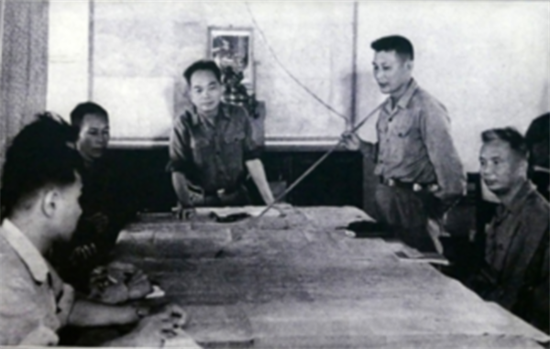 |
| General Vo Nguyen Giap chair the discussion on combat plan for Route 9 - Southern Laos Campaign (A file photo) |
First, accurate anticipation of the main operational area. In a counteroffensive campaign, anticipating the main operational area must be based on the enemy’s direction of attack, terrain conditions, and the likely development of the campaign. It must be the place where the enemy concentrates their main forces and means, and we have favourable conditions to deploy our forces and means. On the basis of thoroughly grasping the enemy’s scheme, the Campaign Command determined that the section of Route 9 from Lao Bao to Ban Dong would be the main operational area, with Ban Dong designated as the location for fighting the decisive key battle. This decision proved entirely correct as the area possessed significant tactical value, controlling part of the southern Laos border and Route 9, the only axis along which the enemy could transport their forces and equipment towards Sepon. Moreover, the section from Lao Bao to Ban Dong had many tactically valuable heights such as Hill 639, Hill 351, Hill 311, etc., which were conducive for our forces to establish solid defence and positions capable of controlling Route 9 and repelling enemy attacks. As for Ban Dong, it was an open terrain area with a broad frontage where the enemy could use as a springboard to advance toward Sepon. For us, it was also an area where forces and means could be deployed to conduct combined-arms operations.
During the campaign, after crossing the Viet Nam-Laos border, the enemy immediately deployed the 1st Airborne Brigade, the 11th and 17th armoured regiments and the 9th Airborne Battalion to seize Ban Dong, continuously reinforcing and transforming it into a strong mixed defensive strongpoint complex and a springboard for the advance toward Sepon. Thanks to accurate anticipation of the main operational area, the forces participating in the campaign were able to prepare the battlefield, deploy units, means, and logistical-technical facilities, and proactively establish firm defence positions west of Ban Dong. This enabled them to pin down and confine the enemy’s main forces at Ban Dong, creating a sharp, flexible counteroffensive posture that quickly led to victory and conclusion of the campaign.
Second, establishment of a sharp and advantageous offensive posture. Given victories in the opening battle and the key battle at Hill 723, our forces broke the two pincers of the enemy’s advance toward Sepon, forcing them to shift from offensive initiative to passive defence at Ban Dong and seek withdrawal along Route 9. Recognising that the window of opportunity for counteroffensive had emerged, the Campaign Command deployed the 8th and 9th Battalions of Regiment 102 to the area close to Route 9 to coordinate with Regiment 24 to establish strong interdiction positions at Hill 351, Hill 311, etc., while conducting mobile attacks to defeat multiple enemy relief attempts, resolutely cutting Route 9 from Lao Bao to Ban Dong and preventing the enemy from withdrawal.
At the same time, Division 2 was assigned to organise three defensive strongpoints along Route 9 at Kilometer 27, S-shaped Bridge, and the Route 18 junction ready to repel enemy attacks should they recklessly attempt to advance toward Sepon. This was a timely and wise action, reflecting the sharp thinking and accurate situational assessment of the Campaign Command and staff. Without timely blocking and interdiction positions, enemy forces from Khe Sanh would have quickly maneuvered to reinforce Ban Dong. If that had been the case, we might not have had sufficient strength to attack. Even if we had attacked, the combat effectiveness would have been limited and the campaign’s objective to destroy large numbers of the puppet army’s main forces would not have been achieved.
Additionally, the Campaign Command ordered Division 2, Division 324, and local forces to continue encircling and attacking the puppet’s 1st Division and the 147th Marine Brigade at Hills 723, 660, 550, etc., destroying eight companies and shooting down 40 helicopters, thereby cutting off reinforcement from the southern axis and completely isolating Ban Dong. To ensure victory, the Campaign Command simultaneously employed the 36th, 64th, and 66th infantry regiments, the 368th and 45th artillery regiments, five tank companies, and air-defence support to attack the enemy. The forces were deployed in an encirclement formation around Ban Dong in which Regiment 36 attacked from the northeast, Regiment 66 and combined-arms units attacked from the northwest, and Regiment 64 attacked from the west, thereby maximising combined-arms strength to shatter the enemy’s fortified defensive system. Moreover, the air-defence forces of Unit 559 actively controlled the airspace, limiting the enemy’s ability to reinforce and evacuate by helicopter. The B4 and B5 fronts intensified ambushes and raids on enemy logistics bases and command posts in Dong Ha, Ai Tu, Sa Muu, Ta Con, etc., creating simultaneous and widespread pressure across the entire campaign area, forcing the enemy to disperse command and stretch their forces, limiting their ability to reinforce, supply, and support Ban Dong, thus providing our main forces with the most favourable conditions to successfully conduct the decisive key battle.
It can be affirmed that in the decisive key battle at Ban Dong, the art of establishing operational posture was applied flexibly, creatively, and effectively. Efforts to shape the battlefield were carried out widely in the front, flanks, and rear, targeting both directly engaged enemy forces and related enemy forces. As a result, all plans for reinforcement, relief, or breakout by land and air were destroyed, leaving the enemy at Ban Dong completely encircled and isolated, falling into a dilemma with morale shaken and combat effectiveness gradually declining, leading to their destruction.
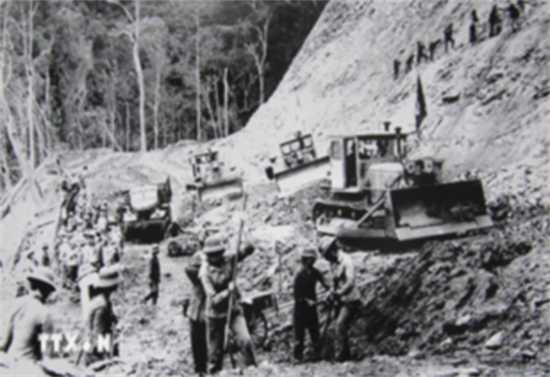 |
| Troops of Corps 559 make road for the Campaign |
Third, determination of appropriate operational methods and flexible application of tactics. Although we had broken the enemy’s two pincers from the north and south, the enemy at Ban Dong had formed a defensive strongpoint complex with relatively solid fortifications, strong firepower, and multiple layers of obstacles. Meanwhile, our troops had limited experience in attacking fortified positions. An immediate assault could have resulted in heavy casualties. Therefore, the Campaign Command determined to continue tightening the encirclement while conducting continuous small-scale attacks and concentrating firepower against the Ban Dong area, forcing enemy forces within the strongpoints to withdraw so that we could apply the principle of attacking the enemy while they were outside their fortifications. By using this method of combat, we compelled the enemy to fight on our terms, luring and forcing them to move into our planned ambushes and interception positions. At the same time, this created conditions to concentrate command, forces, means, and firepower for Division 2 and Division 324 to continue attacking and destroying the enemy’s southern force. This represented a distinctive feature of the operational art of “using the few to defeat the many, using the weak to defeat the strong,” concentrating forces at the right place and time, avoiding dispersion, and exploiting the enemy’s weaknesses.
More importantly, in the decisive key battle, operational art was closely integrated with tactics. Tactical command flexibly and creatively employed many tactical forms and combat techniques, maintaining the initiative and continuously creating surprise, forcing the enemy into a passive and confused posture. In practice, while Regiments 36, 64, and 66 tightened the encirclement, special operations and artillery units conducted raids against all three enemy groupings within Ban Dong. Regiment 102 and Regiment 24 applied mobile attack tactics combined with blocking positions at Hills 351, 311, etc., defeating enemy breakthrough attempts by tanks and armoured vehicles, resolutely besieging and confining the enemy before shifting to offensive operations. Under increasing pressure from our forces, enemy troops inside the strongpoints became extremely demoralised and collapsed psychologically, abandoning weapons and equipment to slip through the forests to retreat, thereby creating conditions for the Campaign Command to direct units to simultaneously break through, penetrate deep, and promptly shift to pursuit combined with interception south of Route 9, destroying large numbers of the puppet military’s main forces and capturing or destroying many weapons and equipment.
Although much time has passed, study and clarification of the distinctive features in terms of operational art in the Route 9 - Southern Laos Campaign remains important and necessary. It enriches the theoretical and practical foundations of enduring value, enabling continued inheritance and creative application in developing Vietnamese military art under the new conditions of the people’s war for national defence.
Senior Colonel, Doctor NGUYEN VAN TRUNG, Political Academy