February 2026 marks four years since the outbreak of the Russia-Ukraine conflict, a confrontation that has exerted multidimensional impacts on the region and the wider international community. Although significant differences remain among the parties involved, it is evident that all stakeholders recognise the necessity of bringing this conflict to an end. The question remains whether this shared awareness will translate into meaningful efforts to achieve a viable and sustainable settlement in the near future. This is an issue that continues to attract profound global attention.
During his campaign for a second presidential term, U.S. presidential candidate Donald Trump asserted that he would end the Russia-Ukraine conflict “within 24 hours” if he returned to office. To date, more than a year into his new term, President Donald Trump and his associates have undertaken considerable diplomatic efforts, acting as mediators and organising multiple meetings with the parties concerned in an attempt to bring the conflict between Russia and Ukraine to an end. However, negotiations remain deadlocked.
Following talks held in Abu Dhabi (United Arab Emirates) on the conflict, the White House set a deadline of June 2026 for reaching a peace agreement. Nevertheless, after the most recent round of negotiations in Geneva (Switzerland) concluded, the two parties still failed to narrow their differences.
Assessing the balance of forces on the battlefield, as well as the strategic intentions and core interests of the parties involved, many analysts contend that this deadline may once again pass without result unless a genuinely breakthrough solution emerges.
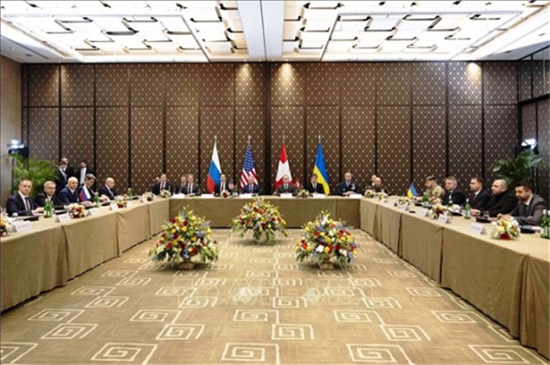 |
| Negotiation between the U.S., Russia and Ukraine in Switzerland on 17 February 2026 |
A strategic stalemate
According to international military analysts, after more than four years of hostilities, the battlefield situation between the two sides remains largely characterised by a strategic stalemate, with neither achieving a decisive victory. Since 2024, however, developments on the ground have gradually shifted in a direction more favourable to Russia. Leveraging advantages in firepower and manpower, together with flexible tactical employment of new-generation unmanned aerial systems, Russia has regained the initiative on the battlefield, launching renewed offensives in Donbass, Kherson, and Zaporizhzhia. Notably, adjustments in U.S. strategy during President Donald Trump’s second term - moving towards what appears to be a near reversal of the firm stance adopted by the administration of President Joe Biden on the Russia-Ukraine issue - have provided Russia with additional advantages both on the battlefield and at the negotiating table.
For its part, Ukraine is widely perceived by international observers to be in a more difficult and reactive position. It has not only failed to secure control over Russia’s Kursk region - an objective that was seen as a potential bargaining chip in negotiations - but has also lost additional territories. As for the European Union (EU) and NATO, both organisations have exhibited growing internal divisions, having fallen short of their stated objective of inflicting a strategic defeat on Russia. Both Ukraine and its Western backers have adopted a more pragmatic stance, acknowledging that a military defeat of Russia is not feasible.
According to Ukrainian President Volodymyr Zelensky, after nearly four years of conflict with Russia, Ukraine has suffered losses amounting to approximately USD 800 billion. International agencies and organisations estimate that around 70% of Ukraine’s energy infrastructure and 13% of its total housing stock have been damaged or destroyed. The war has forced nearly five million Ukrainians to seek refuge abroad, while more than six million people have been internally displaced. Regarding military casualties, President Zelensky has publicly estimated that approximately 55,000 Ukrainian soldiers have been killed in action. However, several assessments by Western research institutions suggest significantly higher casualty figures. For instance, the U.S.-based Centre for Strategic and International Studies (CSIS) estimates that total Ukrainian casualties by the end of 2025 may range between 500,000 and 600,000. Experts further note that even after the cessation of hostilities, Ukraine may require decades to clear landmines and unexploded ordnance remaining across affected areas.
For Russia, the toll has likewise been substantial. In terms of casualties, CSIS estimates that Russia may have sustained approximately 1.2 million casualties as of December 2025, including between 275,000 and 325,000 fatalities - representing the largest military losses suffered by a major power since the Second World War. The economic and financial impact has also been considerable. According to senior Russian officials, Moscow is currently subject to approximately 30,000 Western sanctions measures. More than USD 300 billion in Russian assets remain frozen in Western financial institutions, while lost revenues from oil and gas exports alone are estimated at nearly USD 160 billion. More broadly, the conflict has contributed to Russia’s diplomatic isolation and significant disruption of its links with Western financial and economic systems - developments that are expected to generate long-term adverse consequences.
One war, multiple calculations
International scholars observe that policy adjustments by the administration of U.S. President Donald Trump during his second term have altered the trajectory of the Russia-Ukraine conflict, effectively shifting it into a phase of “fighting while negotiating” from 2025 onward. Guided by the principle of “America First,” the Trump administration has sought to bring the conflict to an end as swiftly as possible, prioritising the reduction of security burdens in Europe in order to concentrate on what it regards as more critical U.S. strategic interests in the Western Hemisphere and the Indo-Pacific region. At the same time, Washington has not concealed its intention to improve relations with Russia in pursuit of both economic and strategic interests. Faced with the prospect of either accepting concessions in order to reach a negotiated settlement or risking the complete withdrawal of U.S. support, Ukraine has been compelled to adopt a more pragmatic approach and has participated in multiple rounds of negotiations with both the United States and Russia.
According to analysts, from Ukraine’s perspective, any ceasefire or peace agreement would need to meet at least three fundamental conditions:
(1) The protection of Ukraine’s sovereignty and territorial integrity, at least in legal terms; (2) The provision of credible security guarantees to prevent the recurrence of conflict; and (3) A clear framework for post-war reconstruction, including Ukraine’s proposal that part of Russia’s frozen overseas assets be used to compensate for war damages and reconstruction costs.
For its part, Russia has maintained a firm position. Moscow demands that Ukraine acknowledge the new territorial realities on the ground and seeks to address what it considers the root cause of the conflict - NATO’s eastward expansion. It continues to insist that Kyiv make territorial concessions and fully withdraw its forces from the Donbass region. In addition, Russia emphasises security guarantees for itself, including Ukraine’s commitment to neutrality, the imposition of strict limitations on the size and composition of Ukraine’s armed forces, a prohibition on receiving military assistance from allies, and the safeguarding of the rights of Russian-speaking populations within Ukraine, among other conditions.
From the European perspective, the European Union has articulated at least three principal requirements:
(1) Any ceasefire arrangement concerning Ukraine must involve European participation; (2) Any territorial adjustments affecting Ukraine must be determined by the Ukrainian people themselves, without external imposition; and (3) Ukraine must receive substantive and credible security commitments.
Prospects ahead
The considerable differences in calculations, positions, and interests among the parties involved suggest that, despite numerous rounds of negotiations in recent years, the path towards a mutually acceptable and sustainable settlement remains fraught with obstacles. International observers note that while Ukraine is currently in a difficult position, this does not necessarily imply that Kyiv will readily yield to pressure from either Russia or the United States. The prospects for peace negotiations depend not only on the will of political leaders but also on societal acceptance. Four years of conflict have undoubtedly intensified “war fatigue,” yet surveys indicate that a majority of Ukrainians continue to oppose territorial concessions.
In principle, Ukraine’s Constitution imposes constraints on any alteration of national borders, rendering legally binding “land-for-peace” arrangements extremely difficult to accept, even under international pressure. This reality underscores that although the desire for peace and the fatigue of prolonged war have grown over time, most Ukrainians still regard territorial compromise as a “red line.” Consequently, negotiations may progress in technical domains - such as prisoner exchanges, limitations on attacks against energy infrastructure, or the establishment of humanitarian corridors - but a comprehensive peace agreement ultimately hinges on political decisions regarding territory and security guarantees.
According to analysts, even in the event that the United States completely suspends assistance to Ukraine, Kyiv would likely retain both the determination and sufficient resources to continue fighting. As of October 2025, the European Union had surpassed the United States as Ukraine’s largest military donour, committing approximately €99.48 billion, of which around €69.62 billion has been disbursed (compared with U.S. commitments of €65.58 billion, with €64.62 billion allocated). In terms of financial assistance, the EU has pledged approximately €102.94 billion, significantly exceeding the roughly €49.96 billion committed by the United States. In early February 2026, the EU finalised the details of a €90 billion loan package for Ukraine for the period 2026-2027, with roughly two-thirds earmarked for military assistance and one-third for budgetary support. Thus, despite internal frictions and divisions, Europe has effectively replaced the United States as Ukraine’s largest source of assistance.
Drawing on current developments on the battlefield and in the political arenas of the parties involved, researchers have outlined several possible scenarios for the Russia-Ukraine conflict in 2026. The first scenario envisages a protracted war, with fluctuating intensity depending on the pace of external assistance, ammunition production capacity, air defence capabilities, and each side’s ability to mobilise manpower. This would essentially be a contest of endurance and will, as victory or defeat would not hinge on a single decisive battle, but rather on sustained political resolve and the cumulative strength of military, economic, and industrial resources. The second scenario involves a ceasefire or a freezing of the conflict along the current line of contact. In practice, however, Russia continues to insist that Ukraine withdraw from the remaining parts of the Donbass region, while Ukraine seeks to freeze the conflict along the existing front line and rejects unilateral troop withdrawals. As such, this scenario would only be feasible under substantial multidimensional pressure, accompanied by credible security guarantees and a robust monitoring and enforcement mechanism. The third scenario entails a conditional peace settlement. A comprehensive peace agreement would require the simultaneous resolution of multiple interrelated issues, including territorial arrangements, Ukraine’s future security status, sanctions, and the disposition of frozen Russian assets, among others. To date, these elements have yet to align sufficiently to make such an outcome imminent.
International scholars widely characterise the Russia-Ukraine conflict, after more than four years, as a war of attrition in the fullest sense. Neither side has succeeded in decisively breaking nor subduing the other’s will to fight. Consequently, recent negotiations have not yielded any major breakthroughs. Nevertheless, certain positive signals have begun to emerge with increasing frequency. International public opinion hopes that the conflict will come to an end in the near future, allowing the peoples of both countries to live in peace and to embark upon national reconstruction.
Doctor VU DUY THANH, Ministry of Foreign Affairs