Brigade 972 improves its synergy to meet the requirements of strategic transport tasks
As a strategic transport unit of the Department of Vehicles, Machinery, and Transport, General Department of Logistics and Technology, Brigade 972 is responsible for transporting weapons, technical equipment, logistics supplies, and troops for units stationed in the southern provinces and the Central Highlands, carrying out related missions along the North - South strategic transport route, maintaining combat readiness, training reservists, participating in search and rescue, responding to natural disasters, and performing other unexpected tasks.
In recent years, the Brigade has consistently maintained its position as the leading unit of the Military Transport Sector and a typical model in the entire Military’s Determined to Win Emulation Movement, receiving many noble awards from the Prime Minister, the Ministry of National Defence, and the General Department of Logistics and Technology. To meet the requirements of building the Military in the new period, the Brigade has been equipped with many modern transport vehicles with large payloads and high mobility. Its staff members have undergone systematic training and possessed broad experience in transport under complex operational environments. These are fundamental advantages for the Brigade to successfully fulfil its tasks in all situations.
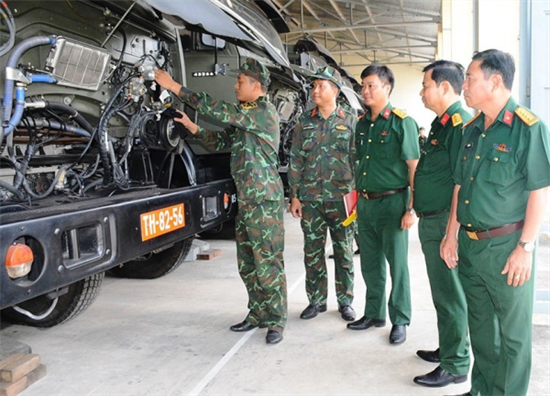 |
| A technical check on military vehicles carried out by Brigade Command |
However, due to the particularities and requirements of its tasks, the Brigade must transport large volumes of cargo, with many contingency tasks requiring high standards within a short period of time. Meanwhile, the Brigade is stationed in a large area; its personnel, vehicles, and ships often operate in a dispersed manner, far from the direct management of unit commands, subject to various impacts from the negative aspects of the market economy. The nature of its troops’ work is stressful and demanding, especially when absolute safety must be ensured under complicated traffic conditions. Besides, the transported goods are diverse, including many flammable or explosive items and those with high economic value, which can easily lead to negative phenomena and safety risks. For that reason, the Brigade’s Party Committee and Command have focused on adopting various solutions synchronously to improve the Brigade’s synergy and meet the task requirements in the new situation.
First of all, the Brigade’s Party Committee and Command have concentrated their leadership and direction on enhancing troops’ resolve and political steadfastness. To that end, the Brigade has attached great value to well conducting political education under regulations and selecting relevant additional topics for its troops to study. In the process, it has actively renewed forms and methods of education, combining basic education with regular education, aligning tasks-based education with history education, stepping up legal dissemination, propagation, and education, especially regarding road and inland waterway traffic laws, promoting the role of cultural institutions to improve troops’ mental life. In addition, it has strengthened discipline management, effectively implementing grass-roots democracy regulations, maintaining dialogue between commanders and soldiers during the Political and Cultural Day, properly taking all the steps of “forecasting, grasping, managing, and resolving ideological issues” along with the motto of “staying close to troops, understanding troops, trusting troops”, thereby preventing negative thoughts from arising or persisting. Attention has been paid to promoting the role of Soldiers’ Councils and Youth Unions in providing orientations in terms of awareness, ideology, and action, building proper attitudes and motivations, fostering the will to overcome difficulties, maintaining the qualities of transport soldiers, and developing “immunity” against temptations and negative social impacts.
Alongside measures for educating and managing troops, the Brigade has placed emphasis on consolidating its organisational structure and enhancing the leadership capacity and combativeness of party committees and grass-roots party organisations, promoting emulation movements and campaigns in tandem with the intensified study and following of Ho Chi Minh’s thought, morality, and lifestyle via practical actions, thereby creating widespread influence across itself. At the same time, due regard has been paid to ensuring troops’ material and mental life and well implementing policies for military families. As a result, the Brigade has always maintained stability, solidarity, and unity; its officers, employees, and soldiers have shown political and ideological steadfastness, devoting themselves to the unit, remaining ready to undertake and successfully fulfil all assigned tasks.
Drivers, helmsmen, and repairmen constitute the force that directly determines the results of the Brigade’s political tasks. Therefore, the Brigade has always paid attention to training and fostering this force’s professional qualifications and skills. It has correctly assessed the current state of drivers and repairmen and developed training plans suitable for each group. It has both selected its staff members for external training and organised on-site training courses, while encouraging self-study through practical work among its manpower. Training management and operation have been carried out in a close, scientific, “centralised, unified, synchronous, and effective way without overlap”; training has been aligned with the performance of transport tasks; cadre training has been seen as the key, while training in vehicle driving techniques and safety assurance has been considered as the centre.
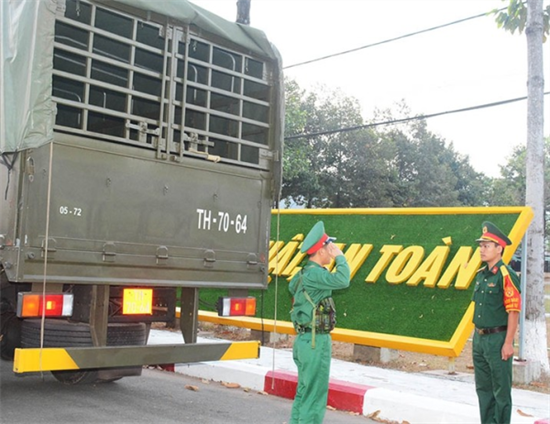 |
| Vehicle inspection prior to a mission |
Emphasis has been placed on training troops in staff work, command and control, and coordination in transport tasks, technical procedures for the preservation, maintenance, and repair of vehicles and vessels, procedures for cargo handover, receipt, loading, and unloading, night-time driving techniques, safety assurance measures in transport, skills for handling road and inland waterway traffic situations, transport techniques and tactics for different types of operations, and transport in disaster and epidemic prevention and control. Methodologically, the Brigade has organised additional driving practice for its drivers and improved its technical staff’s professional skills; superiors have been required to train inferiors, while experienced personnel have been assigned to train those with less experience. It has effectively organised internal technical contests and actively taken part in competitions held by the General Department of Logistics and Technology and the Ministry of National Defence. As a result, most officers, drivers, helmsmen, and technicians of the Brigade now possess solid professional qualifications and skills, meeting their task requirements.
As a technical unit, the Brigade has attached great importance to technical support for vehicles and vessels, ensuring that technical work would be one step ahead in all tasks. Regulations on maintenance and preservation have been strictly, regularly implemented, becoming a routine practice of each collective and individual. Units have promoted the spirit of self-reliance and self-strengthening and strictly followed maintenance and repair procedures at each level. In addition, the Brigade has actively mobilised resources to upgrade and modernise equipment for maintenance and repair at stations and workshops, encouraging its officers and soldiers to promote technical initiatives and improvements, thereby further enhancing its technical support capability. Consequently, the technical condition and coefficient of vehicles, machines, and ships have always been guaranteed, ready to depart on missions under any circumstances.
To accomplish its missions, the Brigade has attached great value to renewing the management, command, and operation of transport activities. For each transport mission, it has developed specific, meticulous plans, clearly defining the duties of each section, stipulating transport routes, timeframes, and measures. It has emphasised professionalism and standardisation in transport, linking individual responsibility to cargo safety. On each transport route, strict regulations have been set regarding distance between vehicles and among vessels; specific distances for driver rotation, stopping points, ports, and parking areas have also been determined. When transporting troops, the Brigade has prioritised vehicles and vessels with the best technical condition to ensure the safety of troops’ lives and health. When transporting cargo of large volume or weight, complex characteristics, and long distance over many days, its units have selected commanders, drivers, and loaders with great resolve, experience, and professional qualifications, enhancing command and inspection work at all stages, from reception and loading to transport and settlement with partner units. During manoeuvres, the Brigade has stipulated that formations of three to four vehicles must be commanded by a company-level commander; formations of five vehicles or more must have a battalion-level commander; formations of more than ten vehicles must have a Brigade-level officer in command.
In the transport process, commanders have always strictly maintained marching and billeting discipline, complying with regulations on formation, speed, and rest periods, regularly reminding forces of the difficulties, advantages, and characteristics of each route and stage. At the same time, they have ensured material, mental, and health conditions for troops, harmoniously resolving relationships and maintaining solidarity and unity during participation in traffic. After each mission, reviews have been conducted to highlight advantages, rectify shortcomings, opportunely commend and replicate exemplary collectives and individuals as important criteria for annual commendation. Thanks to its close organisation, command, and operation, in recent years, the Brigade has successfully completed all assigned tasks and ensured the absolute safety of its personnel, equipment, vehicles, and cargo.
Through the synchronous, effective implementation of those solutions, the Brigade’s transport capability has been increasingly enhanced. This provides a solid foundation for building an “exemplarily, typically” comprehensively strong and “standardised, safe, efficient” Brigade capable of successfully fulfilling all assigned tasks, worthy of being a strategic military transport unit.
Sr. Col. DO VAN XUAN
Commander of the Brigade