Phu Tho province improves the quality of selecting and enlisting citizens into the Military
The selection and enlistment of citizens for military service (military recruitment) is one of the key political tasks in local military and defence work. It is the first stage of crucial importance to directly raising the Military’s overall quality and combat strength and building a revolutionary, regular, elite, modern Vietnam People’s Army (VPA).
The year 2026 is the first year that the whole country in general, Phu Tho province in particular, performs the task of military recruitment under the two-tier local government model. After the merger1, the province now has 148 commune-level administrative units (133 communes and 15 wards), with many areas characterised by fragmented and rugged terrain; in some places, facilities and transport infrastructure remain limited. The contingent of grass-roots military cadres has been reassigned and supplemented from many localities, with differences in their professional capacity and practical experience. Many tasks that were previously undertaken at district level have been transferred to commune level. That situation has led to numerous difficulties and challenges for military recruitment work.
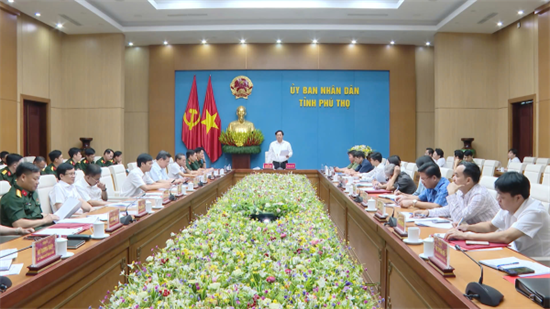 |
| Comrade Tran Duy Dong, Chairman of the Provincial People’s Committee, Chairman of the Provincial Military Service Council addresses the conference on 2026 military recruitment work |
Against that backdrop, the Provincial Military Party Committee (PMPC) and the Provincial Military Command (PMC) have always promoted their core role in coordinating with competent agencies at all levels to give advice to the Provincial Party Committee and the Provincial People’s Committee on resolutely, synchronously adopting many solutions to effectively carry out this important work.
Enhancing the effectiveness and efficiency of leadership and direction of all-level party committees and authorities and encouraging the involvement of the entire political system in military recruitment work
The selection and enlistment of citizens for military service is an important task involving many levels, sectors, and forces. In particular, the adoption of a “closed-process” method requires a very strong sense of responsibility from the political system, especially at grass-roots level. For that reason, the PMPC and PMC have grasped guiding documents of the Ministry of National Defence and Military Region 2 to give advice to the Provincial Party Committee and the Provincial People’s Committee on promulgating a complete system of leadership and direction documents and action plans in line with the province’s practical conditions and directing communes and wards to develop and disseminate specialised resolutions to each party cell, village, and residential area, thus creating a high level of unity in awareness and action in the process. Besides, the PMC has focused on advising party committees and authorities to consolidate Military Service Councils at provincial and commune levels both qualitatively and quantitatively, develop and issue these Councils’ working regulations, with specific and clear responsibilities delegated to each collective and individual. Refresher courses have been organised for 100% of members of all-level Military Service Councils to enable them to grasp their functions, duties, and working procedures and methods. At the same time, working delegations have been formed and deployed to directly conduct inspections and provide guidance for communes and wards on each task. The role of regional defence commands as an “extended arm” in guiding and assisting communes and wards in handling new tasks that previously fell under the authority of district-level military commands has been promoted, thereby helping handle difficulties arising in the process. The role of sectors and unions within the political system in coordinating the registration, management, and review of sources of eligible citizens for military service in accordance with the prescribed steps and procedures has been brought into play, which has contributed to improving the performance of military recruitment work under the new local government model.
Proactively creating sources, managing, classifying, and reviewing citizens for military service in a strict, democratic, open, transparent manner
Phu Tho province has a large natural area, uneven population distribution, and many communes being located in disadvantaged areas. A large number of citizens in the military service age bracket are studying or working outside the province, including those working overseas; residency changes occur frequently. To firmly, effectively manage sources of eligible citizens for military service right from grass-roots level, the PMC has directed relevant units and agencies to strictly implement procedures for management of citizens from their first-time military service registration until the end of the enlistment age. Military agencies at all levels have been required to coordinate with police and judicial forces to make lists and organise registration work at the right time, for the right target citizens, and with full, accurate information under regulations. Due attention has been paid to promoting digital transformation, effectively exploiting the National Population Database and specialised information databases to ensure inter-connectivity and synchronisation among levels and sectors. Population changes have been regularly updated to avoid omissions, duplicates, or inaccuracies in the process. In addition, the province has promoted the role of the grass-roots political system in closely monitoring localities, firmly grasping each household and the political quality of every citizen in the military service age bracket, especially those working far from home or overseas. For citizens studying at tertiary education institutions and eligible for temporary postponement of military service, localities have coordinated with those institutions to verify each case and require citizens to present certification of their current enrolment.
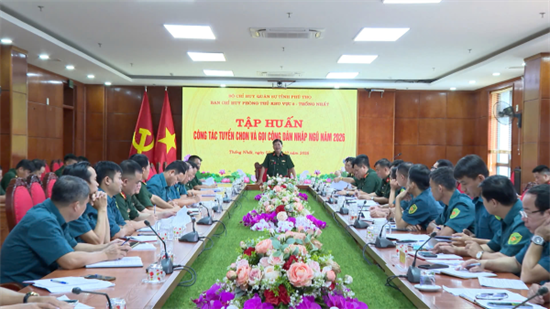 |
| A refresher course on military recruitment work held by the PMC |
To avoid mistakes and create high consensus, the province has required localities to seriously review and select citizens eligible for military service in a democratic, open, transparent manner right from grass-roots level. Commune-level Military Service Councils have worked with agencies, sectors, and unions to comprehensively review each case in terms of political standard, health, educational level, and family circumstance. Selection meetings with the participation of party committees, authorities, Fatherland Fronts, unions, and representatives of the people have been held within hamlets and residential areas. Lists of citizens eligible for exemption or temporary postponement of military service, as well as lists of selected and non-selected citizens, have been publicly posted at commune-level People’s Committee headquarters, on commune-level web portals, and at communal facilities. Doing so has helped promote the people’s right to supervision, promptly detect and handle arising issues, avoid complaints and denunciations, and create high social consensus.
Raising the quality of health examinations for military service in an accurate, scientific, objective, procedural way
Health examination is the stage that directly determines the quality of military recruitment. Therefore, to ensure that “enlisted citizens will meet the standards” and to avoid replacement due to failure to meet health standards, the PMC has coordinated with the Department of Health to advise the Provincial People’s Committee on organising 32 health examination sites at qualified regional medical centres with synchronised equipment and personnel. At the same time, medical staff members with professional qualifications, practical experience, and a strong sense of responsibility have been selected to consolidate Military Service Health Examination Councils at all levels; refresher courses have been organised to standardise examination procedures. In its difficult areas, the province has required the Department of Health to deploy specialist doctors and modern medical equipment from hospitals to conduct specialised examinations.
The health examination process has been carried out in a strict, scientific manner, from preliminary screening at commune level to specialised examinations at the designated sites. The Provincial Military Service Council has assigned its members together with officers of regional defence commands to directly inspect and take responsibility for each locality’s examination results. Cases suspected of eye diseases, cardiovascular problems, and internal diseases have been examined and rechecked several times, with collective conclusions to ensure accuracy and objectivity. The results of health examinations have been posted publicly under regulations to promote the people’s right to supervision. After health examinations, communes, wards, and competent agencies have closely managed the selected youth; military agencies have worked with receiving units to finalise troop numbers; localities have made preparations for the handover and reception of recruits, ensuring solemnity, brevity, and compliance with regulations.
Promoting communication and education to raise public awareness and civic responsibility, and well implementing policies for military families
In practice, a number of young people and families still have incomplete awareness regarding the performance of military service; some even express hesitation or do not fully understand their rights, obligations, and the policies and benefits they are entitled to. Against that backdrop, alongside organisational solutions, the PMC has advised the province to promote communication and education to raise a sense of responsibility among the youth and their families in fulfilling the duty of defending the Fatherland. Communication and education work has been conducted regularly with clear focuses and priorities, in accordance with the characteristics of each locality and target group. Emphasis has been placed on clarifying new points of military recruitment work in 2026, the rights, responsibilities, obligations, and policies of servicemen and their families, as well as the revolutionary tradition of the Ancestral Land.
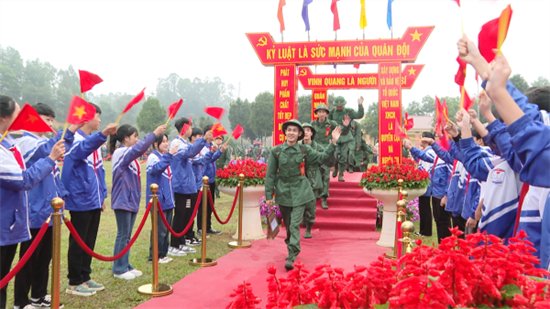 |
| Young citizens of Phu Tho province eager to join the VPA |
Forms of communication have been renewed and made flexible; direct propagation has been combined with communication via mass media, digital platforms, social networks, and systems of posters and slogans. Communication work has also been integrated into meetings of organisations and communities, as well as gatherings, talks, and exchanges with veterans and demobilised soldiers. Communes and wards have been directed to coordinate with political training centres to organise courses on Party awareness and admit outstanding Youth Union members among the youth ready for military service into the Party.
Furthermore, the province has attached special importance to promoting the role of families and grass-roots organisations in grasping the thoughts and aspirations of young people, promptly conducting communication work relating these people’s concerns, thereby creating unity in their awareness and action. In difficult areas with low population density, localities have strengthened mobile communication and promoted the role of reputable persons, village elders, hamlet chiefs, and ethnic minority cadres in persuading young people to enthusiastically join the VPA.
Apart from communication and education, the province has mobilised social resources for military recruitment, promptly encouraging enlisted citizens both spiritually and materially through various activities, such as visits and gift-giving. Local party committees and authorities have been directed to pay attention to families whose members have been enlisted in the VPA and who have been in difficult circumstances. Demobilised soldiers have been provided with vocational counselling and job placement assistance to stabilise their lives. As a result, confidence and reassurance have been created for both families and young people, thus strengthening their motivation and determination to fulfil their military service.
With political resolve and proper, scientific solutions, up to now, Phu Tho province has fulfilled 100% of its 2026 military recruitment targets and has been ready to hand over enlisted personnel to military units. The quality of enlisted citizens has improved considerably; nearly 72% of them have health grades 1 and 2; more than 400 hold university or college degrees; nearly 4.1% are Party members. 100% of the selected citizens have shown their enthusiasm for joining the VPA and their determination to successfully fulfil their military service, thereby contributing to successfully carrying out the task of building and defending the Fatherland in the new era.
Maj. Gen. NGUYEN DINH CUONG
Member of the Provincial Party Committee Standing Board
Standing Vice Chairman of the Provincial Military Service Council
Commander of the PMC
_________________________
1 - The merger of Hoa Binh province, Vinh Phuc province, and former Phu Tho province.