Modernising Artillery and Missile Forces: a vital step in the cause of Fatherland protection in the new era
Today ground-based artillery and missiles remain a critical element of combat forces, providing the primary firepower that often decides the outcome of military operations. Consequently, to meet the demands of defending the Fatherland in a changing world, the development of artillery and missile forces that are rationally organised, heavily armed, precise, and highly mobile is not merely important, it is an urgent priority demanding comprehensive study.
Global military history, particularly recent local wars and conflicts, underscores the critical role of these assets on the modern battlefield. Crucially, for nations where air capabilities are still limited, long-range ground-based missile forces, including surface-to-surface and surface-to-ship systems, serve as a vital strategic deterrent. This reality, combined with the demanding task to strengthen national defence in the new era, has created a pressing, objective requirement to reform and develop the artillery and missile forces of the Vietnam People’s Army (VPA). This modernisation must encompass every aspect: from force structure and weaponry to operational art and the enhancement of overall combat power.
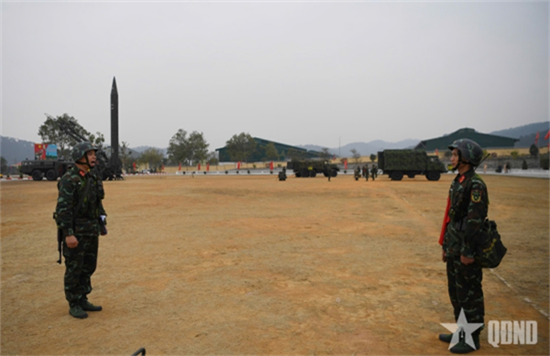 |
| Companies 9 and 10, Battalion 3, Missile Brigade 490 during a training session (photo: qdnd.vn) |
Drawing on the VPA’s own experiences during the wars of national liberation and border defence, alongside an analysis of global development trends and recent conflicts, this article offers a personal perspective that outlines a potential path for building and developing our artillery and missile forces to meet the challenges of the modern age.
1. The Strategic Reserve Artillery and Missile Force
The strategic reserve artillery and missile force constitutes the strategic mobile arm of the Ministry of National Defence (MND), operating under the direct management and command of the Artillery - Missile Command. As the primary component of the nation’s firepower and strategic deterrence, this force must be prioritised for robust development in terms of organisational structure and equipped with increasingly modern, high-combat-power weaponry. Currently, if the strategic reserve relies solely on artillery brigades and surface-to-surface missile units, without the integration of ground-based anti-ship missile (ASM) units, its combat capability, specifically its strategic deterrent value, remains significantly constrained. Consequently, meeting the demands of the new era requires reinforcing existing surface-to-surface missile brigades and establishing new ground-based ASM brigades. Simultaneously, existing reserve artillery brigades must be upgraded into mixed artillery brigades boasting greater range and firepower.
The establishment of powerful, long-range surface-to-surface and ground-based ASM brigades directly under the Artillery - Missile Command represents a critical structural evolution and an urgent necessity. Given Vietnam’s distinct geography - long and narrow, with an extensive coastline and vast maritime territories - these units are essential for extending firepower reach to key targets. They play a pivotal role in anti-access/area denial (A2/AD) operations and countering strategic-level maritime blockades during a (potential) war to defend the Fatherland, thereby establishing the core strategic deterrent of the nation’s overall defence capability. This approach aligns with the global trend of enhancing stand-off defence capabilities. Furthermore, it adheres to Vietnamese military doctrine, which dictates the centralisation of strategic deterrent assets under the unified command of the MND. This ensures firepower is coordinated to execute strategic A2/AD actions, rather than being limited to operational or tactical levels.
In the harsh environment of modern warfare, where adversaries prioritise the detection and destruction of artillery assets, force survival is paramount. Structurally, missile brigades (both surface-to-surface and ground-based ASM) should be composed of multiple battalions, broken down into companies and individual launchers. Depending on the missile type, command should be decentralised to enable independent combat operations at battalion, company, or even launcher levels. This facilitates the dispersion of forces over a wide area, preserving combat strength. Crucially, these units must be accompanied by organic support elements, including air defence, combat engineering, communications, electronic warfare, target acquisition/reconnaissance, fire control, and logistics/technical support.
In parallel, to meet diverse fire support requirements across various combat mission types, strategic reserve artillery brigades must be equipped with a versatile mix of weaponry, including self-propelled guns, multiple launch rocket artillery (MLRS), and towed artillery to ensure operational flexibility. It is imperative that these units possess weapons with longer ranges and greater destructive power than the artillery assets organic to Military Regions, Army Corps, or the Navy.
Should a war to defend the Fatherland occur, distinct theatres of operations may emerge across different regions. Hence, alongside organisational development, force disposition must be adjusted to create a comprehensive strategic defensive artillery-missile posture across all regions, with a focus on key strategic directions. Specifically, each theatre of operations requires the presence of at least one surface-to-surface missile brigade, one long-range ground-based ASM brigade, and one mixed artillery brigade to ensure proactive combat capability. Vital strategic theatres may require a higher density of these forces.
2. Artillery and Missile Forces of Military Regions and Army Corps
Military regions and army corps serve as the backbone of operational-level warfare, executing the operations that form the broader strategic actions of our VPA. Upgrading the artillery and missile capabilities of these formations is therefore critical. To meet the escalating demands of modern combat, these forces must provide rapid fire support across their areas of responsibility. This requires assets with the extended range, pinpoint accuracy, and sheer destructive power necessary to obliterate operational and strategic targets deep behind enemy lines. Consequently, restructuring and expanding the organic artillery and missile units of military regions and army corps is an urgent necessity. This enhanced force structure should encompass surface-to-surface missile brigades, operational artillery brigades, and MLRS battalions. Crucially, surface-to-surface missile brigades must possess sufficient range to neutralise high-value targets deep within the adversary’s operational formation.
Concurrently, infantry and mechanised infantry divisions must be allocated organic tactical artillery regiments. These formations should feature a potent mix of self-propelled guns, towed artillery, MLRS, and anti-tank guided missiles (ATGMs). Recent field trials integrating organic artillery regiments into select infantry divisions have proven highly effective. This model must now be rolled out rapidly across all infantry and mechanised divisions of the VPA. Furthermore, the ongoing conflict between Russia and Ukraine has starkly illuminated the indispensable role of anti-tank missiles within tactical combined-arms units. In the future, steps must be taken to systematically embed ATGM units directly into infantry regiments and battalions.
At the local level, provincial and municipal defensive zones are seeing their operational spaces expand due to the merger of administrative units. The structure of their organic artillery forces must be recalibrated to match this new reality. For geographically large provinces and cities, deploying multiple organic tactical artillery battalions is essential to guarantee sufficient fire support across the entire operational area. Local armed forces, capitalising on their intimate knowledge of the terrain, are uniquely positioned to employ man-portable artillery to harass and engage the enemy effectively - a cornerstone of the “people’s war” strategy. Therefore, at commune level, as well as within broader regional defence units, military planners must look into establishing mobilised reserve platoons and companies equipped with lightweight, man-portable artillery and anti-tank missiles, tailored to local combat scenarios.
3. Naval Artillery and Missile Forces
To fulfil the task of safeguarding the Fatherland’s sacred maritime sovereignty in this new era, we must prioritise the development of the Navy’s ground-based ASM brigades. These formations should be structured around multiple missile battalions, each comprising several batteries equipped with a diverse arsenal of advanced missiles. Boasting superior technical and tactical specifications, these systems must be capable of engaging hostile forces across the full depth of their operational zones, concentrating firepower to neutralise incursions into the Exclusive Economic Zone (EEZ) and decisively repel amphibious landings.
Similarly, naval infantry brigades and regional naval base defence brigades must be augmented with organic operational and tactical artillery battalions. These units require high mobility, rapid combat readiness, and pinpoint accuracy to effectively engage targets at sea and along the littoral zones. For island and archipelago garrisons, artillery platoons and companies must be reinforced and strictly tailored to the specific topographical constraints of the islands and the distinct mission profile of defeating amphibious assaults.
Furthermore, to amplify the combat power of our artillery and missile forces without expanding the organisational footprint, we should transition swiftly to the six-gun artillery battery model - a standard deployment in many advanced militaries. Crucially, this structural shift must be paired with the integration of cutting-edge reconnaissance assets. Equipping units to exploit modern radar, unmanned aerial vehicles (UAVs), satellite intelligence, and aerial photography is essential. Furthermore, embedding strike UAVs (loitering munitions) directly into the organisational structure of artillery and missile brigades and battalions would facilitate coordinated strikes.
Modernising the artillery and missile forces to meet contemporary national defence requirements is an objective reality that will demand immense resources. To that end, a pragmatic road map with appropriate milestones is essential, particularly for the capital-intensive surface-to-surface missile and ground-based ASM contingents. In tandem, we must enhance training programmes to cultivate a corps of officers and technical specialists fluent in modern ground-based missile systems. In addition, elevating the standard of combat training on these advanced platforms is paramount. This proficiency must be validated through rigorous, realistic joint and combined-arms exercises across expansive training ranges. Through these sustained efforts, the comprehensive quality and combat power of our Artillery - Missile troops will be assured to firmly protect the Fatherland in any contingency.
Col. CAN DINH HAI MINH, PhD
Artillery Officer College