Building a powerful reserve force with increasingly high quality, ready for mobilisation upon order, capable of promptly reinforcing standing units, is a strategic policy of our Party and State. It contributes to strengthening national defence potential, building strong, modern all-people national defence, and firmly safeguarding the Fatherland in all situations.
Therefore, Division 350 of Military Region 3 has focused its leadership and direction on resolutely, synchronously adopting numerous measures to accomplish this important task. With the determined involvement of party committees and commands at all levels, as well as the efforts of officers and soldiers, over the years, the Division’s coordination in building, managing, and training the reserve force has seen relatively comprehensive results. Coordination with localities in reviewing and arranging members of the reserve force has been conducted in a close and uniform manner. The innovation and quality of training and exercises have achieved positive results. The Division’s reserve force has been built with sufficient numbers and high political quality and readiness for mobilisation in any circumstances.
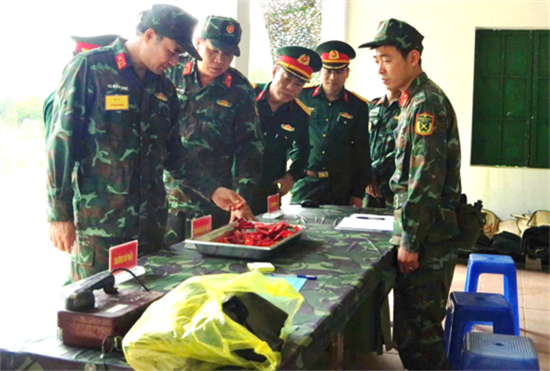 |
| Inspecting a reservist reception station during the reservist mobilisation exercise of 2025 |
To obtain those good results, first of all, the Division’s Party Committee and Command have concentrated on improving the leadership and direction capacity of all-level party committees and commands regarding the building of the reserve force. Based on resolutions, legal documents, and guidance on building the reserve force, the Division’s Party Committee and Command have directed party committees and commands of agencies and units to formulate their specialised resolutions together with action plans and programmes in a scientific, appropriate, highly feasible manner, and resolutely combat complacency, oversimplification, and formalism that could lead to low quality and effectiveness. Besides, the Division has focused on enhancing the leadership capacity and combativeness of all-level party committees and party organisations, adhering to the principle of collective leadership and individual accountability, and renewing the content and forms of Party meetings in accordance with the functions, tasks, and training characteristics of the reserve force. Specific responsibilities have been assigned to each agency and unit, with due attention paid to promoting the role and responsibility of party committees and commands at all levels, especially key cadres and party members, ensuring “clear personnel, clear tasks, clear timelines, clear responsibilities, clear authority, and clear outcomes”, promptly resolving arising difficulties, thereby creating high unity in the process of leadership, direction, and implementation.
Advocating that “words must go hand in hand with deeds”, commands at all levels have stayed close to grass-roots units and troops, firmly grasping situational developments, promptly giving directions to resolve difficulties and obstacles arising in the building and training of the reserve force. Inspection and supervision have been strengthened to draw lessons and ensure the synchronous, uniform, and effective implementation of the content and measures set out in resolutions.
As cadres in the reserve units may easily have wavering attitudes, lack confidence in their work, or show signs of underestimating and lowering their task requirements, the Division has attached importance to conducting political and ideological education and strengthening legal propagation, dissemination, and education for cadres, soldiers, and reservists. As a result, a high level of unity in awareness and action has been created, while a sense of responsibility and discipline, and the spirit of surmounting difficulties to successfully fulfil all assigned tasks among troops have been encouraged.
Due to the recent merger of provinces¹ and the adoption of a two-tier local government model, the management, arrangement, and training of the reserve force initially experienced certain disruptions. Thus, the Division has closely coordinated with local party committees, authorities, and military agencies in managing the reserve force. It has worked with the Military Command of Ninh Binh province to make plans for re-inspecting and training reservists in a scientific, practical fashion, creating favourable conditions for both units and localities in the process of implementation. Based on that re-inspection plan, it has cooperated with localities in proactively summoning reservists and registering technical equipment for mobilisation at the pre-set time and fully, accurately, promptly updating changes in the quantity, quality, and permanent residence of reservists. In addition to grasping quantity, quality, and technical status, technical equipment with their attached documents has been carefully inspected under regulations. Based on the re-inspection, the Division has comprehensively evaluated the quality of reservists and coordinated with localities in discharging those who have not met health or service age requirements, and promptly supplementing new personnel under the Law on the Reserve Force. Along with the re-inspection plan, on a quarterly basis, it has directed its units to regularly, effectively maintain meetings between frame A (permanent) cadres and frame B (reservist) cadres within localities, thereby grasping the actual strength of the reserve force, quickly detecting and resolving new arising issues.
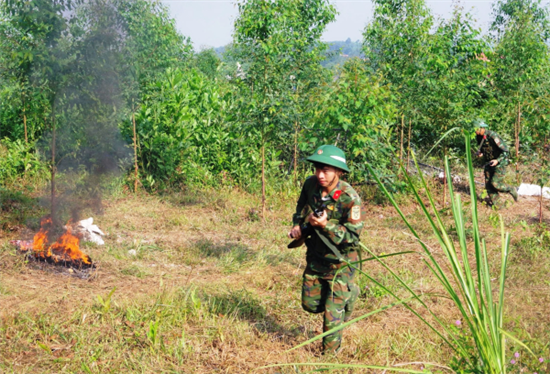 |
| The Division’s reservists during a field exercise in 2025 |
As reservists work in many different fields and scattered locations, there are significant difficulties in the process of training and mobilisation. In order to assemble sufficient personnel on time during training periods, the Division has placed emphasis on working with localities to grasp the training targets assigned by the Military Region, proactively develop training plans, and notify grass-roots units and reservists in advance for the sake of training effectiveness. Information exchange has been regularly maintained to monitor reservists’ ideological developments, family background, and employments, promptly resolve arising problems, and create favourable conditions for reservists to keep their mind on their work and remain ready to perform their duties when ordered. In doing so, in 2025, the set targets of training and re-inspecting the reserve force by the Division have been reached in line with higher echelons’ regulations.
In order to build a reserve force that is truly “sufficient, strong, and ready” to meet operational requirements in the new situation, the Division has attached significance to raising the quality of training and mobilisation readiness in all situations. Due to the fact that reservists come from many different groups, age ranges, educational levels, and uneven military knowledge, the Division has regarded the training of cadres as the key stage to standardise their professional qualifications and organisational and commanding methods to meet the management and training requirements. For frame A personnel, emphasis has been placed on methods of training, exercise, and inspection; for frame B personnel, great value has been attached to military specialities, especially methods of training organisation and management as well as knowledge and experiences in troop management and command. To achieve greater effectiveness in the training process, the Division has concentrated its efforts on resolving training-related weaknesses and requiring superiors and agencies to train their inferiors and units respectively.
Grasping the training mottos of “basics, practicality, solidity” and “basics, practicality, gradual solidity” for frame A and frame B personnel respectively, the Division has held training courses in accordance with plans and procedures. Given the short training period, it has selected training content, conducting training from simple to complex, classifying trainees by groups to guarantee individual proficiency prior to joint training at grass-roots level, improving political steadfastness as well as infantry and combined-arms combat techniques and tactics at platoon and company levels, ensuring that after mobilisation and supplementary training, battalion-level reserve units would be able to engage in combat. Besides, it has actively renewed forms and methods of inspection, contests, and evaluation, ensuring strictness and accuracy, closely following the principle of “two substantive aspects”² in training. As a result, in 2025, the training of reservists within the Division achieved 100% of the assigned targets with over 70% rated good or excellent.
Improving the mobilisation of the reserve force in all situations is an inevitable requirement; therefore, the Division has closely combined training with the maintenance of regulations on mobilisation readiness. Accordingly, in addition to raising the quality of exercises with absolute safety in all aspects, it has proactively worked with the Military Command of Ninh Binh province to make plans for inspecting mobilisation readiness, conduct mobilisation exercises in a strict, scientific manner closely aligned with combat realities, and mobilise forces for handover to standing units. Through this process, it has drawn lessons promptly, supplementing and perfecting mobilisation plans in accordance with realities of localities and units, enhancing the capacity to handle arising situations, especially under the conditions of short assembly time, dispersion of reservists, and high task requirements.
To ensure that reservists would achieve good results in training and exercises, the Division has focused on support work. In recent years, it has mobilised resources to build “bright, green, clean, beautiful” barracks, ensuring good living conditions for troops. In addition, food standards, hygiene, and safety have been fully guaranteed in accordance with regulations, thereby maintaining troops’ health and physical strength, meeting the requirements of high-intensity training and exercises. Along with ensuring “troops’ stable living conditions”, the Division has invested in and consolidated training facilities in a unified, standardised way closely aligned with practical requirements. Due attention has been paid to consolidating and repairing training grounds and fields, promoting initiatives and improvements in training equipment, contributing to raising the quality of training. Weapons and equipment for training and exercises have been provided in sufficient quantity, good quality, and synchronisation.
Furthermore, the Division has taken care of its troops’ cultural and mental life via political education activities, legal propagation and dissemination, and cultural, artistic, and sport programmes, while fully, promptly ensuring policies and entitlements for reservists under regulations. Doing so has enabled reservists to single-mindedly devote themselves to their work and successfully accomplish their assigned missions.
Bringing into play the achieved results and experiences, Division 350 will continue striving to build a powerful reserve force with increasingly high quality to meet the requirements of Fatherland protection in the new situation.
Sr. Col. VU DINH HUNG
Commander of the Division
___________________
1 - Ha Nam, Nam Dinh, and Ninh Binh provinces.
2 - Substantive training, substantive testing and evaluation.