Lang Son Provincial Border Guard realises the “two accelerations” initiative to enhance the quality of national sovereignty and border security protection
Thoroughly grasping General Secretary, State President To Lam’s “two accelerations”1 directive, Lang Son Provincial Border Guard (PBG) has been translating this guidance into synchronised, effective measures, thereby improving the quality of national sovereignty and border security protection.
Lang Son province occupies a particularly strategic position along Vietnam’s Northern border, serving as a gateway connecting Vietnam with China and other countries in the region.
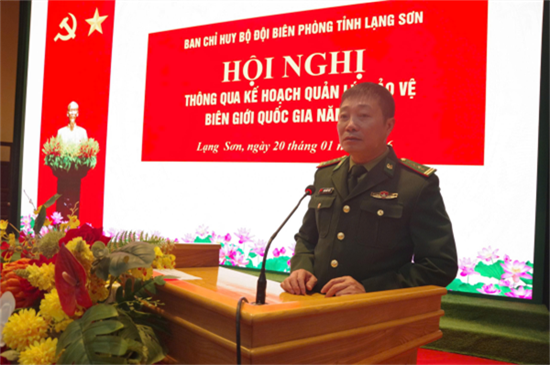 |
| Conference held by the PBG Command to approve the 2026 plan for national border management and protection |
In recent years, political security and social order in the province’s border areas have remained generally stable. Relationship and cooperation between the authorities, competent forces, and people on both sides of the border have continued to be developed. However, the province faces numerous challenges due to its extensive area of responsibility, its rugged, fragmented mountainous terrain, and the difficult living conditions of a section of the border population; meanwhile, the activities of various types of crime, particularly smuggling, drug trafficking, human trafficking, and illegal border crossings, remain complex and have had a significant impact on the management and protection of national sovereignty and border security.
Against that backdrop, the PBG’s Party Committee and Command have performed border defence work comprehensively. In particular, they have grasped and realised the “two accelerations” initiative, regarding this as one of the key measures for building an “exemplarily, typically” comprehensively strong PBG capable of managing and firmly protecting national sovereignty and border security.
First, priority is given to streamlining the organisational structure and strengthening the political foundation of the force as the basis for enhancing its overall quality, combat power, and capacity to manage and protect national sovereignty and border security. In implementing Decision 2722/QĐ-BQP, dated 14 June 2025, issued by the Minister of National Defence on the establishment of the PBG Command under the Lang Son Provincial Military Command, the PBG has proactively developed and executed a specialised resolution and plans to adjust its organisational structure in an “adept, compact, strong” manner, ensuring strict compliance with the prescribed road map and relevance to its particularities. Consideration has been given to reviewing and restructuring the force by reducing personnel at headquarters and reinforcing posts, stations, checkpoints, and key areas. Assessments of officers and technical staff have been carried out comprehensively as the basis for assignment and deployment in accordance with their professional expertise and strengths. At the same time, efforts have been made to build “four-good” party organisations and party cells, enhance the leadership capacity and combativeness of party committees and party organisations, and promote the exemplary role of cadres and party members, particularly key leaders at all levels according to the “seven dares” spirit and the “six clear things” principle.
The PBG has stepped up political and ideological education to raise the awareness and sense of responsibility of officers and soldiers, while proactively preventing “all signs of degradation in political ideology, morality, and lifestyle, as well as self-evolution and self-transformation” within the force. Notably, in recent years, the PBG Command has directed its agencies and units to intensify political activities under the theme “Conscience - Responsibility - Determination - Transformation” and implement Directive 76/CT-BQP, dated 28 April 2026, by the Minister of National Defence on strengthening political education, ideological management, discipline maintenance, and safety assurance across the Vietnam People’s Army. Inspection, supervision, and discipline management have been strengthened, particularly among personnel performing duties at border gates and in key areas. Any misconduct or violations of State law and military discipline have been handled resolutely to uphold the prestige and image of the Border Guard Force among the people.
 |
|
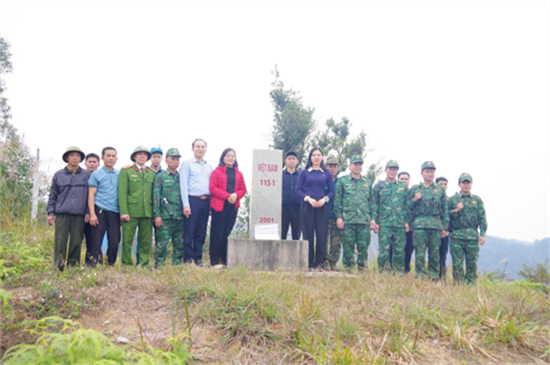
Troops of Thanh Loa Border Guard Post coordinate with other competent forces and locals in patrolling the border
|
The management and protection of national sovereignty and border security is an especially important task that constantly involves many complex challenges. To successfully accomplish this task, the PBG has made breakthroughs in improving the quality of training, refresher courses, and professional development to build a contingent of officers and soldiers who are “politically steadfast, professionally proficient, equipped with scientific working methods and style”, and capable of meeting both immediate and long-term requirements. Emphasis has been placed on training officers and soldiers to fully grasp their duties, master their specialised skills, border and border-gate management and protection plans, and contingency response procedures, improve their coordination capacity and response to complex, unexpected situations. In the process, importance has been attached to renewing and making training methods relevant to operational realities, with practical exercise as the main method, closely integrating training with the sharing of operational experience and professional skills.
In particular, the PBG has regularly organised specialised training courses, especially in immigration control and the identification of new methods and tactics employed by criminal groups. Attention has been paid to enhancing the force’s capacity to collect, assess, analyse, and process information, anticipate situational developments, and provide timely advice on measures to prevent and combat crime early and from afar. To meet the requirements of border-gate and border management in the context of intensive international integration, particularly the effective operation of the “smart border gate” model, the PBG has focused on improving its troops’ information technology competence and digital skills, enabling them to utilise modern technical equipment and specialised management software. Great value has been attached to training personnel to proficiently operate inspection and surveillance equipment, biometric identification systems, and automated control systems, thereby shortening customs clearance duration, facilitating cross-border trade, ensuring the firm management of people and vehicles entering and leaving the country. The application of science, technology, and digital transformation in immigration control, border surveillance, and command and control has also been promoted. These efforts have contributed to gradually building a regular, modern PBG capable of meeting the requirements of firmly protecting national sovereignty and border security under the new circumstances.
To build a border of peace, friendship, stability, cooperation, and development, the PBG has fostered border defence diplomacy to deepen mutual understanding, trust, and cooperation among the authorities, competent agencies, and people of the two countries in preventing and combating crime and promptly resolving issues arising along the border, thus defending the Fatherland early and from afar. In implementing the Party’s lines on international integration and defence diplomacy, together with relevant legal documents on the Vietnam - China land border, the PBG has proactively, effectively maintained coordination mechanisms with its Chinese counterparts. Regular talks, face-to-face meetings at border gates, communication via hotline channels, and the exchange of official letters have been sustained to share information, assess and anticipate situational developments, combat crime, prevent illegal border crossings, and handle emerging incidents. It has effectively maintained joint border patrols, advancing the “Friendly border guard posts and stations, building a peaceful border” Programme, organising legal dissemination activities for border residents and cross-border travellers. In addition, it has actively advised the Provincial Party Committee, the Provincial People’s Committee, and 11 border communes across the province to step up government-to-government and people-to-people diplomacy, maintain twinning activities between border residential clusters and between communes and towns on both sides of the border, and organise cultural and sporting exchanges and visits on the occasion of major national holidays and traditional festivals of the two countries. These activities have made a practical contribution to deepening friendship, trust, mutual understanding, and cooperation between the PBG and China’s border protection forces, cementing solidarity among people living on both sides of the border, and making all-people border defence, the posture of all-people border defence, and border areas increasingly strong.
 |
|
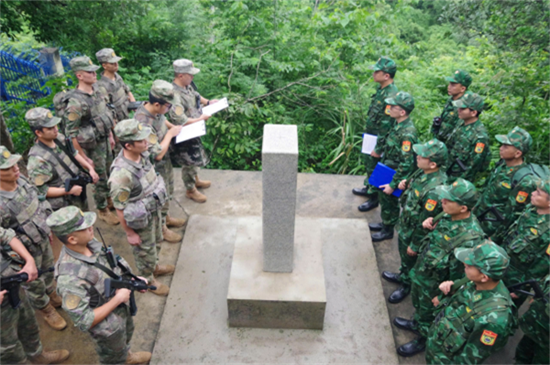
A joint patrol between the PBG and its Chinese counterparts
|
Alongside these measures, the PBG has consistently ensured a high level of combat readiness, intensifying specialised measures to have a firm grasp of situational developments on both sides of the border, the activities of various criminal groups, and issues relating to security and order in border areas, proactively giving advice to the Provincial Party Committee, the Provincial People’s Committee, the Border Guard Force’s Party Committee and Command on the timely handling of emerging situations to maintain the initiative and avoid passivity and surprise under any circumstances. Great weight has been added to giving advice on realising Directive 01/CT-TTg, dated 9 January 2015, by the Prime Minister on organising the movement encouraging the entire population to participate in protecting territorial sovereignty and national border security in the new situation. The role of officers assigned to build political bases and party members from border guard posts joining village party cell meetings and providing support for border households in border areas, has been promoted to consolidate the grass-roots political system. Legal dissemination and education have been intensified, while local people have been encouraged to participate actively in self-management movements to safeguard border lines, border markers, and security and order in their villages. Social welfare activities, health care services, and assistance for local people in economic development and poverty reduction have been expanded through innovative, effective initiatives such as “Vietnamese border bamboo ramparts” and “Lighting up border patrol roads”, thereby improving the material and spiritual life of border residents, building a firm “posture of people’s hearts and minds”, strengthening the posture of all-people border defence in border areas.
Bringing into play its recorded achievements, the PBG will continue to effectively implement the “two accelerations” initiative, further enhance the quality of border defence work, and coordinate closely with local party committees, authorities, and ethnic groups to build strong all-people border defence and firmly protect national sovereignty and border security.
Sr. Col. DAO QUOC THAO
Deputy Commander of the Lang Son Provincial Military Command
Commander of the Lang Son PBG Command
_____________________
1. “Two accelerations”: (1) acceleration of the building of a revolutionary, regular, elite, modern Vietnam People’s Army, (2) acceleration of international integration and defence diplomacy.