Issues on building and multiplying typical examples in implementing Directive 05-CT/TW across the Military today
Building and multiplying typical examples in studying and following Ho Chi Minh's ideology, morality, and lifestyle is a crucial stage, which helps create positive spillover effects throughout the entire Vietnam People’s Army (VPA) and serves as one of the decisive driving forces in building pure, strong Party organisations as well as “exemplarily, typically” comprehensively strong offices and units. However, “the building and replication of typical examples, new models, and creative, effective approaches in some offices and units have yet to be good enough”. Hence, researching and proposing solutions to continue improving the effectiveness of this important work is an urgent issue today.
In recent years, the work of building and multiplying typical examples in studying and following Ho Chi Minh's ideology, morality, and lifestyle has received growing attention from offices and units throughout the VPA and has been organised in diverse, creative forms. Many typical collectives and individuals have become strong driving forces for cadres and soldiers across the VPA to actively improve themselves and strive to successfully accomplish their assigned tasks.
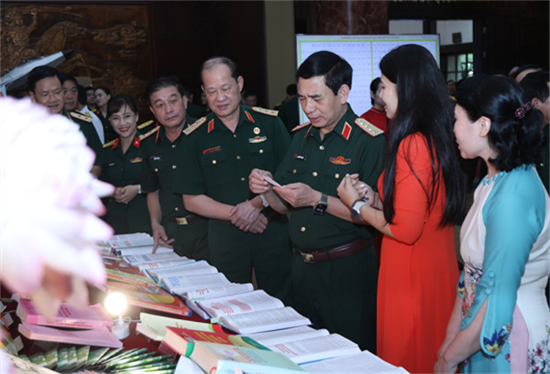 |
| Gen. Phan Van Giang visits exhibition booths of typical units in implementing Directive 05 (photo: mod.gov.vn) |
Alongside the recorded results, this work has several limitations. Awareness among some Party committees and commands towards the building of typical examples has yet to be adequate; merit-driven and quantity-driven disease has still existed in some places. The discovery, selection, cultivation, and replication of typical examples have not been conducted regularly; some offices and units have adopted passive, inconsistent approaches. Criteria for evaluating typical examples have been still general and not closely aligned with the characteristics, requirements, and tasks of each type of unit, leading to difficulties in selection and honouring. The work of disseminating and replicating typical examples in some offices and units has yet to be truly vivid, creative, or persuasive; some models have remained poor in form; the content of dissemination has yet to be really attractive.
In order to keep effectively executing Guidance 2326/HD-CT, dated 3 December 2020, by the General Department of Politics, on building and multiplying typical examples across the VPA for the period of 2021 - 2025, the following solutions can be applied flexibly.
First, strengthening the close, direct leadership and direction of all-level Party committees and commands over the building and replication of typical examples in studying and following Ho Chi Minh's ideology, morality, and lifestyle. It is the foundational solution that decides the effectiveness of this essential work. Thus, all-level Party committees and commands should continue grasping and concretising guidelines and directions by the Party, the Central Military Commission, and the Ministry of National Defence on studying and following Ho Chi Minh's ideology, morality, and lifestyle; they should clearly understand that building and multiplying typical examples constitute a routine task of strategic importance to building pure, strong Party organisations and “exemplarily, typically” comprehensively strong units. All-level Party committees and commands should be in charge of determining criteria for typical examples suitable to the functions and tasks of each unit, while all-level Party committees’ leadership role in detecting, fostering, commending, and replicating typical models and examples should be promoted. Specific responsibilities should be delegated to each organisation and individual; the quality of this work should be seen as one of the criteria for evaluating organisations, cadres, and party members annually; political leadership should be closely combined with professional management to create unity within units.
One of the deciding factors in replicating typical examples is the “example-setting responsibility” of all-level leaderships and commands. To that end, all-level cadres must constantly improve themselves and demonstrate a pioneering role in practising the values of Uncle Ho's ideology, morality, and lifestyle. In their process of leadership and direction, there should be specific plans, objectives, tasks, and solutions for fostering and multiplying typical examples suitable to the particularities of each unit. All-level commands must regularly conduct inspection and evaluation to opportunely detect and foster typical individuals and collectives; they should also actively organise propagation work and experience sharing activities to replicate typical examples.
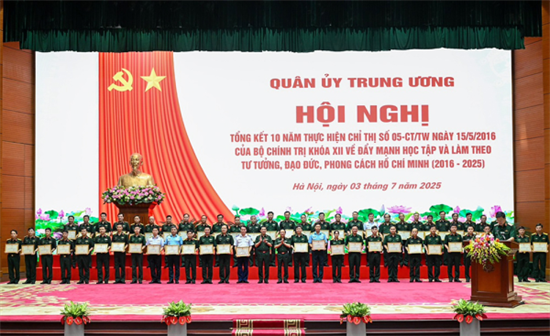 |
| Gen. Phan Van Giang gives certificates of merit to typical collectives and individuals in the study and following of Ho Chi Minh’s ideology, morality, and lifestyle for the period of 2016 - 2025 (photo: mod.gov.vn) |
Second, renewing the content and forms of detecting and multiplying typical examples. This is an important task aimed at spreading humanistic values, revolutionary spirit, and creativity in each office and unit. Regarding content, it is essential to focus on core values, such as a sense of responsibility, integrity, and dedication to the collective. Forms of detecting typical examples should be diverse, from leadership and direction to the building of pure, strong Party organisations and “exemplarily, typically” comprehensively strong, units. Typical examples should be detected through competitions, training, and daily tasks, instead of focusing only on major achievements. To replicate typical examples, offices and units should flexibly apply various creative, appropriate forms of propagation.
First of all, it is necessary to renew the content and form of propagation towards closeness, ease of understanding, and strong diffusion. Emphasis should be placed on highlighting core values and specific meaningful deeds of typical examples, rather than just achievements. Replication of typical examples should be integrated into units’ study programs and daily activities; digital technology and social networks should be applied to disseminate typical examples vividly, attractively; there should be open exchanges and forums for typical examples to share their experiences, instead of just one-way reporting. Besides, all-level political agencies should develop a “bank” of easy-to-understand, accessible documents through political education lectures and law dissemination to convey noble images and typical examples. Doing so will help spread noble images in terms of political quality, work capacity, self-study, and self-improvement, as well as practical, meaningful deeds of typical examples. In addition, typical examples should be propagated and multiplied via a combination of traditional forms (commendation, conferences, wall newspapers, columns) and modern ones (video clips, images, and short documentaries on applications and social networks, such as Zalo, QiMe, Facebook, YouTube, TikTok) to convey beautiful stories, turn typical examples into “inspirers”, and extensively, practically foster the movement of studying and following Uncle Ho’s ideology, morality, and lifestyle.
Third, closely linking the “Determined to Win” Emulation Movement and campaigns with the building of typical examples in studying and following Ho Chi Minh's ideology, morality, and lifestyle. Reality shows that emulation movements and campaigns easily become formalistic if not linked to the detection and development of typical examples. Thus, units should consider the study and following of Ho Chi Minh's ideology, morality, and lifestyle as well as the performance of political tasks as a yardstick for evaluating collectives and individuals, while setting the goal of detecting and nurturing individuals and collectives with brilliant achievements, creating opportunities for them to promote their capabilities and improve their task performance. Offices and units should be fully aware that a typical example must create strong positive effects to arouse the spirit of emulation within the collective. Typical examples should be detected promptly through activities, such as training, education, combat readiness, production, discipline management, and cultural, artistic, and sport movements. The process of replication should be combined with propagation work, emulation movements, and the honouring of typical examples to create a wide effect within units and the entire VPA. Furthermore, fairness and transparency in commendation must be ensured to maintain the trust and motivation of cadres and soldiers. This linkage requires close coordination between organisations and unions to create an environment that encourages creativity and learning. Typical examples will become “seeds” that promote the sustainable development of emulation movements.
Fourth, conducting preliminary and final reviews, opportunely commending the task of building and replicating typical examples. Party committees and commands at all levels across the VPA should attach importance to carrying out preliminary and final reviews to draw lessons as the basis for adjusting directions effectively. Preliminary and final reviews must be conducted seriously, objectively, with a focus on highlighting achievements, pointing out weaknesses, and proposing plans to overcome those weaknesses. Through preliminary and final reviews, it is vital to opportunely honour and commend typical collectives and individuals. In the process, it is essential to ensure accuracy, fairness, and transparency, and avoid formalism, bias, and priority over short-term results. Besides, preliminary and final reviews should be carried out on the basis of practical verification to ensure objectivity and comprehensiveness and deal with one-sided assessment. Once exemplary cadres and soldiers are recognised with both titles and development opportunities, they will devote more efforts to spreading positive values in their units; hence, all-level Party committees should use the results of commendation work as the basis for personnel planning and utilisation, with a view to creating long-term motivation for typical examples to continue improving and dedicating themselves.
Building and replicating typical examples in studying and following Ho Chi Minh's ideology, morality, and style represent a practical, important task. This article proposes several solutions to help Party committees and commands at all levels further improve the quality and effectiveness of this work, thereby contributing to transforming ideological values into revolutionary actions among every cadre and soldier across the entire VPA, creating great internal strength for the building of a revolutionary, regular, elite, modern VPA, forever worthy of an absolutely loyal, reliable political and fighting force of the Party, State, and people.
Sr. Col. NGUYEN VAN THANG, PhD