Hanoi Pedagogical University 2’s Centre for Defence and Security Education steps up the implementation of its “three breakthroughs”
In response to the requirements of renewing education and training and developing a comprehensively qualified workforce for the cause of Fatherland construction and protection in the new situation, the Centre for Defence and Security Education of Hanoi Pedagogical University 2 has been stepping up the implementation of its “three breakthroughs”, bringing about significant changes in the quality of defence and security education for students.
Over the past years, the Centre for Defence and Security Education of Hanoi Pedagogical University 2 has continuously developed in all aspects: its contingent of cadres and lecturers has been regularly consolidated and standardised; scientific research has been promoted; its infrastructure, lecture halls, and training grounds have been gradually upgraded in a synchronous and modern manner, thereby affirming its position and prestige within the system of defence and security education centres nationwide.
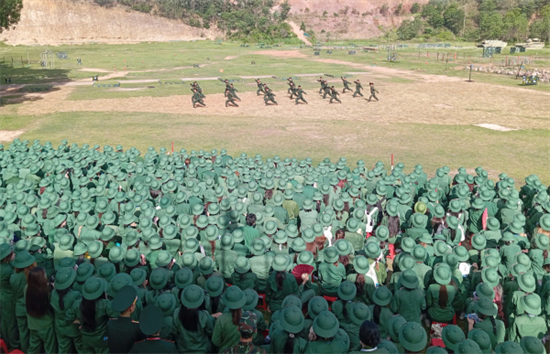 |
| Field trip to a military unit |
Since 2021, the Centre has provided defence and security education and issued certificates to more than 100,000 students from 16 universities and colleges, while training nearly 300 full-time students on the four-year Defence and Security Education programme, contributing to supplementing the pool of teachers of defence and security education for educational institutions. At present, the Centre’s training tasks and scale have seen new developments, with more demanding requirements. Meanwhile, the corps of lecturers remains insufficient compared with its task requirements; young lecturers have limited practical experience; although attention has been paid to investment in infrastructure and training grounds, certain aspects have yet to keep pace with the development of the Centre’s tasks.
Against that backdrop, in order to fulfil its tasks, the Centre has focused on comprehensively assessing the current situation and clearly identifying its advantages and difficulties. On that basis, it has developed the Project on Developing the Centre for Defence and Security Education of Hanoi Pedagogical University 2 to 2030, with a vision towards 2045, with a specific road map and goals; at the same time, it has introduced numerous synchronous measures, with a focus on the “three breakthroughs” to create a foundation for its sustainable development.
Building a contingent of lecturers who are professionally competent, dedicated, creative, and supported by solid succession
Teachers play a decisive role in the quality of education at educational institutions. For the Centre, due to the special characteristics of the subject, the contingent of lecturers is subject to even higher requirements. This is because they are not only responsible for imparting military knowledge and skills and fostering students’ revolutionary ideal, patriotism, and sense of responsibility, but also serve as direct role models for the “future teachers of defence and security education”. Hence, the Centre has attached importance to building and developing a pool of lecturers that is sufficient in number, appropriate in structure, comprehensive in quality, politically steadfast, professionally competent, dedicated to their profession, dynamic, and creative, together with solid succession among generations.
To that end, the Centre has proactively advised the University’s Party Committee and Board of Management on formulating a road map for human resource recruitment and development in a stable, long-term manner. Priority has been given to recruiting students majoring in defence and security education who graduate with good or excellent results, thereby creating a pool of successor lecturers. At the same time, great importance has been attached to recruiting retired military cadres and those who have transferred to other sectors, provided that they have received formal training, possess practical experience, good health, and the capacity to apply information technology, and fully meet the prescribed criteria. For key leadership and management positions, the Centre has proactively developed a pool of personnel and selected seconded officers from military units, making use of their strengths in organisational and command capabilities and training experience, thereby gradually consolidating the contingent in sufficient numbers and with an appropriate structure to meet both immediate and long-term requirements.
Furthermore, the Centre has continued to implement the Project on training and developing the contingent of lecturers for the 2026 - 2030 period, with a focus on comprehensively and intensively improving their quality and enabling them to rapidly adapt to the requirements of education and training reform. Accordingly, alongside selecting and sending cadres and lecturers for postgraduate training, the Centre has strengthened training in professional expertise, pedagogical skills, digital transformation, the application of artificial intelligence (AI), and modern educational methods. It has maintained competitions, class observations, and experience-sharing sessions, encouraging scientific research, the compilation of textbooks, and the improvement of training models and teaching aids, continuously enhancing the professional competence and innovative capacity of the pool of lecturers. Notably, to ensure consistent and solid quality, it has promoted the role of seconded officers and experienced lecturers in imparting knowledge, methods, and working practices to young lecturers and intensified the organisation of research visits and field trips to military units. As a result, a pool of successor lecturers with strong political qualities, professional competence, pedagogical skills, and practical experience has been gradually developed.
At the same time, the Centre has attached great value to fostering and training lecturers in ethics, lifestyle, and working methods, building a contingent of dedicated and responsible lecturers who truly inspire and accompany students throughout their learning and training. It has also actively advised on the development of appropriate mechanisms and policies to enable cadres and lecturers to keep their mind on their work and dedicate themselves wholeheartedly to the development of the Centre and the University.
Comprehensively renewing teaching and learning forms and methods
This is a breakthrough that directly creates changes in the quality of defence and security education. Given its distinctive role in both providing education for university and college students and training future teachers and lecturers of defence and security education, the Centre has identified the need to make a breakthrough in innovation on the following orientations: in-depth content, diverse forms and methods, modern teaching facilities, and high quality and effectiveness of education, turning the training process into a process of self-training and self-improvement of students.
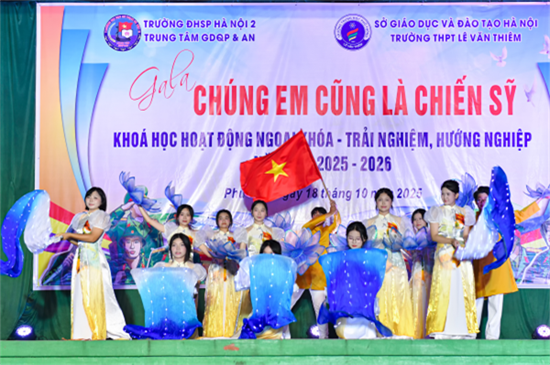 |
| Extracurricular activities for students |
Accordingly, the Centre has reviewed and updated its training programmes’ content in a practical and modern direction, linking theory with practice, focusing on studying and supplementing new issues concerning defence and security policies, the tasks of building and protecting the Fatherland, traditional and non-traditional security issues, and the requirements set for the younger generation. It has strengthened extracurricular and research activities at the Vietnam Military History Museum, historical sites, and military units, allowing students to directly observe and experience reality, relate theoretical knowledge to practice, and enhance their awareness of and responsibility for the task of building and protecting the Fatherland.
In particular, for students majoring in Defence and Security Education, the Centre has strictly adhered to the motto “firm knowledge - proficient skills - professional conduct”. It has closely combined the provision of military knowledge and pedagogical expertise with training in military regulations, infantry combat techniques, tactics, and shooting. It has focused on developing teaching methods, management and command skills, working practices, and the capacity to organise extracurricular activities. As a result, it has gradually improved students’ political zeal, professional conduct, and practical competence to meet their task requirements after graduation.
In terms of methods, the Centre has made a strong shift from knowledge transmission to providing guidance and promoting learners’ active participation. It has stepped up the implementation of the “flipped classroom” model in conjunction with the application of AI; lecturers have intensified the use of information technology, AI, images, materials, and practical examples to turn lessons into video content, while students have proactively studied materials in advance and prepared and presented content by topic. In the teaching and learning process, lecturers have played the role of providing guidance, raising questions, and drawing conclusions, while students have proactively presented, discussed, and supplemented content. Doing so has helped develop students’ capacity for self-learning, critical thinking, teamwork, and problem solving. Besides, consideration has been given to building a regular and disciplined learning and training environment; innovation in testing and assessment has been promoted towards more substantive, objective, comprehensive evaluation, with importance being attached to knowledge, skills, professional conduct, and the ability to apply knowledge. For students majoring in Defence and Security Education, particular attention has been paid to assessing their practical military skills, management and command capabilities, and teaching methodology. This has helped ensure an accurate assessment of learners’ quality, address the “achievement-orientated disease”, create a competitive environment, strengthen solidarity, and increase students’ interest in learning and training.
Modernising infrastructure and promoting digital transformation
While the contingent of lecturers is the decisive factor and teaching methods are the direct driving force, infrastructure is an important foundation for the quality of defence and security education. Therefore, the Centre has proactively coordinated with competent agencies in advising on the completion of a master plan and clearly determining a road map and resources for investment. Emphasis has been placed on constructing and upgrading lecture halls, operations rooms, dormitories, dining halls, training grounds, and supporting facilities, acquiring training models and teaching aids to allow students to study and train in a regular environment closely aligned with practical requirements.
Great weight has been added to stepping up the development of digital infrastructure, gradually forming a “digital defence and security education centre”, completing digital systems for managing training, students, infrastructure, weapons, and equipment, developing shared databases, an electronic library, a digital learning resource repository, and platforms serving teaching, testing, and assessment. The Centre has gradually connected and shared data among its departments, standardised its management procedures, and enhanced its monitoring and supervision capabilities. Significance has been attached to improving the efficiency of managing and using infrastructure, effectively carrying out maintenance and repair, promptly addressing damage and deterioration, clearly defining the responsibilities of each agency, unit, and individual for managing and using public assets. These efforts have enabled the Centre’s infrastructure to meet its immediate requirements and created a foundation for the Centre’s stable and sustainable development in the years ahead.
With high political resolve, creative approaches, and an appropriate road map, the Centre for Defence and Security Education of Hanoi Pedagogical University 2 will successfully achieve its development objectives to 2030, with a vision towards 2045, and become one of the country’s outstanding defence and security education centres, thereby contributing to training generations of students with firm political qualities, comprehensive defence and security knowledge, and a high sense of responsibility for the cause of building and protecting the Fatherland.
Sr. Col. PHAN XUAN DUNG, PhD
Deputy Director of the Centre