The August Revolution of 1945: aspiration for national independence and indisputable historical values
The victory of the August Revolution of 1945 marked the fulfilment of the Vietnamese nation’s aspiration for independence. It was an inevitable outcome, rooted in the strength of the great national unity bloc under the sound leadership of the Communist Party of Vietnam. This historical truth has become an enduring political and cultural value in the course of the nation’s history, which no hostile force can distort.
Every year, as our entire Party, people, and Military celebrate the victory of the August Revolution and Independence Day on 2 September, hostile forces intensify their sabotage activities in an attempt to distort and falsify the truth about this Revolution.
Hostile forces deliberately distort history by claiming that the victory of the August Revolution of 1945 was merely a stroke of luck for the Viet Minh, and that the Viet Minh possessed neither strength nor capability to achieve such a victory, but simply sat back and waited for the fruits of victory to fall into hands. They further allege that the victory did not embody the aspiration for national independence, but was merely an act of “seizing the fruits of others’ efforts” or a “coup” against the Tran Trong Kim Government (the cabinet of the feudal regime). They argue that, because Japanese fascists had already “returned independence” to Vietnam on 11 March 1945, Vietnam’s Independence Day should be commemorated on 11 March rather than 2 September.
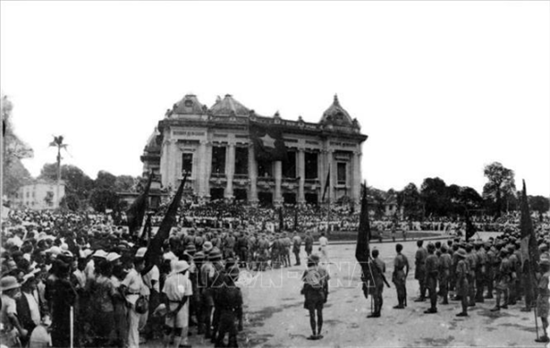 |
| The August Revolution of 1945 opened up a new era for the Vietnamese people (photo: VNA) |
Such allegations are, in essence, a brazen attempt to deny all the immortal values of the August Revolution of 1945 and the legitimacy of the revolutionary government of the Democratic Republic of Vietnam.
History has demonstrated that the victory of the August Revolution of 1945 was of epochal significance, embodying the Vietnamese nation’s aspiration for independence and affirming enduring values for the country’s development. The victory not only gave birth to a revolutionary government of the people, by the people, and for the people, transforming the Vietnamese people from slaves into citizens of an independent and free country, but also exerted a profound influence on the international communist and workers’ movements and national liberation movements worldwide. It opened up a new era for the Vietnamese nation - the era of national independence and socialism. Vietnam joined the ranks of the world’s vanguard nations in the struggle for peace, national independence, democracy, and social progress; our Party became a ruling Party, rightfully serving as the vanguard political organisation of a vanguard nation in the 20th century.
For more than 80 years, the Vietnamese people have upheld and promoted the values of the August Revolution of 1945, waging a steadfast and resilient struggle for decolonisation and the eradication of colonialism in all its forms and achieving victories that “resounded throughout the five continents and shook the globe” in the resistance wars against French colonialists and US imperialists (1945 - 1975). They have pursued the Doi Moi (Renewal) process since 1986 and are now entering a new era of development - the era of national rise - for peace, independence, democracy, prosperity, civilisation, and happiness, steadily advancing towards socialism and standing on an equal footing with the great powers across the five continents. With this victory, “for the first time in the history of revolutions of colonial and semi-colonial nations, a Party that was only 15 years old successfully led a revolution and seized power nationwide”.
That was a source of pride not only for “our working class and people”, but also for “the working class and oppressed nations”, as pointed out by President Ho Chi Minh. Over the more than 80 years that followed, this pride has continued to grow stronger as Vietnam has actively contributed to globalisation and international integration and striven for peace, friendship, cooperation, development, and progress of humankind. As an independent and sovereign nation - the fruit of the August Revolution of 1945 - Vietnam has gained “the fortune, strength, and international standing and prestige it enjoys today”. Vietnam is now an active and responsible member of international organisations, pursuing a development path of independence, self-reliance, and self-resilience, harnessing its internal resources while leveraging international cooperation for bilateral and multilateral interests in the region and the world.
The August Revolution of 1945 stands as a milestone in the history of the Vietnamese nation under the courageous and clear-sighted leadership of the Party, headed by President Ho Chi Minh. The Vietnamese people’s burning aspiration for national independence, forged throughout their millennia-old history, was magnificently realised in the August Revolution of 1945. That victory has since become an enduring source of inspiration for the country’s continued development in pursuit of those values, especially whenever the fundamental national rights of independence, sovereignty, unity, and territorial integrity are challenged.
The values of the August Revolution of 1945 are an undeniable historical fact. Was the success of the August Revolution of 1945 merely a matter of luck? The answer is unequivocally no. It was a victory achieved through the internal strength of our entire Party and people, not something they simply sat back and reaped without effort. The Party and our people turned the revolutionary opportunity into internal strength rather than relying on chance or external forces. If the Revolution had truly been a matter of luck, why, among all Southeast Asian countries at that time, were only Vietnam, Laos, and Indonesia able to win independence and break free from colonial rule? Moreover, while numerous political forces existed in Vietnam at that time, why was the Viet Minh the only one to secure victory? History itself has answered these questions. When the opportunity presented itself, it was the internal factors - the Party’s clear-sighted leadership and the strength of the great national unity bloc - that enabled the Revolution to triumph through the Vietnamese people’s own efforts to “use our own strength to liberate ourselves”.
During the August Revolution of 1945, our Party took three essential steps in order to create favourable conditions, seize the right opportunity, and harness the strength of the great national unity bloc to secure victory. First, when the Second World War broke out, the Party promptly shifted its strategic direction, temporarily shelving the slogan of agrarian revolution and placing national liberation above all else. This was consistent with the circumstances and aspirations of all social strata, whose overriding concern was to resolve the fundamental contradiction between the entire Vietnamese people and the imperialist - colonialist forces and their lackeys. Second, the Party built up a great national unity bloc, enabling the whole nation to rise as one to seize power. The Viet Minh Front, established in May 1941 and strengthened throughout the years of struggle for independence leading up to the General Uprising, was the inevitable outcome of the Party’s far-sighted vision under the leadership of President Ho Chi Minh. The Party also prepared the material strength for the August Revolution by developing revolutionary armed forces, notably through the establishment of the Vietnam Propaganda Liberation Army Team, the first main-force unit of the Vietnamese revolution, and combining armed forces with political forces to create the revolutionary force needed for victory. Third, the Party seized the favourable opportunity to launch the General Uprising when fascism had been defeated by the Allies, and Japanese fascists in Vietnam were in a state of confusion and disarray. At the same time, Vietnam’s feudal class was in severe crisis, while the overwhelming majority of the Vietnamese people rallied behind the Viet Minh rather than the pro-Japanese government headed by Prime Minister Tran Trong Kim. The General Uprising therefore broke out at the right moment. Yet without sufficient revolutionary strength, success would have been impossible. As President Ho Chi Minh pointed out: “Because the Party’s policy was correct and was implemented in a timely and flexible manner, the August General Uprising succeeded”.
History has proven that when a revolution is led by a vanguard force with steadfast political resolve and clear-sighted wisdom, and enjoys the wholehearted support of the entire nation, it will triumph. The August Revolution of 1945 involved no element of luck whatsoever, but rather was the product of years of intense struggle, during which the entire Vietnamese nation built up its strength, created favourable conditions, and rose to break free from slavery, instead of waiting for other nations to bestow independence and freedom upon it.
The General Uprising took place over a relatively short period and involved comparatively little bloodshed, but that by no means made victory easy. Its success was forged through the blood and sacrifice of communist fighters and patriotic Vietnamese people in successive revolutionary movements. These movements passed the courage and heroic spirit on to the August Revolution of 1945. Hostile forces may persist in their schemes to distort this historical truth, but truth remains truth. The Vietnamese people will always remember this truth, and no force can sway them.
Hostile forces often claim that Vietnam gained independence because Japan granted Vietnam independence. That is entirely false. The aspiration for national independence embodied in the August Revolution of 1945 refutes this distortion. The historical fact is that, after overthrowing the French colonial government on the night of 9 March 1945, Japanese fascists imposed direct rule over Indochina and, on 11 March 1945, proclaimed the “return” of independence to Bao Dai’s feudal government, subsequently helping to establish the cabinet headed by Tran Trong Kim. It must be stated unequivocally that this was merely sham independence. There could be no genuine independence as long as Japanese fascist troops maintained their presence throughout Vietnam, with Bao Dai’s feudal government and the Tran Trong Kim cabinet remaining under Japanese fascist control. At that time, the Vietnamese people rallied behind the Viet Minh, in reality acting under the Party’s leadership, rising up to break the grip of foreign occupation and overthrow the feudal regime.
President Ho Chi Minh affirmed in the Declaration of Independence: “The French have fled, the Japanese have capitulated, Emperor Bao Dai has abdicated. Our people have broken the chains which for nearly a century have fettered them and have won independence for the Fatherland. Our people at the same time have overthrown the monarchic regime that has reigned supreme for dozens of centuries”. Therefore, the absurd allegations of hostile forces may deceive a few credulous individuals, but they can never distort historical truth, turn black into white, substitute one concept for another, or diminish the Vietnamese people’s aspiration for national independence. Historical truth remains unchanged. Those who distort it ultimately reveal themselves as duplicitous elements, sham patriots, and pseudo-democrats.
The aspiration for independence has become part and parcel of the political and cultural heritage of the Vietnamese nation. The Vietnamese people’s struggle under the Party’s leadership realised that aspiration. Their great revolutionary cause has been put to the test by the many twists and turns of history, with the victory of the August Revolution of 1945 marking one of the most significant milestones. Its values are timeless, and no force can distort or deny them.
Prof. MACH QUANG THANG, PhD