Amid intensifying strategic competition among major powers, the United States’ policy shift towards renewed emphasis on the Western Hemisphere, coupled with the growing influence of other major powers, has been reshaping Latin America. How these developments affect regional relations, strategic interests, the security environment and stability across this resource-endowed region has become a matter of international concern.
Latin America’s geostrategic position and the new regional context
Situated in the Western Hemisphere, linking the Atlantic and Pacific Oceans, and connected to the Caribbean region and the strategic maritime route through the Panama Canal, Latin America occupies a particularly pivotal position in the world’s geopolitical and economic landscape. The region possesses abundant natural resources, including oil and gas, copper, lithium and other minerals, alongside considerable potential in agriculture, energy and consumer markets. As global supply chains are being restructured, these resources have strategic significance for energy security, high-tech development and the strengthening of national strategic autonomy.
According to expert analyses, one notable feature of Latin American politics over the past decade has been the shifting balance between left-wing and right-wing forces. Between 2018 and 2022, the world witnessed a “pink tide”, as left-wing forces successively won elections in Mexico, Argentina, Bolivia, Chile, Brazil and Colombia. However, since 2023, the region’s political trajectory has shifted, with right-wing forces coming to power in 15 of the region’s 33 countries, while left-wing forces currently govern 11. Notably, Brazil and Mexico, two of the region’s largest countries, remain under left-wing governments. These developments demonstrate that Latin American politics is evolving along multiple trajectories, against a backdrop of mounting socio-economic pressures that regional governments must address, ranging from economic growth, employment and inequality to organised crime, drug trafficking and migration. Meanwhile, differences in development conditions, national interests and policy priorities have led individual countries to adopt distinct approaches to these challenges. In foreign affairs, the trend towards diversifying international relations has become increasingly pronounced. Alongside maintaining relations with the United States, Latin American countries have been seeking to expand cooperation with a range of partners, including major powers, to attract investment, broaden market access, acquire technology and mobilise resources for development. As a result, the region’s external relations have become increasingly interconnected and complex, making it difficult to reduce them to a single axis of influence. This, in turn, has created greater scope for major powers to expand their presence and compete for strategic interests in the region.
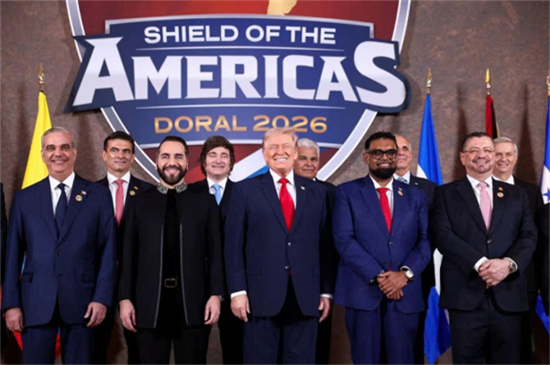 |
| President Trump and leaders of Latin America announce the establishment of an alliance against drug cartels. (Photo: vov.vn) |
Major powers expand their presence and compete for influence
According to researchers, China is gradually developing its economic relations with Latin American countries into an increasingly extensive network of interconnected ties spanning trade, investment, infrastructure, logistics, energy and technology. A notable milestone was Chinese President Xi Jinping’s attendance at the inauguration of the deep-water port of Chancay in Peru in November 2024. Invested in and operated by China’s COSCO Shipping Corporation, the port has established a direct maritime link between South America’s Pacific coast and Asia, opening up new cross-regional logistics corridors. Cooperation between China and the Community of Latin American and Caribbean States (CELAC) has also continued to advance. At the Fourth China–CELAC Ministerial Forum in May 2025, Chinese President Xi Jinping announced a credit facility of approximately US$9.2 billion to support development in the region and promote cooperation in trade, investment, technology and emerging sectors. Experts note that the significance of China’s expanding influence lies not merely in the scale of individual projects or investments, but also in its gradual integration of trade with infrastructure, logistics, technology and supply chains. This creates enduring interdependencies and strengthens Beijing’s position in the region.
Alongside China, Russia and the European Union (EU) have pursued their own approaches. Russia continues to maintain relations with traditional partners, focusing on energy, military-technical cooperation and diplomacy to preserve its influence in the region. Meanwhile, the EU has expanded its relations with Latin American countries by drawing on its strengths in trade, investment, technology and institutional cooperation. At the Fourth CELAC–EU Summit in Colombia in November 2025, the two sides pledged to promote cooperation in the energy transition, digital transformation, the environment, infrastructure and security. Notably, on 17 January 2026, the EU and the member states of the Southern Common Market (Mercosur) formally signed the EU–Mercosur Partnership Agreement (EMPA) and the Interim Trade Agreement (iTA), aimed at expanding economic integration in trade, investment, supply chains and sustainable development. These initiatives have enabled the EU to pursue a distinct approach in Latin America while expanding its presence and influence through economic ties and long-term cooperation frameworks.
Against this backdrop, the second administration of US President Donald Trump has introduced far-reaching policy adjustments towards the region. The National Security Strategy (NSS), released in 2025, set out the Trump Corollary to the Monroe Doctrine, known as the Donroe Doctrine, declaring the restoration of US pre-eminence in the Western Hemisphere and the exclusion of external powers from the region. The Department of War subsequently translated this strategic orientation into its National Defence Strategy, identifying the restoration of US military dominance in the Western Hemisphere as its top priority, ahead of the Indo-Pacific. At the Shield of the Americas summit on 7 March 2026, attended by 12 regional heads of state and government, most of whom represented right-wing governments aligned with Trump, the US President reaffirmed the exceptional importance of the Western Hemisphere to the United States, describing it as his country’s “own backyard”.
Alongside these declarations, the United States is strengthening its presence in the region through economic and diplomatic instruments, anti-drug cooperation and even military means. Politically and diplomatically, Washington is applying maximum pressure on, isolating or intensifying pressure against radical left-wing governments, while openly supporting right-wing administrations in an effort to fragment and weaken the region’s left-wing forces.
In the military and security domains, the United States has increased its presence in the Caribbean waters bordering Venezuela and Colombia, citing the need to combat drug trafficking, crime and irregular migration. It has also intervened militarily in Venezuela and detained President Nicolás Maduro. In addition, Washington has promoted the establishment of an Americas Counter-Cartel Coalition, involving 17 countries, with a primary focus on deploying military forces to combat drug trafficking and transnational crime across the region. Economically, Washington is combining tariffs, market access and investment with demands concerning border security, migration, counter-narcotics efforts and supply chain security. The United States is also focusing on strategically valuable locations and resources, including the Panama Canal and oil and gas reserves. Recently, the Trump administration reached an agreement with Caracas to develop 17 oil and gas fields with estimated reserves of approximately 65 billion barrels, enabling US companies to re-enter the region’s energy sector. By combining political, security, military and economic instruments, Washington is expanding its influence across the Western Hemisphere, reshaping the presence and interests of major powers in Latin America.
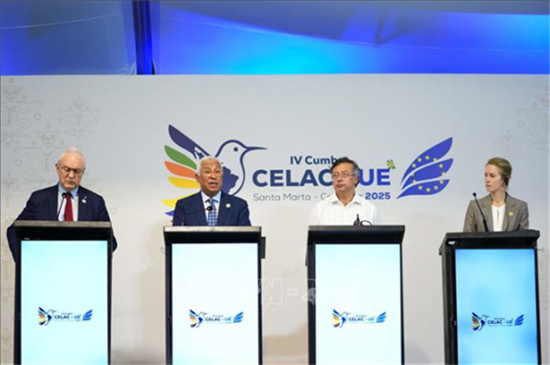 |
| The CELAC - EU Summit in 2025 (Photo: nhandan.com.vn) |
Implications for the region
According to international affairs experts, US policy adjustments have consolidated Washington’s influence in Latin America, prompting several regional governments to shift towards more pro-US policies or align themselves more closely with the United States on issues such as security and the economy. Even some left-wing governments have adopted a more cautious approach to relations with China and Russia to avoid direct confrontation with Washington. In Argentina, President Javier Milei has maintained close relations with Washington. In Colombia, Abelardo de la Espriella, a right-wing lawyer who has openly expressed support for President Trump, has pledged to restore close security and economic ties with the United States following four years of tension under President Gustavo Petro. This trend is also evident in several other countries, where pragmatic governments are prioritising cooperation with Washington to attract investment, secure financial assistance and gain access to the US market.
Latin American countries continue to maintain relations with China and Russia, albeit within certain limits to avoid jeopardising their ties with the United States. This reflects a proactive response to changes in the strategic environment, helping to preserve a balance in their foreign relations. However, experts also observe that the strategic adjustments made by major powers are drawing Latin American countries into an intensifying spiral of competition, making the regional landscape increasingly unpredictable. As competition among major powers for influence in Latin America extends into such areas as seaports, transport routes, energy, strategic minerals, digital infrastructure and supply chains, regional countries face difficult decisions regarding their choice of partners, investment sectors, technologies and approaches to security in order to mitigate external pressures. Developments in Panama, Mexico, Chile and several South American countries demonstrate that great-power competition is directly influencing national development choices, blurring the distinction between economic cooperation and strategic rivalry. Meanwhile, non-traditional security challenges, including drug trafficking and transportation, human trafficking, irregular migration, transnational crime and the activities of cartels, have exceeded the capacity of many countries to address them effectively. To tackle these problems, Latin American countries are compelled to expand cooperation with major powers, thereby creating opportunities for the latter to become more deeply involved in regional security affairs. Thus, challenges that were once primarily domestic in nature have become avenues for major powers to compete for interests and pursue their strategic calculations.
According to researchers, in the long term, great-power competition has exerted and continues to exert pressure on Latin American countries’ ability to exercise autonomy in formulating their development policies. While expanding relations with a broader range of partners, attracting additional resources and capitalising on opportunities to adopt advanced technologies, these countries also face the risk that the growing influence of major powers will narrow their policy options, widen differences in national interests and complicate decisions on which partners to prioritise.
Overall, strategic competition among major powers continues to shape Latin America’s security environment, economic interests and geostrategic landscape, making them increasingly interconnected and complex, with direct implications for regional countries’ development prospects and national interests. Developments in the region are therefore no longer confined to the Western Hemisphere but are becoming increasingly intertwined with shifts in the global economy, energy markets and international security. In this context, proactive adaptation, strengthened cooperation, diversified international relations and the effective promotion of multilateral mechanisms will remain important factors in maintaining stability, advancing development and fostering a peaceful and cooperative international environment, both regionally and globally.
Dr NGUYEN HONG QUANG, Department of the Americas, Ministry of Foreign Affairs