The 13th Beijing Xiangshan Forum: Dialogue for peace and cooperation amid competition
The 13th Beijing Xiangshan Forum was held in China from 15 to 17 September 2026, coinciding with the 20th anniversary of its establishment. It brought together delegations from nearly 100 countries, territories and international organisations, as well as a large number of experts and scholars. Through its discussion sessions, the Forum reaffirmed its role as a global platform for defence and security dialogue, while reflecting China's efforts to promote initiatives, shape the international agenda and expand its influence in the fields of defence and security.
Expanding dialogue and strengthening influence
Over two decades of development, the Beijing Xiangshan Forum has gradually established itself as an influential high-level international forum for defence and security dialogue.
Since 2014, the Forum has been held annually rather than biennially, with both the level of representation and the scope of discussions expanding steadily. In its early years, the Forum primarily served as an academic platform for exchanges among defence and security researchers and scholars (Track 2 dialogue). It has since evolved into a Track 1.5 dialogue platform, bringing together government and military officials, researchers and experts. This development has helped strengthen connectivity, facilitate the exchange of views, promote mutual understanding and explore opportunities for cooperation on regional and global security issues.
This year's Forum took place against a backdrop of growing global complexity, escalating conflicts and intensifying strategic competition, from Europe and the Middle East to Asia. Accordingly, discussions focused on key issues, including the international order, strategic stability, solutions to localised conflicts, security in the Asia-Pacific region, and the role of developing countries in global security governance. These discussions were in line with the Forum's theme: “Building consensus on stability and jointly advancing security governance”. In addition to public sessions, the Forum also hosted high-level exchanges and closed-door academic discussions on China–US relations, prospects for peace in the Middle East, artificial intelligence (AI) and security governance.
In his opening remarks, Chinese Minister of National Defence Dong Jun outlined six priorities: (1) building consensus in addressing emerging security challenges; (2) maintaining stability through multilateralism; (3) proactively preventing risks by drawing lessons from history; (4) resolving differences through dialogue and consultation; (5) promoting security in conjunction with development; and (6) strengthening cooperation through concrete action. At the welcoming reception on the evening of 15 September, Han Zheng, Vice-President of the People's Republic of China, also emphasised the need to uphold the Charter of the United Nations, promote substantive multilateralism and resolve differences through dialogue and consultation. He also highlighted a people-centred approach and the need to ensure that technology serves humanity. These messages reflect the approach China seeks to advance in international security, with dialogue, cooperation and the role of multilateral mechanisms at its core. Notably, the emphasis on the Global Security Initiative (GSI) and other global governance initiatives also demonstrates China's efforts to link its proposals to the process of addressing emerging security challenges. Through this approach, China seeks to promote its own perspectives and initiatives while expanding its role in shaping regional and international security governance mechanisms.
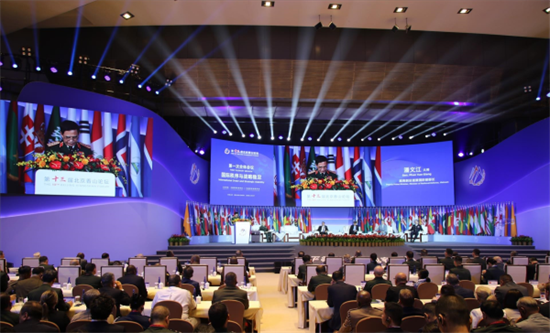 |
| General Phan Van Giang, Vietnam Minister of National Defence, speaks at the Forum (Photo: VNA) |
Multipolarisation and the role of developing countries
A notable feature of this year's Forum was the expanded agenda space afforded to developing countries in Asia, Africa and Latin America. The official programme included a plenary session on “The role and vision of developing countries”, providing an opportunity for these countries to exchange views on global security governance.
As the international balance of power continues to evolve towards multipolarity, developing countries are increasingly seeking to participate more actively in rule-making, advance their development priorities and address common security challenges. However, their ability to play a greater role remains constrained by disparities in national capabilities, divergent interests and competitive pressures from major powers. Therefore, broadening the voice and participation of developing countries not only helps enhance representativeness but also contributes to a more inclusive system of international security governance.
More broadly, multipolarisation is reflected not only in the redistribution of power among major centres of influence but also in the need to adjust approaches to cooperation and the governance of global security issues. Both traditional and non-traditional security challenges, ranging from armed conflicts, maritime security and cybersecurity to climate change and the implications of emerging technologies, extend beyond the capacity of any single country to address. Meanwhile, differences in interests, capabilities and security perceptions make it increasingly difficult to build international consensus. Against this backdrop, broader participation by developing countries not only introduces a wider range of perspectives but also ensures that the security and development concerns of the international community are more fully represented.
Nevertheless, an increase in the number of countries participating in dialogue does not necessarily translate into a fairer and more effective security order. What matters is whether developing countries are genuinely involved in setting the agenda, formulating rules and monitoring the implementation of agreements. Their ability to maintain an independent voice depends significantly on their capacity to coordinate around shared interests, mitigate the risk of being drawn into competition among major powers, and remain steadfast in upholding the principles of international law. This is a key measure of the inclusiveness and substantive value of multilateral security dialogue mechanisms.
In addition, the Forum's provision of a platform for dialogue among countries involved in conflicts or disputes also reflects China's efforts to promote dialogue, ease tensions and seek peaceful solutions to international disagreements. Against the backdrop of restrictions on Russia's participation in certain international forums and Western security dialogue mechanisms following the outbreak of the Russia–Ukraine conflict in 2022, the Beijing Xiangshan Forum has continued to provide Moscow with a platform to express its views on international security issues. Nevertheless, participation in the same forum or sharing certain views on dialogue does not necessarily mean that differences between the parties have narrowed. Progress ultimately depends on concrete diplomatic efforts and the ability to translate dialogue into action.
Strategic competition between China and the United States
The 13th Beijing Xiangshan Forum took place amid the continued profound impact of strategic competition between China and the United States on the regional and international security environment, shortly before the meeting between Chinese President Xi Jinping and US President Donald Trump in Washington on 24 September 2026. Accordingly, the messages conveyed at the Forum concerning strategic stability, dialogue and cooperation among major powers attracted particular attention.
In his address to the Forum, Chinese Minister of National Defence Dong Jun emphasised the role of multilateralism, dialogue and consultation in resolving differences, while warning of the risks posed by hegemonism, zero-sum thinking and militarism. Notably, the Chinese Minister of National Defence made no direct reference to the United States or the Taiwan issue in these remarks. This approach suggests that China chose to emphasise general principles of security and cooperation rather than focus on openly criticising any specific rival.
Furthermore, the discussion session on China–US relations held on 15 September demonstrated that bilateral relations remained an important item on the Forum's agenda. The allocation of a dedicated session to exchanges on relations between the two countries reflected the need to maintain dialogue amid persistent strategic differences, particularly on issues with direct implications for regional peace and stability. Nevertheless, the dialogue at the Forum merely provided an additional opportunity for the two sides to exchange views and was insufficient to conclude that their differences had narrowed.
According to researchers, the greatest challenge in China–US relations lies not only in the existence of divergent interests but also in managing the impact of strategic competition on the regional and international security environment. Competition in technology, military modernisation, cybersecurity and outer space, together with disagreements over Taiwan and the South China Sea, could heighten the risk of misperceptions regarding each other's intentions and actions. When communication channels are unstable or crisis management mechanisms fail to function effectively, even an unforeseen incident could generate pressure for escalation. Therefore, maintaining defence dialogue, communication hotlines and consultation mechanisms for emergency situations is of practical importance in preventing conflict, even when fundamental differences remain unresolved. In this context, dialogue forums such as the Beijing Xiangshan Forum can help maintain contact, clarify positions and facilitate exchanges on issues of mutual concern. However, their role is primarily supportive and cannot replace official diplomatic channels or direct communication mechanisms between the defence authorities of the two countries. Accordingly, the effectiveness of strategic competition management should be assessed not only in terms of the degree of convergence in official statements but also by examining the ability to maintain communication during crises, implement agreements reached and refrain from actions that could heighten the risk of confrontation.
From the perspective of international security, China's emphasis on dialogue, the management of differences and strategic stability at the Beijing Xiangshan Forum reflects both the host country's intended messaging and the challenges facing relations among major powers. The effectiveness of this approach will continue to depend on whether the parties can translate declarations and exchanges into communication mechanisms, risk-reduction measures and substantive cooperation.
This year's Forum demonstrated efforts to build consensus among the parties amid deepening divisions in the international security environment, particularly as China continues to promote initiatives aimed at expanding its role in regional and global security governance. Researchers argue that the Forum's substantive effectiveness should be assessed in terms of its ability to promote cooperation, build trust and help resolve differences based on respect for international law, sovereign equality and the legitimate interests of all countries.
Amid intensifying strategic competition, maintaining open, inclusive dialogue that excludes no party is of considerable importance to peace, stability and development in the region and the world.
Doctor VU DUY THANH, Ministry of Foreign Affairs