Commemorating the 115th Anniversary of the Birth of General Vo Nguyen Giap (25/8/1911 - 25/8/2026)
General Vo Nguyen Giap’s philosophy on “people’s war” - its application in the contemporary era
General Vo Nguyen Giap devoted himself to the development and creative application of the concept of “people’s war”, making tremendous contributions to the triumphs of the resistance wars for national liberation and reunification. These lessons continue to serve as a vital theoretical and practical foundation for building robust, modern all-people national defence in the new context.
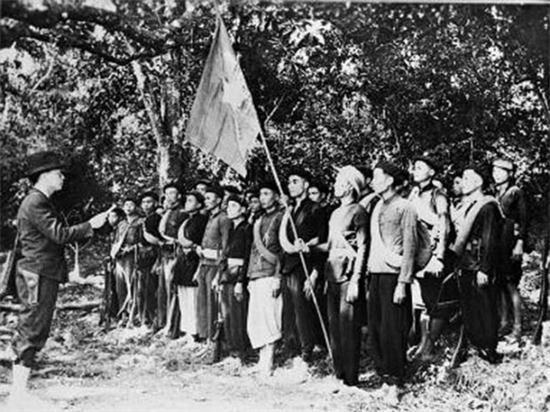 |
| Gen. Vo Nguyen Giap reads Military Order No.1 on establishing Vietnam Propaganda Unit of Liberation Army (file photo) |
General Vo Nguyen Giap’s philosophy on “people’s war”
Through a unique combination of traditional military quintessence, Ho Chi Minh Thought, and modern military theory, General Vo Nguyen Giap’s philosophy on “people’s war” plays a foundational role. It demonstrates his strategic brilliance in the nation’s historic victories during the resistance wars against French colonialists and American imperialists, as well as in the battles to defend the Fatherland’s borders.
For a small nation with limited resources to defeat the world’s leading military powers which possessed overwhelming superiority in weaponry, technology, and economic strength and to achieve great victories such as the Dien Bien Phu Campaign of 1954 and the historic Ho Chi Minh Campaign of 1975, the General elevated the art of “people’s war” of our forebears to a new level. This was based on the principle of mobilising the strength of the entire nation. According to the General, a “people’s war” is a war of all the people, by all the people, and for all the people, wherein the people are simultaneously the direct combatant force and the solid rear echelon for the military”. Unlike other global military doctrines that typically focus on the might of a regular army, Vietnam’s “people’s war” places the people at the centre, featuring a close integration of regular units, militia and self-defence force, and people from all walks of life.
The core values of General Vo Nguyen Giap’s philosophy on “people’s war” can be summarised in the following points.
First, the source of strength in a “people’s war” is the great unity of the entire nation. As the Vietnamese revolution had to face severe challenges, the General realised that only the solidarity of the entire population could generate sufficient strength to fight the enemy. The greatest strength lies in the consensus of all people, irrespective of class, religion, or ethnicity, united under the revolutionary banner of the Party. From the frontline civilian conscripts trekking through forests and wading across streams to bring supplies to the Dien Bien Phu Campaign, to the “American-slaying belts” where people clung to their land and defended their villages in the South, all bear testament to this truth.
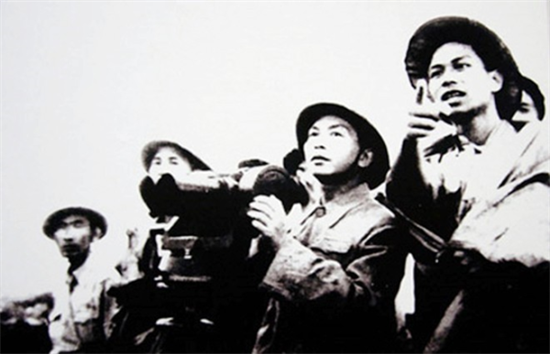 |
| Gen. Vo Nguyen Giap monitors developments in Dien Bien Phu Campaign (file photo) |
Second, the “people’s war” in the General’s philosophy was always flexible and creative; it did not adhere to rigid military templates but relied upon adaptation to specific circumstances. The standout feature is the strategy of “using the weak to defeat the strong”. Amid severe shortages of equipment, the General directed our forces to capitalise on the terrain, the hearts of the people, and solidarity to invent flexible tactics, such as guerrilla warfare, “encirclement and encroachment”, and mobile warfare, thereby weakening the enemy and turning limitations into advantages.
Third, a “people’s war” involves the comprehensive mobilisation of all spheres of social life, combined with the strength of the times. This is not solely a military conflict but a combined struggle of the political, economic, cultural, and diplomatic fronts, creating a total war with the participation of the entire population. The General affirmed: “Our strength lies not merely in guns and ammunition, but in the hearts of the people, in the indomitable will of the entire nation”. During the resistance against French colonialists, propaganda campaigns, international advocacy, and the building of a robust rear echelon provided powerful support for military operations. Similarly, the global anti-war movement, sparked by Vietnam’s victories, exerted immense pressure on the US government and contributed to the ultimate victory.
General Vo Nguyen Giap’s philosophy on “people’s war” has been tested and developed throughout various revolutionary stages, leaving behind immense theoretical and practical value for the tasks of building the Military, consolidating national defence, and protecting the Fatherland in the new context.
Applying General Vo Nguyen Giap’s philosophy on “people’s war” in the current period
Currently, as the world is experiencing profound, complex, and unpredictable changes, applying the core values in the “people’s war” philosophy of General Vo Nguyen Giap is extremely necessary.
First, transforming great national unity in the “people’s war” philosophy of the General into a solid “posture of the people’s hearts and minds” of all-people national defence. The key task is to continue improving the material and spiritual lives and consolidating the trust of the people, especially in strategic areas, border regions, islands, and remote areas. In addition, we must focus on socio-economic development, ensure social security and equity, affirm the superiority of the socialist regime that our Party, Uncle Ho, and people have chosen. Accelerating national target programmes for ethnic minority and mountainous areas, narrowing the development gap, and improving the material and spiritual lives of the people are also critical tasks. Along with that, it is essential to actively disseminate policies and cultural traditions, awaken national pride and self-respect for every Vietnamese citizen, and foster innovation in mindset and methods of defence and security education among the younger generation. In the current information boom era, traditional education and defence and security education need to be digitalised, with a focus on propagation in cyberspace, integrating educational content into cultural and technological products suitable to the preferences of the people, especially the youth. The ultimate goal is to render every citizen fully aware that defending the Fatherland is not the exclusive task of the armed forces, but the right, duty, and sacred responsibility of every citizen. When patriotism, national pride, and national defence awareness deeply permeate each person, Vietnam will have a solid defensive posture right from within the mindset of each citizen - the “posture of the people’s hearts and minds” of strong, modern all-people national defence.
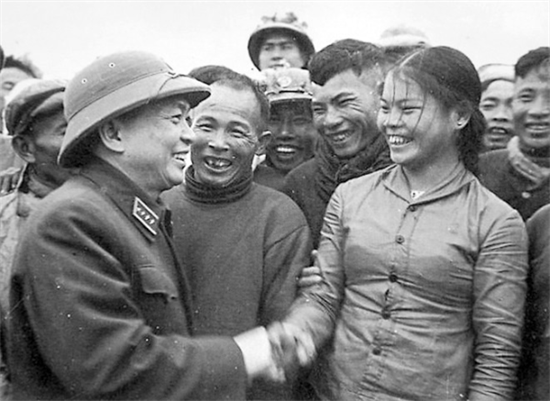 |
| Gen. Vo Nguyen Giap encourages Gianh river transport unit (file photo) |
Second, applying the “flexible, creative” mindset in the “people’s war” of the General to modernise the Vietnam People’s Army (VPA) and military art. The outstanding feature of Vietnamese military art is flexibility in specific circumstances. That creativity originates from the practical mindset of our forefathers: “using the small to defeat the large”, “using the weak to oppose the strong”, “using short-range weapons to counter long-range formations”, etc.
The form of warfare has fundamentally changed with the advent of hi-tech weapons, precision guidance, application of artificial intelligence, and cyber warfare, requiring the “people’s war” mindset to be elevated with modern knowledge and science and technology. In this regard, it is necessary to focus on realising three core issues.
Firstly, developing modern Vietnamese military art, remaining proactive in research and forecasting, innovating operational thinking. Accordingly, it is important to research and supplement theories on how to mobilise all-people strength in conditions where the adversary uses hi-tech weapons, precision weapons, and cyber warfare. We must decisively shift the mindset from “responding when there is war” to “proactively preventing and eliminating the risks of war” and focus on non-armed solutions, such as legal struggle, defence diplomacy, etc. In addition, it is essential to develop comprehensive military art in terms of military strategy, operational art, and tactics. At the same time, the VPA needs to proactively build flexible defence scenarios according to the motto: “Using the immutable to cope with the ever-changing” and formulate effective countermeasure plans using modern Vietnamese military art.
Secondly, building an “adept, compact, strong, modern” VPA according to a scientific, solid road map, harmoniously combining the elements of personnel, organisational structure, and weapons and equipment. That must be the process of optimising force structures and building peacetime and wartime organisational structures scientifically to ensure that when necessary, it is possible to quickly shift readiness states and expand the force. Apart from a regular, elite, modern revolutionary standing force, it is necessary to develop a strong, extensive militia and self-defence force, improve this force’s political quality and combat readiness and build a formidable, high-quality reserve force.
Thirdly, stepping up the building of a self-reliant, self-strengthening, dual-use, modern defence industry. This is one of the strategic breakthroughs emphasised in the country’s development orientation and VPA building. The goal is to make defence industry truly become the spearhead of the national industry, both ensuring self-reliance in weapons and equipment and actively fostering socio-economic development. It is essential to effectively implement the Law on Defence and Security Industry and Industrial Mobilisation to create a uniformed legal framework and open mechanisms for attracting all social resources. Also, it is important to build specific, outstanding mechanisms with preferential policies on capital, taxes, land, and intellectual property protection for projects on researching and manufacturing high-tech weapons and equipment.
Furthermore, there is a need to establish strict control mechanisms and minimise administrative procedures to optimise the process from experimental research to production. We must also focus on allocating resources to domestic corporations and research institutes to enable them to master production technology, improve modern military hardware and strategic weapons, especially communication systems, electronic warfare equipment, and smart guidance technologies; the ultimate aim is to master core and strategic technologies. At the same time, defence industry must be closely linked with national industry, ready to convert production capacity between peacetime and wartime.
Third, upholding the mindset of promoting comprehensive strength in the “people’s war” of General Vo Nguyen Giap - the core method to actualise strong, modern national defence, linking economic development with defence and security consolidation and foreign affairs. Each step of economic development must be a step forward in strengthening defence and security, while dual-use elements must be included in all macro-strategic plans and each economic sector. We must persistently pursue the policy of independence, self-reliance, self-strengthening, peace, friendship, cooperation, and development in foreign affairs, build an extensive network of strategic partners, enlist international support, and develop a solid diplomatic posture and strength for the country. Last but not least, consideration should be given to improving the capability to respond to non-traditional security challenges with a comprehensive combination between the management capacity of the State, the rapid response of the armed forces, and the self-management strength of the community, thereby forming a shield protecting the stability of the country, contributing to building strong, modern all-people national defence, maintaining peace and territorial integrity for the country to rise in the new era.
TRAN NGOC NHIEU, PhD
Ho Chi Minh National Academy of Politics (Region III)