The Strait of Hormuz - A convergence point for energy, military, and political concerns
The Strait of Hormuz holds a position of critical importance in international maritime affairs. It serves as a vital energy transport artery and a space where the interests of numerous influential Middle Eastern actors converge and intertwine. Consequently, any developments in the Strait have a direct impact on the economic, political, and diplomatic security of both the region and the world.
Hormuz - A crossroads of strategic interests
In geographical terms, Hormuz is a narrow strait linking the Persian Gulf, the Gulf of Oman, the Arabian Sea to the Indian Ocean. However, within the global energy and maritime trade structure, it is regarded as a critical “chokepoint”, occupying one of the world's most strategically significant positions.
As the sole maritime outlet connecting the Persian Gulf to the rest of the world, Hormuz is of immense value as the majority of oil and liquefied natural gas (LNG) exported from Gulf nations to major consumer markets in Asia, Europe, and North America must transit this strategic route. Notably, while the Strait spans nearly 170 km in length, its narrowest point is only about 39 km wide with only two navigable channels (one for inbound and one for outbound traffic), each just over 3 km wide, making it highly vulnerable to military activities, maritime incidents, and geopolitical tensions involving the nations on either shore. Therefore, any instability in the area or among the bordering states can severely disrupt the global flow of energy.
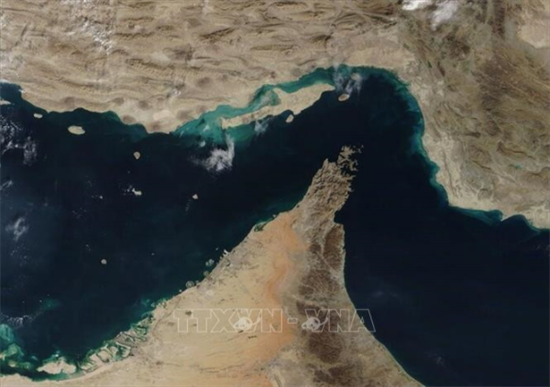 |
| The Strait of Hormuz (Photo: VNA) |
According to statistics from the International Energy Agency (IEA), in 2025 alone, on average, nearly 20 million barrels of oil (equivalent to nearly 25% of global seaborne oil trade) and roughly 20% of internationally traded liquefied natural gas (LNG) passed through the Strait daily. Unlike many other vital global energy shipping routes, there is no adequate alternative to this passage, currently. While Saudi Arabia and the UAE have invested in pipeline systems extending to the Red Sea and the Gulf of Oman to reduce reliance on this critical artery, their transport capacity only meets part of export needs. This means the majority of the region's energy supplies must still transit the Strait before reaching target markets.
For this reason, the Strait of Hormuz has long been a focal point where the strategic interests of regional nations and global powers converge and intertwine. For Gulf states, this maritime route is essential for energy export which is their main income. For importing nations, the Strait plays a pivotal role in securing stable energy supplies, maintaining uninterrupted supply chains, mitigating market volatility, and curbing inflation risks. For regional and global powers, upholding freedom of navigation in the Strait is inextricably linked to their strategic interests and the maintenance of influence in the Middle East. Thus, the mutual dependence and interconnected interests of these nations have made the Strait one of the world's most sensitive geostrategic area, where any policy decision regarding the area must account for the reactions of all stakeholders.
From the geopolitical perspective, the value of the Strait of Hormuz extends beyond its role as an international energy shipping route. What gives it such a unique status is its capacity to simultaneously impact energy security, trade, freedom of navigation, and strategic competition among major powers. Consequently, a single political statement, a military exercise, or a maritime incident in the Strait can cause fluctuations in energy prices, shipping costs, negatively impacting financial markets and supply chains, and generating repercussions to not only the Middle East, but the entire world.
Military balance in Hormuz
Researchers hold that the unique geostrategic value has made the Strait of Hormuz one of the most heavily militarised regions in the world. Most actors with interests in the Middle East seek to maintain influence and operational control within this critical area. In reality, for years, the Strait has been a focal point where efforts to ensure freedom of navigation intersect with military deterrence and power competition, making it prone to escalating tensions.
Citing the need to ensure maritime security and safety while maintaining influence in the Middle East, the U.S. and its allies have progressively established a dense military network concentrated around the Strait of Hormuz. The core of Washington’s military presence in the region is the Fifth Fleet, headquartered in Bahrain. The fleet is responsible for controlling a vast maritime area comprising the Persian Gulf, the Gulf of Oman, the Red Sea, the Gulf of Aden, and parts of the Indian Ocean. Additionally, the U.S. and its allies can deploy carrier strike groups, nuclear-powered submarines, destroyers equipped with the Aegis missile defence system, and carrier-based air assets to enhance maritime control and safeguard shipping operations. The U.S. has also built a network of military bases in Qatar, the UAE, and Kuwait, enabling rapid force deployment to handle contingencies and providing logistical support for combat operations in the region. According to the U.S. Department of War, the country currently maintains a force of 30,000 to 40,000 troops across Gulf nations. Alongside the U.S., key strategic allies, the UK and France, also maintain permanent naval forces in Bahrain and Abu Dhabi to coordinate the escort of commercial vessels and ensure maritime security.
Iran, the nation directly controlling the entire northern coast of the Strait, has adopted a completely different approach. According to international military analysts, rather than attempting to compete directly with major powers in terms of force size or the sophistication of weaponry and equipment, Tehran focuses on developing an asymmetric warfare doctrine that leverages its formidable terrain and on-the-ground control. Consequently, the country has prioritised the development of surface-to-sea missiles, ballistic missiles, unmanned vehicles (UVs), and high-speed boat fleets capable to handle contingencies in the Strait. Simultaneously, it has enhanced its capabilities in mine-laying and controlling strategic islands, such as Qeshm, Larak, and Hengam, thereby establishing a multi-layered deterrence posture. Tehran’s objective is not to achieve absolute maritime supremacy, but rather to maintain the capacity to disrupt or blockade shipping lanes in the event of a crisis or conflict, effectively turning the Strait of Hormuz into a high-value strategic “card” in dealing with the U.S. and the West, and safeguarding its national interests.
Beyond the U.S. and Iran, regional nations also play a pivotal role in shaping the security landscape of the Strait of Hormuz. On the Musandam Peninsula guarding the Strait's gateway, Oman maintains a modern, elite naval and surveillance presence to monitor these vital waters. Arab states are also continuously boosting defence investment and expanding military cooperation with the U.S. and other partners to strengthen their ability to protect energy infrastructure and maritime shipping routes. These factors contribute to the increasingly complex and multifaceted security dynamics within the Strait of Hormuz.
In assessing the regional situation, military experts hold that the military balance in the Strait of Hormuz is not maintained through the absolute dominance of any single nation, but rather relies primarily on a state of mutual deterrence and restraint. It is the interplay between military power and strategic interests that has brought the region a relatively stable state. However, the risk of escalation remains ever-present in the event of miscalculations or unintended incidents.
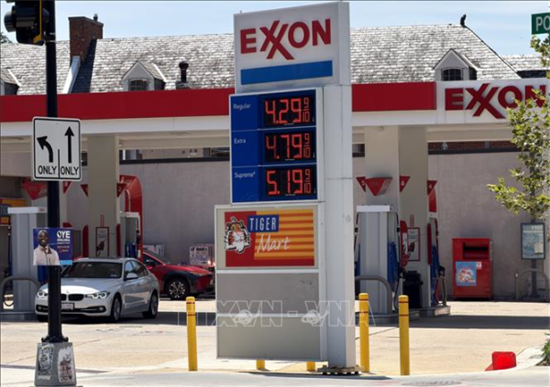 |
| An oil station in the US (Photo: VNA) |
The shift in strategic competition methods
According to researchers, recent developments in the Strait of Hormuz indicate a significant shift in both method and scope of strategic competition among major powers in the Middle East. Previously, superiority was primarily gauged by force size, weaponry sophistication, or the capacity to secure battlefield victories through military might. Today, however, control over critical maritime routes, energy supplies, supply chains, and geostrategic spaces has emerged as a crucial instrument for establishing and expanding influence. Consequently, the Strait of Hormuz is no longer merely a waterway of military significance, but has become a focal point where security, economic, commercial, and geopolitical interests converge, exerting influence that extends far beyond the region itself.
In practice, whenever tensions escalate between Iran and the United States or Israel, what the international communities concern first and foremost is not the scale of military operations, but whether the flow of energy through the Strait of Hormuz might be disrupted or not. Even the mere threat of a blockade or restrictions on maritime traffic can trigger immediate volatility in global oil prices and drive up insurance and shipping costs, creating a ripple effect on production, trade, and inflation across many nations. It is evident that in the current competitive landscape, the ability to exert pressure on the “lifeblood” of the global economy can be effective and impactful as much as the direct military deterrence strategies employed by major powers in recent years.
Studies indicate that this trend is clearly evident across various regions and sectors within the strategic competition among major powers and power centres. The conflict in Ukraine has demonstrated that energy serves as an “extremely effective” tool, particularly when gas supplies to Europe are disrupted. Amid a rapidly changing, complex, and unpredictable global and regional landscape, the US and the West have increasingly employed financial sanctions and controls on high-tech and semiconductor exports to exert pressure on their rivals. Meanwhile, China has implemented export restrictions on certain critical minerals essential for cutting-edge technology industries. These developments reflect a trend in which competition is expanding beyond the military sphere into the realms of economics, finance, technology, energy, and supply chains.
Recent escalating tensions in the Strait of Hormuz have highlighted that, amidst intensifying great-power competition, the value of a geostrategic area is determined not merely by geographical position or military might, but increasingly by the capacity to influence and control the flows of energy, trade, technology, and global supply chains. Consequently, together with Hormuz, other global “chokepoints” are expected to become focal points of competition among nations and influential stakeholders, profoundly impacting the world security, development, and order.
LAM PHUONG, Department of International Affairs, Hanoi Newspapers, Radio and Television