Ensuring and promoting human rights is a consistent and overarching viewpoint in the leadership lines of the Communist Party of Vietnam. This commitment continues to be affirmed and developed by the 14th National Party Congress with a number of new points that need to be thoroughly grasped and translated into concrete results.
The development of the Party’s theoretical thinking on human rights
Throughout the process of leading the Vietnamese revolution, particularly in the past 40 years of Đổi Mới (national renovation), the Party’s theoretical thinking on human rights has always been clearly defined, gradually supplemented, and developed to be increasingly consistent, comprehensive, and profound, in line with the requirements of national development and international integration.
Our Party and State require that “state agencies must respect and ensure citizens’ rights stipulated by the Constitution”, and that “the State must guarantee the genuine democratic rights of the working people and resolutely punish those who violate the people’s right to mastery”. Notably, the Platform on National Construction in the Period of Transition to Socialism (supplemented and developed in 2011) further clarified this approach by affirming that “people are at the centre of the development strategy and are also the subjects of development”, while advocating “respecting and protecting human rights, associating human rights with the rights and interests of the nation and the people’s right to mastery”. With this approach, our Party and State have gradually improved mechanisms for ensuring human rights, emphasising the role of the rule-of-law State in realising the Party’s viewpoint of “respecting, guaranteeing, and protecting human rights and the rights and obligations of citizens”.
The 13th National Party Congress continued to develop the Party’s theoretical thinking on human rights in association with the country’s Đổi Mới cause, stressing that “the People are the centre and subjects of the cause of Đổi Mới and Fatherland construction and protection”. This represents a development in the approach to people, shifting from viewing them primarily as beneficiaries to enhancing their role as subjects in the development process.
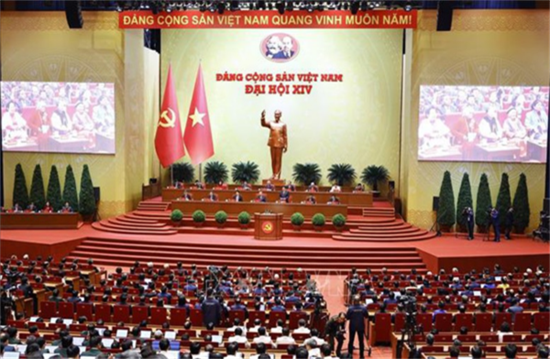 |
| The 14th National Party Congress (photo: VNA) |
Consistent with this viewpoint, alongside its focus on ensuring specific rights, the 14th National Party Congress further affirms the central position of people and human rights in the country’s development process: “All lines and policies of the Party and State must genuinely originate from the needs, aspirations, and legitimate and lawful rights and interests of the People, and take the respect, guarantee, and protection of human rights and citizens’ rights as well as the happiness and satisfaction of the People as the yardstick and goal of endeavour”.
On that basis, human rights are approached in a more comprehensive manner, associated with development conditions, non-traditional challenges, and the requirements of ensuring human security and safety. Amid numerous new risks and issues across the globe, ensuring human rights is increasingly closely linked with human security, sustainable development, and the capacity to respond to new challenges.
The scope of human rights is broadened towards linking them with new drivers of development, particularly science, technology, and digital transformation, with the requirement to “strongly foster science and technology development, innovation, and national digital transformation to create breakthroughs”. This shows that human rights are not only associated with protection and guarantee, but also directly related to the ability to access, benefit from, and participate in scientific and technological advances. This also implies that new rights are becoming increasingly evident in the digital space, such as the right to access information, the right to access technology, and the right not to be excluded from the digital transformation process, etc.
The 14th National Party Congress places human rights in an organic relationship with sustainable development by underlining the requirements of transforming the growth model, promoting green transformation and energy transition, and improving the quality of human resources. Accordingly, human rights are not only a goal of development, but also a core criterion of the development process. This affirms that the Party’s theoretical understanding of human rights has been broadened towards an integrated, interdisciplinary approach and a close combination of human rights and the country’s long-term development objectives.
Thus, the 14th National Party Congress marks an important development in the theory of human rights, shifting from an approach centred on the guarantee of rights to a more comprehensive approach associated with human security, digital transformation, and sustainable development.
The role of people and human rights as subjects in development
In the process of developing the Party’s theoretical thinking, the viewpoint of people as both the centre and subjects of development has been formed and refined through different stages. This consistent development demonstrates a shift from an approach that primarily regarded people as beneficiaries to one that promotes their role as subjects; in this approach, human rights are closely associated with the People’s right to mastery and have become both a goal and a driving force of the country’s development.
The Party continues to further affirm the role of people and the People by “enhancing the People’s role as subjects and their central position in the entire process of Fatherland construction and protection”, calling for “strongly arousing patriotism, aspirations for development, solidarity, the will for autonomy, self-confidence, self-reliance, self-strengthening, and national pride”. Thus, people are not only beneficiaries of policies but also subjects who shape development, directly participate in and determine the country’s development process.
On the basis of enhancing the People’s role as subjects, our Party’s viewpoint clearly reflects a shift from ensuring rights in the traditional sense towards an empowerment approach. Our Party frankly acknowledges drawbacks in reality, stating that “the practice of democracy at grass-roots level remains formalistic, and the People’s right to mastery has not yet been fully respected and promoted”. At the same time, it emphasises the requirement to promote democracy and guarantee the People’s right to mastery.
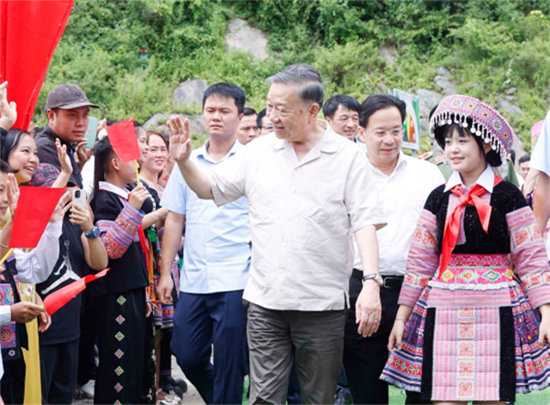 |
| General Secretary, State President To Lam attends the 2026 All People's Day for National Security Protection in Son La province (photo: VNA) |
This represents a development in awareness and approach of profound theoretical and practical significance, because human rights do not stop at being legally recognised or protected by the State, but also require conditions to be created in order to enable rights-holders to exercise their rights substantively. From this perspective, it can be seen that our Party’s viewpoint no longer focuses solely on the State’s obligations to recognise, respect, protect, and ensure human rights, but has taken a further step by setting out the requirement to enhance the people’s capacity as rights-holders, thereby transforming human rights from a value that needs to be protected into a resource for development. This constitutes a point of convergence between the Party’s thinking and modern theoretical trends in human rights; more specifically, people are not only beneficiaries but also subjects who participate in, shape, and exercise oversight over the development process.
A prominent new point is that human rights are linked with new drivers of development, especially science, technology, innovation, and human resource development. The 14th National Party Congress confirms that “science, technology, innovation, and national digital transformation are to be taken as the main drivers; the quality of human resources is to be improved; talents are to be attracted and properly utilised”; the Congress also determines to “bring into full play the strength of culture and people as internal resources and powerful drivers of development”. This shows that human rights are not only approached as a value that needs to be guaranteed, but they are also regarded as a resource for development; in this regard, people are both creative subjects and internal drivers for the country’s rapid and sustainable development.
In the context of digital transformation, the relationship between human rights and development is becoming increasingly close. Rights such as access to education, access to information, and participation in scientific and technological life are not only fundamental rights, but also conditions for developing a high-quality workforce.
Enhancing the role of the State and national governance in guaranteeing human rights
In the context of accelerating the building and improvement of a socialist rule-of-law State, ensuring human rights is closely associated with the requirement to “uphold the supremacy of the Constitution and the law, respect, guarantee, and protect human rights and citizens’ rights effectively”. Human rights are not only a goal pursued by the State, but have also become a benchmark for assessing the effectiveness of the state apparatus and the quality of national governance.
The 14th National Party Congress upholds the role of the State in ensuring human rights through enhancing national governance capacity, adding that it is vital to “step up the building and synchronous improvement of institutions for rapid and sustainable national development, resolutely, promptly, thoroughly remove bottlenecks, release productive forces, unlock all resources, and bring into full play all driving forces”. In practice, “bottlenecks” in institutions, policies, and implementation are precisely the barriers that limit the people’s ability to access and enjoy their rights, particularly in such areas as land, labour, social security, and public services. When legal mechanisms remain overlapping, insufficiently transparent, or ineffective, human rights, even when recognised, are difficult to be fully realised in practice. Therefore, addressing institutional “bottlenecks” is not merely a technical requirement of state management, but also an important condition for realising human rights in practice, ensuring equal access to development resources and improving the people’s quality of life in the new context.
New points on human rights in the Documents of the 14th National Party Congress are of great significance in shaping Vietnam’s development approach in the new period. Placing human rights in a close relationship with development, national governance, and growth drivers indicates that human rights are increasingly becoming a foundation and orientation for policy formulation and implementation. This contributes to ensuring inclusive development, raising the quality of governance, bringing human resources into full play, and meeting the requirements of rapid and sustainable national development in the new context.
CHU THI THUY HANG, PhD
Deputy Director of the Institute of Human Rights
Ho Chi Minh National Academy of Politics