As the international and regional security environment has grown increasingly complex, Australia is adjusting its defence strategy, shifting from traditional territorial defence to enhancing long-range deterrence capabilities. Then what are its core elements, implementation prospects, and impact on the regional security landscape? This is a matter of significant interest to the international community.
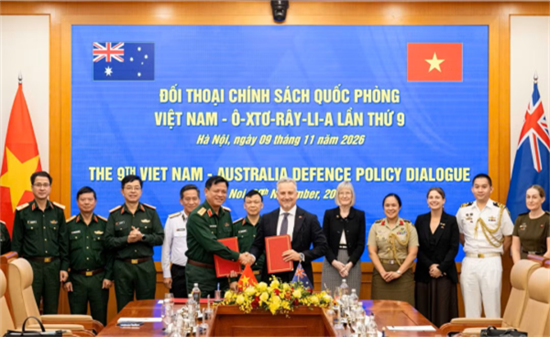 |
| 9th Vietnam - Australia defence policy dialogue (photo: dangcongsan.vn) |
The strategic shift from territorial defence to proactive long-range deterrence
With its isolated geographical position surrounded by oceans, Australia holds a significant natural advantage in ensuring its national security. However, the rapid development of long-range missiles, submarines, unmanned aerial vehicles (drones), cyber warfare, and modern reconnaissance assets has diminished the defensive advantage of geographical distance and posed new challenges to the country’s security.
Recognising these challenges, particularly the shrinking warning window against threats, Canberra requires its defence force to enhance the capacity for detecting and responding to threats early and from afar in multiple directions. To realise this objective, in 2026, Australia announced its new National Defence Strategy with significant adjustments, focusing on building an integrated defence force across land, sea, air, space, and cyber domains, replacing the traditional approach of organising primarily by individual military services. This is a landmark shift in Australia’s defence thinking, moving from defence based on geographical distance and its alliance with the US to proactively establishing deterrence and responding to security threats from afar.
This adjustment is clearly reflected in the 2026 Integrated Investment Programme, which aims to expand long-range strike capabilities, modernise the Royal Australian Navy, and strengthen undersea warfare capabilities through substantial financial investments. Specifically, the Australian government plans to allocate approximately 28 to 35 billion AUD (around 20 to 25 billion USD) to develop targeting capabilities and enhance the range and precision of naval, land, and air weapon systems. According to figures published by the country’s Department of Defence, maritime operational range is projected to increase from about 120 km to 2,500 km; land range from about 40 km to 500 km, with a future target of 1,000 km; and air range from about 370 km to 1,000 km. In the immediate term, Australia plans to purchase additional High Mobility Artillery Rocket Systems (HIMARS) and Precision Strike Missiles (PrSM), and establish a second long-range fires regiment at a cost of approximately 2.3 billion AUD (over 1.6 billion USD).
Alongside the development of long-range firepower, Australia is also dedicating approximately 62 to 77 billion AUD (around 44 to 54 billion USD) to bolster the Royal Australian Navy. The focus is on expanding the fleet size and developing interoperability between long-range missiles, anti-submarine warfare, sensor systems, and unmanned vehicles. The modernisation of the naval force is aimed not only at improving the ability to control maritime approaches but also at protecting sea lanes and supporting combat operations in critical areas.
Regarding undersea warfare, Australia plans to allocate approximately 94 to 130 billion AUD (66 to 91 billion USD) for the development of nuclear-powered submarines to replace its diesel-electric fleet, as well as unmanned underwater vehicles. According to military experts, this change marks a dramatic shift in the organisation of the submarine force, aiming to expand operational range and the ability to maintain a prolonged presence, thereby enhancing its capabilities to deter and control security threats from afar. The adjustments in the 2026 Integrated Investment Programme demonstrate that Canberra is translating its new defence thinking into tangible military capabilities, thereby gradually altering Australia’s position in the Indo-Pacific security architecture.
Operationalising the “Strategy of Denial”
In 2024, Australia formally established the “Strategy of Denial” as the core foundation of its defence policy planning. According to the country’s Department of Defence, the strategy’s objective is to deter adversaries by denying them any expectation of achieving strategic objectives through the use of military force and ensuring they would face heavy costs, while supporting regional security and prosperity. Researchers note that the focus of the strategy is not merely to increase military capability, but to build defence capabilities sufficient to prevent an adversary’s intent to use force. This new thinking shapes how Australia defines the security space it must protect, organises its forces, and develops military capabilities aligned with new strategic requirements.
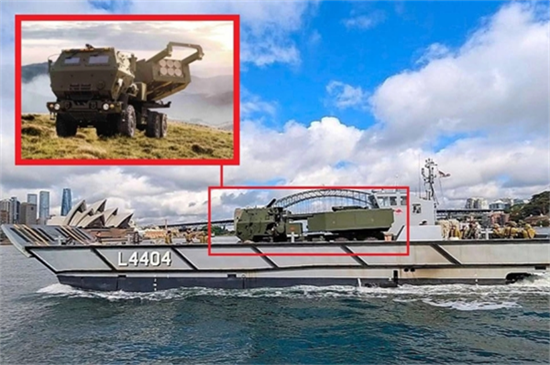 |
| Australia embarks HIMARS on HMAS Canberra amphibious assault ship (photo: Department of Defence of Australia) |
As an island nation whose economy relies heavily on maritime trade, Australia links its national security to defending its territory, maintaining the free flow of sea lanes, and safeguarding the operation of seaports and critical infrastructure serving both the economy and defence. Defence Minister Richard Marles has emphasised that Australia’s “geography of national security” does not stop at its coastline and adjacent waters. This requires Australia to maintain operational capabilities across a vast expanse to detect, prevent, and respond to threats from afar, as well as protect its sovereignty, sovereign rights, and national interests well beyond its territory.
To meet these demands, Australia is advancing multi-domain operational capabilities, aiming to foster close coordination and synergy among its various force components. Rather than developing in a fragmented manner along individual service lines, forces are integrated into a unified network under centralised command and control. The focus is on linking reconnaissance and sensor systems with command-and-control networks to shorten the cycle of detection, information processing, and decision-making, while maximising the power and precision of firepower against key directions and targets to strengthen long-range deterrence and denial.
Alongside developing combat capabilities, Australia also concentrates on bolstering its defence industry to maintain resilience during protracted conflicts and defence supply chain disruptions. According to published figures, the Australian Department of Defence has invested 126.9 million AUD (approximately 89 million USD) to manufacture solid rocket motors, with production of motors for the Guided Multiple Launch Rocket System (GMLRS) expected to begin in 2030. In April 2026, Australia successfully tested a guided rocket, marking a new milestone in developing domestic weapons manufacturing capabilities. By July 2026, the country announced a new Defence Industry Development Strategy, focusing on expanding the production, maintenance, and repair of essential weapons and equipment, ready to scale up manufacturing when defence demand surges.
To achieve these goals, Canberra is strengthening ties between the state, defence corporations, and domestic businesses, linking production with technical and technological workforce training and infrastructure investment to gradually build a self-reliant, robust defence industrial base for the long term. Consequently, Australia’s defence industry is increasingly viewed as a vital component in enhancing deterrence and strategic autonomy, rather than relying primarily on external arms supplies.
Overall, the adjustments in strategy, force organisation, and defence industry that Canberra is actively pursuing are all aimed at enhancing the ability to project and sustain military power in key directions. Within this posture, northern Australia is identified as the pivotal region for translating this new defence thinking into concrete operational capabilities.
Turning the North into a “frontline”
One of the notable shifts in Canberra’s force posture is the major investment of resources on developing military bases and infrastructure in northern Australia. Located near Southeast Asia, the Timor Sea, the Arafura Sea, and the sea lanes connecting the Indian Ocean with the Western Pacific, this region holds a vital position for force projection and controlling strategic approaches compared to military bases in the south. This geographical advantage enables the Australian Defence Force to shorten deployment times, expand surveillance coverage, and strengthen logistical support for military operations.
Canberra is implementing this direction through an investment of approximately 13 to 16 billion AUD (9.1 to 11.2 billion USD) over the next decade to modernise bases at Darwin, Tindal, Learmonth, Townsville, and several other facilities and training areas. In February 2026, Australia completed a dedicated infrastructure complex at RAAF Base Tindal (comprising maintenance hangars, airstrip pavement upgrades, working facilities, and supporting infrastructure) enabling reconnaissance and surveillance operations by MQ-4C Triton unmanned aerial vehicles. By September 2026, the MQ-4C Triton was operating from Edinburgh and Tindal, contributing to enhanced long-range reconnaissance and surveillance capabilities. At Darwin, Australia continues to expand fuel storage, barracks, naval ports, and training ranges to ensure logistics support and facilitate combat operations. These projects show that Australia is aligning the modernisation of its military base network with the requirements of deploying new forces and combat assets, thereby enhancing its ability to maintain a presence, strengthen deterrence, and remain ready to respond to any contingency along strategic approaches.
Notably, this process is taking place alongside Canberra’s deepening defence cooperation with Washington. The US is currently participating in upgrading several military bases in northern Australia, such as Tindal and Darwin, thereby helping Australia bolster its defence strength and expanding interoperability between the two militaries in regional operations. These adjustments are transforming the strategic role of northern Australia, from an area primarily serving territorial defence into a staging ground for projecting forces and assets along key operational axes. The northern base network is increasingly integrated into the Australia - US defence cooperation framework and has become a crucial component of the force posture that the alliance is consolidating in the region. Consequently, the concept of a “frontline” is not understood as a direct line of contact in a conflict, but rather emphasises northern Australia’s role as a forward-operating area, where Australia is progressively bringing its surveillance, logistics, and combat capabilities closer to strategic theatres in the Indo-Pacific.
The adjustments in the new National Defence Strategy demonstrate that Australia is shifting from relying primarily on geographical advantage for defence to proactively shaping its strategic posture, enhancing deterrence, and expanding long-range operational capabilities. This marks a significant shift in Canberra’s strategic thinking, reflecting how it defines its security space, employs military power, and views its role in the Indo-Pacific security environment. Experts believe this trend will continue to have a substantial impact on the regional balance of power and security architecture in the years to come.
LAM PHUONG