Refuting the allegation that national defence and security education is a tool to “militarise” students
National defence and security education plays an important role in equipping young generations with essential knowledge and skills, and raising their awareness of defending the Fatherland. However, hostile forces have deliberately distorted the truth, claiming that it is a “militarisation” tool, aimed at students’ ideological control and freedom restriction. This is a wrong and misled argument that degrades their awareness and responsibility, creates an indifference mindset and vigilance loss, negatively affects the cause of national building and defence, and must be firmly refuted.
One of the common misconceptions deliberately created by hostile forces is that national defence and security education is a form of “militarisation” of schools and “militarising” students, turning them into controlled tools instead of focusing on their learning and personal development.
To make students misunderstand the training content and curriculum, hostile forces have actively misrepresented that national defence and security education only focuses on military training, weapons handling, and physical training without any educational values. They have criticised the national defence and security education programme, arguing that this subject restricts students’ freedom and creative thinking, leading to the ideological imposition and forcing them to conform to military-like regulations, thereby losing their individuality and personal development capability.
Taking full advantage of social media, they have spliced and edited images and videos from military training sessions to exaggerate the difficulties students face during the national defence and security education, creating the misunderstandings and giving them a negative view of this important subject. The purpose of this plot is to create an opposition among students, turning them into tools to put more pressure on the educational system and undermine the State's national defence and security education policy.
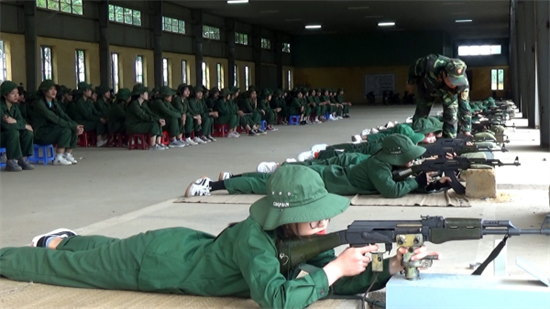 |
| Students attend firing lesson at the Military School of Military Region 5 |
The sabotage by hostile forces targeting the national defence and education, at the first glance, may not seem overly alarming, but behind it exist potentially highly dangerous impacts in both the short and long run.
In the short term, believing in such misguided views on the national defence and security education not only affects students’ awareness but possibly leads to serious consequences, seriously affecting their patriotism and sense of citizen responsibility, and weakening the national defence strength. When students misunderstand the nature of national defence and security education, viewing it as an obligatory form of ideological “militarization” rather than a provision of essential knowledge, it leads to their apathetic and dismissive attitude toward the subject. This creates a generation of students who lack essential knowledge of national defence and security, are unaware of the importance of protecting the Fatherland, they then tend to become irresponsible for the destiny of nation, lack the necessary preparation for responding to urgent situations, which could weaken the all-people national defence. This also serves as a premise for arising the apathy for national defence and security education among a part of students; the roots of action of military service evasion, which causes difficulties in conscription and sourcing of reserve forces, thereby diminishing the nation's defence strength.
In the long run, the underlying purpose of these allegations is to “brainwash” the younger generations, creating a cognitive and ideological “void” so that they could be easily “manipulated” and “infiltrated” with reactionary ideologies. By inciting the oppositive views, and eliminating forms of patriotism education and cultivation such as national defence and security education, hostile forces aim to create generations of students who are apathetic and irresponsible for the country, thereby creating conditions for them to carry out schemes to sabotage the Vietnamese revolution. This is a roundabout, indirect, yet highly sophisticated and dangerous path taken by hostile forces.
When the younger generations lack the awareness of their role and responsibility for the country, and are not adequately equipped with basic knowledge of defence and security, the all-people national defence will lose its self-reliant strength. This creates conditions for foreign powers to interfere, promote their subversive activities, weaken internal resilience, and create loopholes in the protection of national territorial sovereignty. These are highly dangerous consequences that must be properly recognised and actively countered to refute these allegations.
It must be affirmed that national defence and security education for students is an important content in the education and training programme of the national education system, which is clearly stipulated in the Law on national defence and security education. This subject not only equips students with basic national defence and security knowledge, military skills, and disciplined lifestyle training, but also nurtures the patriotism, enhances their awareness and sense of civic responsibility for the cause of building and safeguarding the Fatherland.
In terms of the content and curriculum, national defence and security education goes beyond mere a military training. It also provides fundamental knowledge on the history of national defence, the global security situations, defence legislation, national defence strategy, and survival and emergency response skills, etc. These are essential, basic contents that help students realise the importance of military activities and national defence consolidation, recognise the inevitability of the Fatherland protection task, and enhance their legal awareness, self-defense skills, and ability to respond to dangerous situations.
In fact, the national defence and security education does not aim to turn students into military personnel, but rather to equip them with foundational knowledge of defence and security, self-defence skills, and a sense of responsibility to protect the country. The organisation of practical military training contents, such as line-up regulations, and individual weapon handling skills, etc. represents only a small part of the overall military training programme.
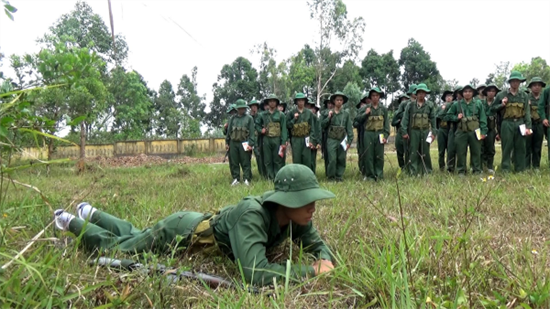 |
| Students attend tactical lesson at the Military School of Military Region 5 |
The claim that the emphasis on discipline in national defence and security education limits the students’ creative thinking is entirely untrue. Discipline training in the national defence and security education is a crucial component in developing and cultivating a sense of organisational discipline and scientific working styles among students right when they are learning in schools, helping them integrate into the collective, become more responsible for themselves, the community, and the nation, as well as fully recognise their roles in the cause of national construction and defence. The principles and regulations of national defence and security education provide students with essential skills to respond to real-world situations, without impacting their freedom of thought or limiting their creativity. These theoretical and practical foundations have completely refuted the distorted and wrong allegations regarding national defence and security education.
In the forthcoming time, hostile forces will continue to speed up their sabotage activities with more sophisticated, dangerous tricks and schemes in all fields. Therefore, to refute the distorted arguments about the national defence and security education, it requires the drastic involvement of all state management authorities, schools, teachers, students, and the whole of society. At first, it is crucial to enhance the propaganda and education so that all pupils and students could correctly understand the nature and role of national defence and security education. Schools are required to organise competitions, seminars, and forums on the role of national defence and security education in the education system and the cause of building and safeguarding the Fatherland; build the core and volunteer groups for national defence and security education propaganda, which act as a bridge between the schools and students, helping to spread accurate information about the subject; proactively propagate and refute distorted allegations about national defence and security education in mass media and social networks; focus on producing articles, videos, and podcasts, etc. featuring experts to analyse national defence and security education, which aims to raise students' awareness and provides them with an objective perspective to independently analyse and evaluate information rather than being misled by false allegations. At the same time, it is necessary to have an official communication strategy to refute wrong arguments on the social media; promptly detect and handle any distorted information, and prevent the spread of wrong views.
Besides, it is necessary to improve the quality of national defence and security education; continue to thoroughly grasp, update, and strictly implement the Party's directives and resolutions, and the State's laws on national defence and security education, focusing on Directive No. 12-CT/TW, dated 03 May 2007 by the Politburo (10th tenure), Resolution of the 14th National Party Congress, Law on national defence and security education, etc. All educational institutions strictly comply with the joint educational regulations; pay attention to providing adequate facilities, means, technical equipment, and devices to serve national defence and security education for students; focus on innovating teaching-learning methods by enhancing the application of advanced teaching approaches combined with modern educational technologies; promote the application of virtual reality (VR) and augmented reality (AR) technologies in teaching to provide students with vivid learning experiences and increase their interest in the subject.
All teachers need to proactively grasp and address students' questions, encourage them to discuss and train their critical thinking to defend their own viewpoints. It is necessary to give more investment in developing the specialised communication channels such as an official website for the national defence and security education, which updates information on the curricula and official reference materials; organise online forums for all pupils and students to exchange their views on any issues related to the national defence and security education.
All youth unions and associations should actively organise diverse extracurricular activities to help students access and gain practical experience in national defence and security education, creating a suitable playground for them to learn and enhance their defence awareness, and practice their emergency response skills; organise many exchange programmes with soldiers and veterans to help students better understand their role and responsibility for safeguarding the Fatherland.
At the same time, it is necessary to make drastic measures to manage and handle any distorted information about national defence and security education. Other functional authorities continue to supervise and punish any social media accounts and websites that spread false information about national defence and security education; collaborate with social media platforms to remove any violating content and prevent the misinformation spread.
Improving the awareness of national defence and security education, and promoting the struggle against wrong and hostile views in general, regarding the national defence and security education in particular, contribute to building a young generation of responsibility, resilience, and readiness to dedicate themselves to the cause of safeguarding the Fatherland from afar.
Colonel, MA. TRAN NGOC TRUNG, Dean of the Social Sciences and Humanities Department, Military School of the 5th Military Region