Global and regional political and security landscape from the perspective of the 2026 Shangri-La Dialogue
In the situation that the world is facing profound geopolitical shifts, intensified strategic competition among major powers, and rising armed conflicts, sovereignty disputes, non-traditional security issues, and transnational challenges, the 2026 Shangri-La Dialogue continued to affirm its position as the premier defence and security forum in the Asia - Pacific region. All presentations and discussions at the Forum outlined a fairly comprehensive picture of the current global and regional political and security landscape.
The world is facing multiple risks and uncertainties
The Shangri-La Dialogue 2026 took place from 29th to 31st May, 2026, in Singapore, with the participation of government leaders, defence ministers, scholars, and strategic research experts from many countries inside and outside the region.
In his keynote speech at the Forum, General Secretary of the Central Committee of the Communist Party of Vietnam and President of the Socialist Republic of Vietnam To Lam pointed out that the world is confronting unprecedented risks and uncertainties, stemming from three root causes: Firstly, the deeper globalisation creates more connection, but also makes countries more vulnerable. Secondly, the achievements of the Fourth Industrial Revolution are being exploited for the purpose of arms race, notably the use of artificial intelligence to develop autonomous weapons, which leads to new forms of combat and new methods of warfare. Thirdly, the deeply economic interdependence among nations is, in some cases, made use as a tool to create strategic pressure, increasing the competition and the risk of fragmentation in the international relations.
In this context, more than ever, all nations need to engage in a sincere dialogue, and respect and comply with international law to reach a unified perception and action, thereby enhancing their capabilities for the prevention, management, and resolution of crises from afar, in order to create a peaceful, stable, cooperative and developing environment for the common interest of the region and the world.
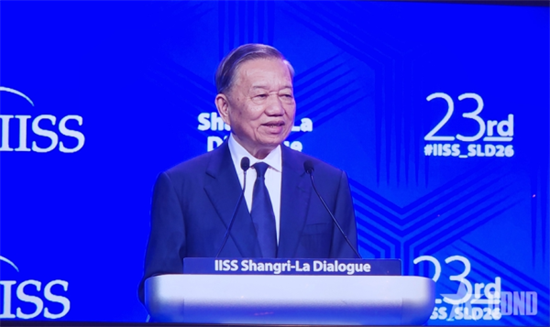 |
| General Secretary of the Communist Party of Vietnam To Lam delivers the keynote speech at the Shangri-La Dialogue 2026 |
Three fundamental crises
All presentations and discussions at the Forum highly agreed with the assessment that the global political and security situation is emerging with three fundamental crises including the international order, the development model, and strategic trust.
Regarding the crisis of the international order: after the dissolution of the Soviet Union in 1991, the bipolar world order came to an end, opening a period of profound realignment in the international political landscape. The United States and its Western allies have strived to establish and dominate a unipolar order, which they refer to as a “rules-based world order”. In fact, the “rules” here were not the United Nations Charter and universally recognised international laws, but rather the “rules” imposed by the US and the West. Meanwhile, Russia, China, India, and non-Western countries have still advocated building a multipolar world order based on the United Nations Charter. Therefore, although the UN Charter is still adhered to by the majority of countries worldwide, its effectiveness has declined as the basic principles of international law continue to be interpreted and implemented in a subjectively imposed manner. Consequently, many small and medium nations are facing the risk of being drawn into geopolitical competitions, pressure to choose sides, and coercion in economy, technology, finance, and security.
Regarding the crisis of the development model: after the collapse of the system of socialist countries in Eastern Europe and the Soviet Union, the US and the West vigorously promoted the theory of “the end of history”, arguing that neoliberal capitalism is the final development stage of human beings. However, after over three decades, this model has fallen into a profound crisis and is struggling in a “great restructuring”. Meanwhile, several countries have achieved remarkable accomplishments by choosing a suitable development path. China has achieved brilliant success on the path of building socialism with Chinese characteristics; Vietnam has also gained great, historically significant achievements on the path of socialist-oriented development. Other non-Western countries are having to choose their own development models under various pressures, such as slowing growth, rising public debt, climate change which are threatening the livelihoods of hundreds of millions of people, growing social inequality, trade barriers, energy and food crises, etc. This reality surely demonstrates that there is no single development model which could be appropriate for all countries.
To overcome the current systematic crisis, the international community desperately needs to build and consolidate the strategic trust among nations. In reality, however, the world has fallen into a deepening crisis of strategic trust, with various manifestations including the fact that (1) Countries easily view one another's actions through a lens of suspicion and insecurity; (2) The defensive moves of any nation are likely to be misinterpreted as provocations; (3) Conflicts of interest potentially escalate into confrontations; (4) Due to the lack of dialogue, contact, and self-restraint, even a minor incident could trigger a spiral of reactions; (5) The achievements of the Fourth Industrial Revolution, while broadening development capabilities, are also becoming tools for competition and conflicts.
Security partnerships in a fragmented world
The discussion session in the Forum on the “Security partnerships in a fragmented world” best reflected the current trend of geopolitical restructuring. In the session, all speakers argued that the world is entering a period of strategic polarisation, declining trust among major powers, and the rise of mini-lateral cooperation mechanisms instead of fixed military alliances as in the Cold War era. In this context, many Asian countries do not want to be put in a position of having to choose between the US and China - two leading powers which are competing with each other for their global influence. Hence, the message of the countries in the region is to diversify the defence relations, build the strategic autonomy, and expand the multilateral cooperation instead of relying on a single major power. Notably, some presentations argued that Japan is emerging as a new centre of the regional defence cooperation network by expanding its defence exports and military-technological cooperation, and strengthening its ties with Australia, the Philippines, and other Southeast Asian countries.
Security challenges in the region
The regional security environment is becoming increasingly complex and unpredictable due to the intertwining of some emerging non-traditional challenges and traditional geopolitical hotspots. The rapid development of science and technology has accelerated the formation of new, complex, and more unpredictable non-traditional security threats. The application of artificial intelligence in defence could lead to the emergence of next-generation autonomous weapons, shorten the decision-making time, and easily escalate the unintended conflicts. Cyberattacks targeting the energy infrastructure, the financial systems, and the military command, along with the disruption of strategic supply chains, are being turned into tools for political pressure and economic deterrence among major powers.
In particular, the Asian maritime space is facing the severe maritime security disruptions, which concentrate in three key areas. In the East Sea, the inability of China and ASEAN to reach a final agreement on the Code of Conduct (COC) has made the sovereignty disputes prolonged with no clear ending. The risk of collision among the law enforcement, semi-military, and military forces at sea has made this area one of the largest potential crisis hotspots in the region. Meanwhile, the Taiwan strait remains as the most sensitive flashpoint in the US - China standoff, so that any miscalculation in here could spark a large-scale crisis, which directly threatens the flow of global supply chains. Finally, the security of seabed infrastructure, in particular, the submarine fibre-optic cable network - the vital information lifeline in the world - is facing the risk of being severely sabotaged, forcing all countries to expand their cooperation and deploy the unmanned underwater vehicles to safely protect this strategic infrastructure.
The strategic approach of the US to the region
The presentation by the U.S. Secretary of War Pete Hegseth on the “U.S. Strategy for peace in the Indo – Pacific region” attracted significant attention at the Forum. The delivered messages clearly outlined the Washington's strategic direction for this region in the forthcoming time, which focuses on the 05 main contents as follows:
Firstly, as a Pacific coastal nation, the United States affirms its long-term commitment to the Indo - Pacific region and will continue to maintain its enduring military, diplomatic, and economic presence in the region. Washington totally rejects all claims that the U.S. is retreating from Asia, while firmly asserting that the Indo – Pacific region remains as the region of its top strategic priority.
Secondly, the U.S. views China as its primary strategic challenge and also shows its concern about the speed of Beijing's military modernisation and the expansion of influence. At the same time, it will not allow any country to establish a hegemonic position in the region. However, the U.S. still leaves the door open to maintaining a stable and constructive relationship with China.
Thirdly, the era of the United States unilaterally bearing the security costs for wealthy nations has ended. The U.S. is pushing all regional allies to share the burden of security, requiring them to increase the defence investments to enhance their self-defence capabilities. At the same time, it aims to build alliances based on shared responsibilities rather than ally dependency on the U.S.
Fourthly, Washington advocates building a multi-layered joint security network. As a result, the U.S. will enhance its cooperation with all allies and partners, such as Japan, Australia, India, the Philippines, and other Southeast Asian countries, in order to create a network of deterrence and ensure a balance of power in the region.
Fifthly, the strategy of peace is through strength and deterrence. All presenters argued that peace can only be guaranteed when the U.S. and its allies maintain their sufficient military superiority to prevent coercion or the use of force. The U.S. strategy focuses on military modernisation, enhancing the joint operational capabilities, and developing the advanced defence technologies.
Generally, the 2026 Shangri-La Dialogue did send a strong message that in such an increasingly polarised, competitive, and deeply interdependent world, no country could ensure its security and prosperity through confrontation or imposition.
Power does not lie in the imposition or coercion, but in the capacity for dialogues, building the strategic trust, respecting international law, and joining hands to act for an international order of justice, peace, stability, and prosperous development.
Senior Colonel LE THE MAU, A former official of the Institute for Defence Strategic Studies