Developing the state economy with its full leading role - A task of strategic importance
The success of the 14th National Congress of the Party has marked the strategic vision, and strong aspiration of our nation in the new era. In particular, “Developing the state economy effectively, truly playing the leading role…” was identified as a key task of strategic breakthrough, a political determination of the entire Party, People, and army, requiring thorough study and effective implementation in practice.
Thoroughly studying and creatively applying Marxism-Leninism and Ho Chi Minh thought on economic development in the transitional period to socialism, our Party has consistently affirmed the leading position and role of the state economy in the national economy.
Through successive Party Congresses, the Party's theoretical understanding of the state-owned economy has been continuously supplemented, developed, and perfected, aligning with the requirements of building a socialist-oriented market economy in Vietnam. In particular, based on the review of theoretical and practical issues over 40 years of national renewal, the 14th National Party Congress persisted in: “Effective development of the state-owned economy, truly is a leading role in ensuring macroeconomic stability, major balances, strategic orientation, and leading the economy…”. This represents an inheritance and development of the Party's theoretical thinking on the position and role of the state-owned economy in the new context. At the same time, it clearly defines the need to improve the efficiency of this sector in building an independent and self-reliant economy, linked to deep international integration and sustainable national development in the new era.
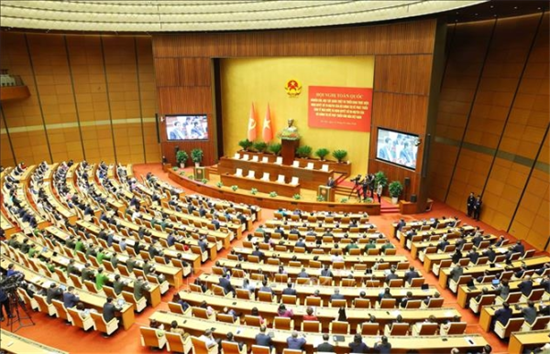 |
| Conference on Resolution No.79-NQ/TW of the Politburo on the development of state economy (Photo: qdnd.vn) |
In order to achieve the above objective, it is necessary to continue deploy a number of solutions synchronously to create a substantial transformation in implementation, focusing on the following key ones:
In the first place, strengthening the Party's leadership and improving the effectiveness and efficiency of state management over the state-owned economic sector, while unlocking, liberating, managing, exploiting, and effectively utilising state-owned economic resources. This requires the Party and State to continue to strongly innovate both their thinking and leadership methods in the development of the state-owned economy, moving from “policies and directions” to “action and breakthroughs”; from “saying the right thing” to “effective implementation”. All policies and guidelines of the Party and State related to the state-owned economy must aim to enhance competitiveness, operational efficiency, and the ability to lead other economic sectors to develop. Emphasis should be placed on improving the quality of leadership, guidance, and implementation by Party committees, Party organisations, managerial agencies, and state-owned enterprises.
Furthermore, there is a need to continue innovating the methods of state management towards constructive development, modern governance, decisive action, using practical effectiveness as a measure. Accelerate administrative reform, decentralisation, and empowerment, coupled with strengthened inspection, supervision, and power control; ensure transparency in governance and administration; promote autonomy and accountability of relevant stakeholders.
To unlock, mobilise, and effectively utilise state economic resources, in the coming time, it is necessary to comprehensively review, compile, standardise, and digitise all public assets owned and managed by the State. Based on this, we must implement full and transparent management and accounting according to market principles, ensuring efficient allocation and utilisation of resources. Furthermore, it is necessary to continue improving the institutions for development, promptly removing bottlenecks in mechanisms, policies, and administrative procedures that are hindering the mobilisation, allocation, and utilisation of state economic resources; build a transparent, stable, and favourable investment and business environment to effectively mobilise and utilise resources. In particular, it is essential to tighten discipline and order in the management, exploitation, and utilisation of state economic resources; promote decentralisation and empowerment coupled with inspection, supervision, and power control; resolutely prevent and combat losses, waste, corruption, negative practices, group interests, and all acts of exploiting policies for personal gain. Through this, a substantial transformation will be achieved in mobilising and utilising development resources, meeting the requirements of rapid and sustainable national development in the new era.
Secondly, enhancing the leading role of the state economy in ensuring macroeconomic stability, maintaining major balances, and guiding the economy. Our country's economy is a socialist-oriented market economy with multi-ownership structure and different economic sectors developing together, in which the state economy plays the leading role. The state-owned economy provides a crucial “material force” for the State to perform its functions of macroeconomic regulation, development orientation, and ensuring the socialist orientation of the economy. However, it is important to understand that enhancing the leading role of the state-owned economy does not necessarily mean the state subsidies or administrative intervention in market activities, but to improve the efficiency, competitiveness, and influence of the state-owned economic sector. This enables the state to effectively fulfill its role in fostering development, regulating and stabilising the macroeconomy, maintaining major balances, and guiding the socialist economy strategically. To realise this goal, it is imperative to focus on developing key, essential sectors and fields that are strategically important to the country's security, economic sovereignty, and self-reliance of the country. Continue to improve the capacity to forecast, regulate, and respond to policies, contributing to maintaining macroeconomic stability, controlling inflation, ensuring major economic balances, and creating a foundation for successfully achieving the country's development goals for the 2026-2030 period.
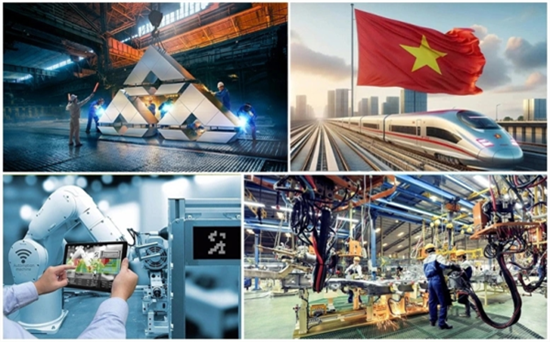 |
| An illustrative photo of key industries and technologies (Photo: vov.vn) |
Moreover, central ministries and agencies should thoroughly study and effectively implement the guiding principle of General Secretary and President To Lam that: “The state-owned economy must occupy the “strategic command heights” of the economy, play a leading role, and become the “national fulcrum” in the new era”, and must develop “five major pillars”: economic security and sovereignty; regulation, stability, and resilience; leadership for the private sector; leadership in innovation and core technologies; and governance standards and public service integrity in the economy.
Striving to make the state-owned economy truly be the pioneering force in implementing the strategic goals set by the 14th National Party Congress, contributing to “achieving an average annual GDP growth rate of 10% and above for the period between 2026 and 2030; GDP per capita reaching approximately US$8,500 by 2030; the proportion of processing and manufacturing industries reaching approximately 28% of GDP; and the proportion of the digital economy reaching approximately 30% of GDP”; etc.
Thirdly, developing the state-owned enterprises (SOEs) into a core and pioneering force in key industries and sectors. SOEs are both production and business entities, as well as a core economic force and a tool for macroeconomic regulation of the State, contributing to economic, political, social, defence, and security stability, and enhancing the resilience of the economy. Therefore, continuing to restructure the SOEs to make them streamlined in structure, effective in production and business with improved administrative capacity and competitiveness on a regional and global levels, is an objective necessity and a strategic task to strengthen national potential and enhance the self-reliance of the economy in the context of increasingly deep international integration.
To gain the strategic breakthrough, it is necessary to focus on developing the SOEs in sectors requiring large resources, high technology, long payback periods, and of particular importance to the country's development in the new era, such as: science, technology, electronics - telecommunications, digital infrastructure; exploitation and processing of strategic minerals, chemicals, manufacturing industry, new materials industry, semiconductors, etc. SOEs should be encouraged to proactively research and apply modern technology, master fundamental and core technologies, and improve their productivity, quality, efficiency, and competitiveness. At the same time, a number of strong, large-scale economic groups with modern technology and regional and international competitiveness should be gradually formed to lead domestic enterprises to participate more deeply in the global supply chains.
Fourth, promoting the pivotal role of the state-owned economy in accelerating the industrialisation, modernisation, restructuring the economy, and forming new growth models. There is a need to focus on developing foundational industries, manufacturing and high-tech industries, digital infrastructure, new energy, new materials, semiconductors, and sectors capable of creating breakthroughs in productivity, quality, and national competitiveness. At the same time, it is necessary to speed up the implementation of key national projects, especially strategic infrastructure projects, creating new development opportunities and promoting regional and sectoral linkages. In particular, building an independent and self-reliant economy requires that the pioneering role of the state-owned economy in research, application, and transfer of science and technology, innovation, and digital transformation must be promoted as the main driving force. SOEs and state-owned economic groups should take the lead in building an innovation ecosystem, mastering core and strategic technologies, gradually improving technological self-reliance, reducing dependence on external sources, and enhancing their ability to participate in global supply chains.
To form a new growth model, it is necessary to rapidly change to development based on productivity, quality, efficiency, science and technology, and high-quality human resources instead of resource exploitation, investment capital, and cheap labour; promote the development of the digital economy, green economy, and circular economy; foster green transformation in production and consumption; and improve the efficiency of resource and energy use and environmental protection. Through its leading role, the state-owned economy should foster the formation of new industries, new production methods, and new, high-quality productive forces, contributing to increased labour productivity, enhanced national competitiveness, and the successful realisation of the country's industrialisation and modernisation goals.
Thoroughly studying and successfully implementing the viewpoint and policy of developing the state economy with its true leading role is a particularly important political task for the entire Party, the entire People, and the entire Military, contributing to building Vietnam into a peaceful, independent, democratic, prosperous, civilised, happy country steadily advancing towards socialism.
Sr. Col., Assoc Prof, Dr. NGUYEN SY HOA, Army Academy