The principle of “man before weapons” in military modernisation cannot be distorted
In order to sabotage the Party's policies and guidelines on military building, hostile forces are actively distorting the truth, claiming that the principle of “man before weapons” is no longer valid in the context of military modernisation and the development of high-tech weapons. In essence, this is a scheme to deny the decisive role of the human factor and to weaken the political and spiritual foundation of our military; therefore, it must be resolutely fought against and refuted.
The principle of “man before arms” is one of the core tenets in the military ideology of the Party and President Ho Chi Minh regarding the construction of revolutionary armed forces.
The essence of this principle is neither to absolutise the human factor nor to underestimate the role of weapons and equipment, but rather to affirm the dialectical relationship between humans and weapons. In this relationship, weapons and equipment are important material factors, while humans play the central role as the subjects who create, organise, manage, deploy, and utilise them, thereby determining the effectiveness of these weapons and equipment. Therefore, in all stages of the revolution, particularly when building a modern military, it is necessary to simultaneously focus on human development and the modernisation of weapons and equipment, however, human development must always remain the pivotal element, playing a decisive role in the overall quality, combat power, and the military's capacity to accomplish all of its missions.
Currently, alongside the robust development of the Fourth Industrial Revolution and the global process of military modernisation, the methods of conducting warfare have undergone profound changes. Exploiting this reality, hostile forces have intensified their distortion of the “man before arms” principle across websites, forums, and various social media platforms. They claim that modern warfare is merely “a contest of technology, artificial intelligence, big data, smart weapons, and automated combat systems”; therefore, technology and weapons are the decisive factors, while humans play only a secondary role. Based on this fallacious argument, they assert that the “man before arms” principle is obsolete and no longer aligns with the requirements of building a modern military. More dangerously, certain individuals deliberately create a contrast between building a politically strong military and military modernisation; they falsely claim that emphasising political and ideological education, along with cultivating the fortitude and qualities of military personnel, will “waste time” and “reduce resources” for the modernisation of weapons and equipment.
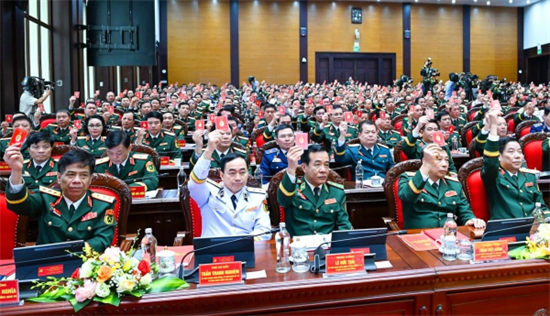 |
| Voting on the approval of the Resolution of the 12th Military Party Congress |
In essence, this is a malicious scheme aimed at denying the fundamental principles of Marxism-Leninism and Ho Chi Minh's ideology on war and the military. It seeks to deny the decisive role of the human factor in the military's combat power, thereby downplaying the significance of Party work and political work, gradually denying the principle of the Party's absolute, direct, and comprehensive leadership over the military, while promoting the plot to “depoliticise” the military. Therefore, accurately identifying the nature and tactics of these erroneous viewpoints and resolutely fighting to refute them is a critical requirement for firmly safeguarding the Party's ideological foundation, and for maintaining the revolutionary nature and combat power of our military in the new situation.
Firstly, the principle of “man before arms” has a solid foundation based on the fundamental principles of Marxism-Leninism and Ho Chi Minh's ideology regarding the role of humans in history and in war. Marxism-Leninism affirms that humans are the subjects creating history; in military activities, humans determine the organisation and conduct of war, as well as create, master, and effectively utilise the material means of war. V.I. Lenin pointed out: “In every war, victory ultimately depends on the morale of the masses who are shedding their blood on the battlefield”. Inheriting and creatively developing this viewpoint, President Ho Chi Minh consistently placed the human factor at the centre, emphasising its decisive role in the combat power of a revolutionary military. According to him, no matter how modern weapons and equipment may be, they remain merely material tools researched and manufactured by humans; their power can only be fully harnessed through individuals possessing steadfast political resolve, high combat morale, and the capacity to master military science and technology: “weapons are necessary, but more important are the people carrying them”.
The evolving reality of modern warfare does not alter this principle. The emergence of artificial intelligence, big data, smart weapons, and automated systems only changes the methods of combat; it cannot replace the role of humans in researching, designing, manufacturing, and utilising weapons and equipment, nor in strategic planning, command, and operational decision-making. Therefore, using the development of military science and technology to deny the principle of “man before arms” is a one-sided perspective lacking a scientific basis. On the contrary, the very development of modern military science and technology further reaffirms the decisive role of the human factor and the consistent value of the principle in the new context.
Secondly, both the history of our nation and the reality of global warfare affirm a truth: humans are the decisive factor in combat power and the outcome of wars. The history of building and defending the nation of Vietnam serves as a vivid testament to this principle. Despite constantly facing enemies with overwhelming superiority in economics, military and weaponry, our nation has consistently secured victory by highly promoting the strength of patriotism, the will for independence and self-reliance, the spirit of great national unity, and a unique and creative military art. From historic victories such as Bach Dang and Chi Lang - Xuong Giang, to the resistance wars against colonialism and imperialism, as well as in the battles to defend the Fatherland during the Ho Chi Minh era, one truth has been consistently affirmed: superiority in weaponry does not necessarily mean ultimate victory. Rather, it is humans - armed with political fortitude, intellect, determined will, and the organisational capacity to harness comprehensive strength - who are truly decisive.
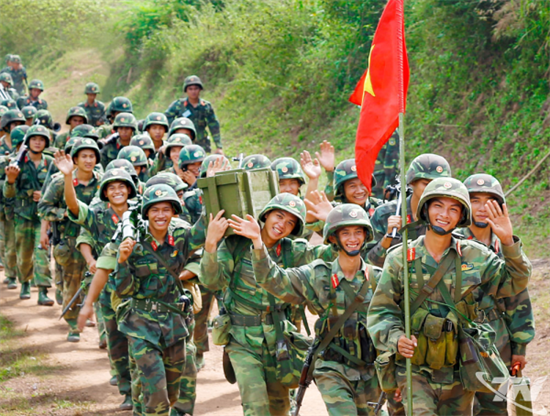 |
| Troops of Division 3, Military Region 1 express their excitement after training |
The reality of the contemporary world continues to affirm this unchanging principle: military strength cannot be measured solely by the size of forces or the modernisation of weapons and equipment; rather, it depends directly on the human factor and the political - spiritual foundation. The collapse of the Soviet Union and the upheavals in Eastern Europe in the late 20th century offer a profound lesson: even when possessing a powerful military force and a wide range of modern weapons, once the ideological foundation is eroded, the leadership role of the Communist Party is lost, and political ideals and beliefs decline, national military strength inevitably weakens from within. Today, despite the continuous development of artificial intelligence, unmanned vehicles, smart weapons, and advanced military technologies, every strategic decision, the organisation and deployment of forces, and the outcome of war still depend on humans. This demonstrates that while the modernisation of weapons and equipment is an inevitable requirement, the combat power of our military is, first and foremost, built upon the political fortitude, fighting ideals, willpower, discipline, and belief in victory of our cadres and soldiers. This serves as a proof of the enduring value of the “man before arms” principle in building a modern military.
Thirdly, the 80-plus years of building, fighting, winning, and maturing of the Vietnam People's Army serves as a direct testament refuting all fallacious arguments that distort and deny the “man before arms” principle. From its establishment with only 34 soldiers and rudimentary weapons, our military was built primarily upon a solid political foundation, noble fighting ideals, and the absolute, direct, and comprehensive leadership of the Party. The history of the Vietnamese revolution demonstrates that all national victories stem from the maximisation of human strength, the core of which is the political - spiritual factor. The success of the August Revolution of 1945 was the result of the art of seizing opportunities and harnessing the strength of the entire nation. The victory at Dien Bien Phu in 1954 was forged through the spirit of “All for the front, all for victory”, transforming material deprivation into an invincible spiritual strength that defeated a professional army equipped with modern weapons and equipment. The Great Victory of Spring 1975 further affirmed Vietnamese mettle and intellect through the art of strategic direction characterised by being “rapid, bold, unexpected, and certain victory”, realising the aspiration: “We would rather sacrifice everything than lose our country, and be enslaved”. These victories demonstrate that military strength lies first and foremost in political fortitude, the will for independence, confidence, and organisational capacity to unleash human potential.
Entering a new era of national development, the “man before arms” principle continues to serve as a guiding force in building a military that meets the requirements of defending the Fatherland. The 14th National Congress of the Party set the objective of building the People's Army to be “revolutionary, regular, elite, and modern”; making breakthroughs in developing the defence industry in the direction of being “autonomous, self-reliant, self-strengthening, dual-use, and modern”, thereby gradually mastering foundational technology, core technology, advanced and dual-use technologies, and key sectors. On this basis, military building is implemented synchronously across human, organisation, weapons and equipment, with humans playing the central role in determining overall quality and combat power.
In the current context, “man first” entails building a team of cadres and soldiers who possess steadfast political fortitude, pure moral qualities, and strict discipline; it also involves focusing on cultivating a contingent of “digital soldiers” equipped with innovative thinking and the capacity to master advanced science, technology, and modern combat systems. Therefore, military modernisation is not merely about upgrading weapons and equipment, but above all, it is the modernisation of the human element, ensuring personnel possess the necessary qualities and capabilities to master and effectively utilise modern weaponry and equipment. This continues to affirm the enduring value of the “man before arms” principle in building the Vietnam People's Army today.
Any distortion or denial of this principle aims to misrepresent the source of our military's strength, thereby impacting its revolutionary nature and the principle of the Party's absolute, direct, and comprehensive leadership over the military. Consequently, it is necessary to proactively identify and resolutely combat to refute these erroneous and hostile viewpoints; at the same time, we must continue to thoroughly grasp and correctly apply the “man before arms” principle in building a revolutionary, regular, elite, and modern People's Army, thereby meeting the requirements for defending the Fatherland in the new era.
Senior Colonel, Dr. DANG TRUONG MINH, Deputy Head of the Faculty of Marxism-Leninism and Ho Chi Minh’s Ideology, Military Technical Academy