Refuting distortions of personnel work of the Communist Party of Vietnam in the current context
As our Party leads the country into pivotal revolutionary periods, hostile forces intensify their efforts to distort and sabotage the Party’s personnel work. They aim to misrepresent the scientific and revolutionary nature of personnel work, thereby undermining the people’s trust in the Party. Hence, accurately identifying and resolutely combating these plots have become an urgent task today.
During the history of leading the Vietnamese revolution, our Party has always grasped the position, role, and importance of cadres and personnel work, regarding them as a decisive factor in the success of the revolution as well as a pivotal step of Party and political system building. For this very reason, personnel work has become hostile forces’ main focus with their increasingly sophisticated tactics and more direct objectives, especially under current circumstances. Their focal points are as follows.
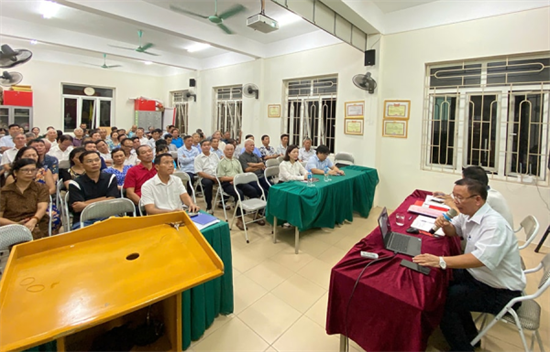 |
| A routine meeting of a party cell at Long Bien ward, Hanoi City in October 2025 (photo: dangcongsan.org.vn) |
First, taking advantage of personnel preparations for the 14th National Party Congress, hostile forces directly distort and attack personnel work. They falsely claim that personnel work is “imposed” and “non-transparent”, portraying the Congress merely as a mechanism for “legitimising pre-arranged personnel decisions”, thus fabricating allegations regarding “group interests” and “the preservation of power”. In fact, this is a conspiracy of sabotage aimed at eroding political trust and denying the Party’s leadership role at a critical juncture.
Second, they distort the Party’s policy of streamlining the political system’s apparatus and personnel restructuring as “internal power struggles” and “factional purges”, with the intention of sowing suspicion, provoking internal divisions, and weakening social consensus. In essence, they conspire to undermine unity in personnel work and the Party’s leadership as well.
Third, exploiting the Party’s strict handling of violations of Party discipline and State law committed by cadres, including high-ranking ones, hostile forces deliberately label the Party’s personnel work as “erroneous”, “out of control”, and “corrupted by power”. They then claim that the Party “lacks the capacity to select competent cadres”, which allegedly explains why “many cadres have become degenerate”. Their purpose is to deny the Party’s self-rectification and self-renewal capacity and political mettle as a ruling Party. These arguments are not only intellectually flawed, but also conceal malicious political motives aimed at weakening the Party’s leadership and ultimately denying the socialist path that our people have chosen and determined to follow. Such allegations must, therefore, be clearly identified and firmly refuted via scientific reasoning and vivid practical evidence.
From a theoretical perspective, historical practice and political science prove that no ruling political party can maintain its leadership if it neglects the building, management, and strict supervision of its members. Loosening discipline and lacking mechanisms for screening and power control in personnel work inevitably lead to degeneration among leaders, erosion of political credibility and public trust, and even political crises. This is an objective and universal law, irrespective of political systems or ideologies.
Accordingly, Marxism - Leninism has scientifically elucidated the crucial role of personnel work in revolutionary causes and the survival of a revolutionary party. V.I. Lenin affirmed: “Give us an organisation of revolutionaries, and we will overturn Russia”. He required ruling parties to constantly engage in self-rectification and resolutely eliminate opportunistic, degenerate, corrupt members, considering any compromise with mistakes in personnel work as detrimental to a communist party’s leadership capacity and combativeness.
Inheriting and creatively developing Marxism - Leninism, President Ho Chi Minh consistently regarded cadres as “the root of all work”, affirming that “training cadres is the Party’s foundational task”, emphasising that “success or failure in every undertaking depends on whether cadres are competent or not”. He stressed that building a pure and strong Party must begin with personnel work. In his view, proper education, training, cultivation, and utilisation of cadres enable the Party to preserve its revolutionary nature, enhance its leadership capacity and combativeness, and cement its bond with the masses.
President Ho Chi Minh pinpointed, “A Party that conceals its shortcomings is a corrupt Party”. Conversely, a Party that dares to acknowledge its shortcomings and “seeks every possible way to correct them is a progressive, courageous, steadfast, and genuine Party”. Therefore, each Party “must constantly rectify its organisation and expel degenerate members”. It is an objective law ensuring the purity, strength, and sustainable development of a revolutionary political party.
Based on this theoretical foundation, the Communist Party of Vietnam has continuously renewed its thinking and refined its viewpoints on personnel work, consistently considering this work as a pivotal step in Party building. Emphasis has been placed on controlling power, closely combining “building” with “fighting”, integrating prevention as a long-term, fundamental measure with struggle as an urgent, important task, clearly showing a scientific understanding of the laws for the existence and development of a ruling political party.
The practical achievements of the Party’s personnel work have provided the most convincing evidence refuting all distortions.
First, personnel work and preparations for the 14th National Congress have been carried out on the basis of a comprehensive, rigorous, increasingly refined system of viewpoints, policies, resolutions, and regulations, thereby reflecting the Party’s scientific, consistent, coherent strategic thinking throughout the revolutionary periods. Accordingly, personnel work has been conducted through a multi-stage process, with internal democracy being promoted and the responsibility of party committees and organisations being heightened, thus ensuring unity, objectivity, and Party discipline. For that reason, the distortions that personnel work is “imposed” or “pre-arranged” are entirely groundless. The strict management of personnel information is not intended to “conceal group interests”, as hostile forces falsely allege, but rather to uphold principles and maintain political stability during key national events.
Second, personnel work has directly contributed to robust, sustainable socio-economic development. Notably, “Vietnam’s economic scale in 2024 exceeded $470 billion, ranking 32nd globally, placing the country among the top 20 economies in terms of trade and foreign investment attraction”. In 2025, GDP growth reached 8.02%, with GDP exceeding $514 billion. The multidimensional poverty rate declined to only 1.93%; Vietnam ranked 46th out of 143 countries and territories in the World Happiness Index; indicators relating to human development, social welfare, education, and healthcare have continued to improve. “Our country has never possessed such fortune, potential, international standing and prestige as it does today”. These achievements are the direct results of the effective leadership, direction, and task performance by cadres from central to grass-roots levels, thereby refuting allegations that the Party’s personnel work is “erroneous”, “out of control”, or that the Party “lacks the capacity to select competent cadres” as hostile forces deliberately distort.
Third, realities of streamlining the political system’s apparatus and reorganising the contingent of cadres have directly disproven allegations that these reforms represent “internal conflicts” or “factional purges”. Apparatus streamlining is not merely an organisational or resource-related measure; it is a strategic choice aimed at enhancing leadership, management, and administration effectiveness, ensuring the smooth, efficient realisation of lines and policies of the Party and State. In fact, these reforms have reduced intermediary layers, addressing overlapping functions and tasks, downsizing manpower, raising the quality of cadres, civil servants, and public employees, strengthening discipline, enhancing the operational effectiveness and efficiency of the political system.
Fourth, Vietnam’s international position and prestige continue to rise. At present, Vietnam has established official diplomatic relations with 195 countries worldwide (including 193 United Nations member states), maintaining strategic and comprehensive partnerships with 30 countries, including all five permanent members of the United Nations Security Council, the G7 countries, and all ASEAN member states. Vietnam is also an active and responsible member of more than 70 regional and global organisations and multilateral forums. This national prestige directly reflects the strategic vision, political resolve, and task performance of the contingent of cadres, especially at strategic level, thus refuting allegations that the Party’s personnel work is “imposed”, “pre-arranged”, or lacks genuine credibility.
Fifth, the Party’s strict handling of violations of regulations committed by cadres, including high-ranking ones, has directly refuted claims that the Party’s personnel work is “erroneous”, “out of control”, or characterised by “power degeneration”. The timely, principled, uncompromising handling of violations under the spirit of “no forbidden zones” and “no exceptions” does not reveal weaknesses in personnel selection, but constitutes vivid evidence of the ruling Party’s political courage, self-rectification capacity, and determination for internal purification. It also demonstrates that personnel work is an ongoing process of self-improvement, disciplined management, and effectiveness aimed at preserving the Party’s revolutionary nature and leadership capacity.
The above realities demonstrate that the Party’s system of viewpoints and policies on personnel work, when implemented seriously and consistently, generates tremendous, comprehensive, and historic achievements for the country. The contingent of cadres, under the Party’s leadership, management, and training, has become increasingly mature, “dynamic, creative, dare to think, dare to speak, dare to act, dare to take responsibility, dare to confront difficulties and challenges, and take resolute action for the common good”, thereby meeting their task requirements in the new situation. In conclusion, all distortions against the Party’s personnel work, which are devoid of theoretical basis and unable to withstand practical scrutiny, must be resolutely contested and refuted.
Col. DANG VAN KHUONG, PhD
Faculty of Marxist - Leninist Philosophy
Political Academy