National independence and socialism - A consistent objective that cannot be distorted
The 14th National Congress of the Communist Party of Vietnam concluded with great success. Among its important outcomes was the Party’s continued affirmation of the consistent principle of “steadfastly upholding the goal of national independence and socialism.” Nevertheless, driven by malicious intentions, hostile forces, reactionary elements, and political opportunists have intensified their distortion and sabotage activities through increasingly sophisticated and deceptive means, seeking to deny the Party’s leadership role and ultimately abolish the socialist regime in Vietnam. Yet, the more fiercely they attack this principle, the more they inadvertently reaffirm that steadfast adherence to the goal of national independence and socialism remains the consistent choice of the Vietnamese revolution - one grounded in a solid theoretical foundation and validated by practical experience, and therefore incapable of being distorted or denied.
Hostile forces, reactionary elements, and political opportunists continue to cling to and deliberately repeat an outdated argument: that in today’s world of globalisation and international integration, capitalism has become and will remain the dominant global system, with the vast majority of countries either being capitalist states or pursuing a capitalist path of development; therefore, Vietnam cannot persist indefinitely in its socialist orientation. Based on this erroneous perception, they claim that the principle of “steadfastly upholding the goal of national independence and socialism” is obsolete, outdated, and incompatible with the prevailing trends of the age.
What these hostile forces either fail to understand - or deliberately choose to ignore - is the law-governed course of development of both human history and the history of the Vietnamese nation. The historical development of human society from ancient times to the present has demonstrated that the Marxist-Leninist theory of socio-economic formations possesses a profoundly scientific and revolutionary character, objectively reflecting the laws governing the movement and development of human history in a progressive direction.
The theory of socio-economic formations constitutes one of the fundamental theoretical and methodological foundations of Marxism-Leninism. It provides a framework for approaching, studying, explaining, and forecasting the historical and natural development of human society in general and of individual nations in particular. Through their analysis of socio-economic formations, the founders of Marxism-Leninism elucidated the nature and laws governing the movement and development of each social system, while also identifying the internal contradictions that inevitably lead to the replacement of one socio-economic formation by another in the course of history. Accordingly, the transition from one socio-economic formation to another may occur either through a gradual evolutionary process or through dialectical leaps in development; however, such transitions invariably conform to the objective laws of history. From this perspective, capitalism will ultimately be superseded by a more advanced social system - communism, the initial stage of which is socialism.
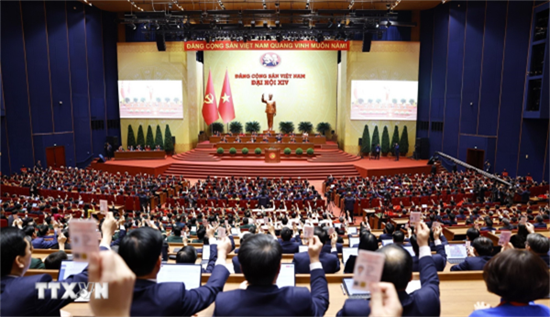 |
| The 14th National Congress of the Communist Party of Vietnam is persistent with the goal of national independence and socialism (Photo: VNA) |
The practice of the Vietnamese revolution has demonstrated an objective and immutable principle: national independence is inseparably linked with socialism. This has been the fundamental and consistent line of the Vietnamese revolution and constitutes a core element of Ho Chi Minh Thought. Throughout more than nine decades of revolutionary leadership, our Party has remained steadfast in its goal and ideal of national independence and socialism. As affirmed by the Party, “This is a matter of principle, of vital significance to our regime; it constitutes the Party’s firm foundation and permits no wavering or vacillation.” In the Platform for National Construction during the Transition to Socialism (the 1991 Platform), the Party consistently reaffirmed: “Firmly uphold the banner of national independence and socialism. This is the enduring lesson running throughout the course of our revolution.” At the same time, it emphasised that: “The entire Party and people must continue to hold high the banner of national independence and socialism - the glorious banner entrusted by President Ho Chi Minh to the present generation and to future generations.” The dialectical relationship between national independence and socialism was clearly defined: “National independence is the prerequisite for the realisation of socialism, and socialism provides the firm guarantee for national independence.” National independence constitutes the essential premise and fundamental condition for building socialism; conversely, the building of socialism creates an increasingly solid foundation for national independence - an independence that is genuine and comprehensive, enabling the nation to overcome poverty and backwardness and to advance towards greater prosperity, democracy, civilisation, justice, and equality.
Throughout successive Party Congresses, the Communist Party of Vietnam has consistently and profoundly upheld the lesson that: “Throughout the process of renewal, it is essential to remain steadfast in the goal of national independence and socialism on the foundation of Marxism-Leninism and Ho Chi Minh Thought.” The Party has consistently affirmed that advancing towards socialism is the aspiration of the Vietnamese People, the correct choice made by the Communist Party of Vietnam and President Ho Chi Minh, and one that is in accordance with the developmental trend of history. The Party has further stressed that: “Under any circumstances and in any situation, it is necessary to persist in implementing the line and objectives of renewal; to steadfastly uphold, creatively apply, and further develop Marxism-Leninism and Ho Chi Minh Thought; and to remain committed to the goal of national independence and socialism.” It has also emphasised that: “Through steadfastness and continuous innovation in the understanding of socialism, and by firmly upholding the banner of ‘National Independence and Socialism,’ the renewal process has achieved great accomplishments of historic significance. Our country has never before possessed such fortune, potential, international standing, and prestige as it does today.” This constitutes compelling evidence of the correctness of Vietnam’s creative approach to resolving the relationship between national independence and socialism.
In the Report reviewing a number of theoretical and practical issues concerning forty years of socialist-oriented renewal in Vietnam, adopted at the 14th National Party Congress, the Party affirmed: “The development of theoretical understanding of the inseparable relationship between national independence and socialism continues to uphold the ideological and theoretical banner of “National Independence and Socialism”, affirming the unity and inseparability of the two strategic tasks of the Vietnamese revolution: building socialism and defending the Socialist Republic of Vietnam.” In his closing remarks at the Second Plenum of the 14th Party Central Committee, General Secretary To Lam emphasised: “Cadres and Party members throughout the Party must continue to thoroughly internalise and consistently implement the ‘Four Commitments’ in political and ideological work. Alongside steadfastly upholding, creatively applying, and developing Marxism-Leninism and Ho Chi Minh Thought, commitment to the goal of national independence and socialism is a historical choice, the guiding thread running throughout the entire course of the Vietnamese revolution, and the ideal and objective of our Party. Under any circumstances and conditions, and especially in the face of difficulties and challenges, we must maintain unwavering faith, courage, and determination in the path chosen by our Party, our State, and our People.”
The practical experience of the Vietnamese revolution over the past nine decades has demonstrated that the choice of national independence in association with socialism made by our Party and People is both an objective necessity and a reflection of the developmental trend of the age. The two are dialectically interconnected and have become a consistent and enduring objective, serving as the guiding principle for the Vietnamese revolution - an objective that cannot be distorted or denied. National independence and socialism are not only a goal, an inevitable requirement, a programme of action, and a banner of mobilisation, but also a source of motivation, a wellspring of strength, and the steadfast faith of our people under the leadership of the Party. By forever holding high the banner of national independence and socialism, our country is confidently advancing into a new era of development.
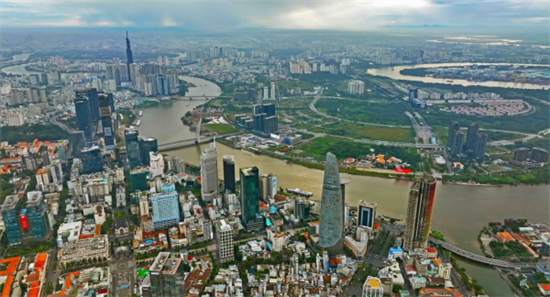 |
| Vietnam is striving for the goal of a developed country with high per capita income in 2045 |
Guided by the objective and ideal of national independence linked with socialism, the Party led the Vietnamese People to the success of the August Revolution, establishing the Democratic Republic of Vietnam (now the Socialist Republic of Vietnam); securing victory in the wars of resistance against foreign aggression; abolishing the colonial and feudal systems; completing the cause of national liberation and reunification; undertaking the process of renewal (Doi Moi); building socialism; and firmly safeguarding the nation’s independence.
Particularly over the past forty years of renewal, national development, and the defence of the Socialist Republic of Vietnam, the country has achieved tremendous accomplishments of historic significance, markedly enhancing its national stature, overall strength, international standing, and prestige. These achievements constitute undeniable evidence of the correctness of the chosen path and are reflected in the following key areas:
Economic development and the implementation of the three strategic breakthroughs have achieved numerous important and outstanding results. Resource management, environmental protection, and climate change adaptation have also recorded positive progress. Macroeconomic stability has largely been maintained, and major economic balances have been safeguarded. Inflation, the state budget deficit, and public debt indicators have remained under control; trade surpluses have consistently stayed at high levels; and the domestic market has continued to expand robustly. Resources for development investment have been mobilised and utilised more effectively. During the 2021-2025 period, Vietnam’s economy grew at an average annual rate of approximately 6.2%, placing it among the fastest-growing economies in the region and the world. In particular, economic growth reached 8.02% in 2025, creating a solid foundation for achieving growth rates of 10% or higher from 2026 onwards. By 2025, GDP exceeded USD 514 billion, representing a 1.48-fold increase compared with 2020, ranking 32nd globally. GDP per capita reached USD 5,026, enabling Vietnam to join the group of upper-middle-income countries and earning favourable assessments from numerous reputable international organisations. The quality of growth has also improved, with total factor productivity (TFP) contributing approximately 47% of economic growth.
Significant achievements have likewise been recorded in cultural, social, and human development, with notable progress across multiple areas and continuous improvements in social welfare and living standards. The Party’s and the State’s policies on comprehensive human development have become increasingly comprehensive, focused, and substantive. Initial positive progress has been made in identifying, attracting, training, and effectively utilising talented individuals. The Human Development Index (HDI) has improved markedly, reaching 0.766 and placing Vietnam among countries with a high level of human development. According to the 2026 World Happiness Report, Vietnam ranked 45th out of 147 surveyed countries, second only to Singapore in Southeast Asia, and among the countries that have achieved the most significant improvements in life satisfaction over the past two decades. Policies and measures aimed at sustainable poverty reduction have been implemented in a coordinated and effective manner under the principle of “leaving no one behind.” As a result, the multidimensional poverty rate declined to 1.3% in 2025, compared with 4.2% in 2022. By September 2025, the nationwide programme to eliminate temporary and dilapidated housing had been completed. The number of beneficiaries of regular social assistance has continued to expand, exceeding 3.5 million people in 2025, of which 55% were elderly citizens. The healthcare system and public health services have made encouraging progress, with service quality steadily improving. Health insurance coverage reached 95.2% of the population by the end of 2025, among other notable achievements.
National defence and security have been continuously strengthened and consolidated, while foreign relations and international integration have been elevated to a new level, achieving numerous outstanding results. The two strategic tasks of national development and national defence have been closely and effectively integrated, thereby maintaining a peaceful and stable environment conducive to national development. National defence and security have continued to grow stronger in terms of capabilities, forces, and strategic posture. The all-people national defence posture and the people’s security posture have been further reinforced and closely linked with a strong “people’s heart and mind posture,” particularly in key strategic areas, border regions, and island territories.
Foreign affairs have effectively fulfilled their pioneering role, contributing to the maintenance and consolidation of a peaceful and stable environment and opening up unprecedented opportunities for national development. To date, Vietnam has established diplomatic relations with 195 countries, including all 193 member states of the United Nations. Comprehensive and extensive international integration has been proactively and actively advanced across all fields. Free trade agreements have been effectively implemented, while the country has actively participated in various economic connectivity initiatives and new frameworks for economic cooperation. Cultural diplomacy, external information work, and affairs relating to overseas Vietnamese communities have been carried out in an increasingly substantive and effective manner.
The work of Party building and rectification, together with the strengthening of the political system, has achieved many important accomplishments, including several unprecedented breakthroughs. In particular, the comprehensive reform of the political system’s organisational apparatus towards a structure that is leaner, stronger, more effective, and more efficient has produced significant and far-reaching results.
The tremendous achievements of historic significance attained over forty years of renewal are the outcome of a long process of persistent and continuous endeavour. They represent the crystallisation of the creativity and dedication of the entire Party, the entire people, and the entire armed forces, affirming that the Party’s renewal policy is both correct and innovative, and that the path towards socialism chosen by the Vietnamese People is consistent with the realities of Vietnam and the broader trends of the age. Through this process, a valuable lesson of both theoretical and practical significance has emerged, providing strategic guidance for the nation’s revolutionary cause in the new era: “To steadfastly uphold, creatively apply, and further develop Marxism-Leninism and Ho Chi Minh Thought; to remain committed to the goal of national independence and socialism; to adhere firmly to the Party’s renewal policy; and to uphold the Party’s organisational and operational principles. Development must serve as the basis for stability, while stability must promote sustainable development and continuously improve the People’s well-being. It is necessary to safeguard and maximise national interests on the basis of international law and the Charter of the United Nations; resolutely and persistently defend independence, sovereignty, unity, and territorial integrity, safeguarding the Fatherland early and from afar; and proactively deepen integration into world politics, the international economy, and human civilisation, combining national strength with the strength of the times in the cause of national development and defence.”
This reality constitutes compelling evidence that the theory underlying the Party’s renewal policy, as well as the theory of socialism and the path towards socialism in Vietnam, has been clearly defined and validated through practice. Its correctness has been demonstrated in reality and therefore cannot be distorted or denied.
Associate Professor, Dr. VU VAN PHUC, Former Editor-in-Chief of the Communist Review, Former Deputy Head of the Central Propaganda and Education Commission