Enhancing the role of the Department of Propaganda and Training and the Propaganda and Training sector in building a politically strong Vietnam People’s Army
Over 80 years of construction, combat, development, and maturation, the Department of Propaganda and Training and the Military Propaganda and Training sector have consistently demonstrated proactiveness and acuity in advising the Central Military Commission, the Ministry of National Defence, the General Department of Politics, as well as party committees and commanders at all levels in exercising comprehensive leadership and direction over ideological and cultural work to steadfastly safeguard the Party’s ideological front within the Army, thereby contributing to building a politically strong Vietnam People’s Army.
In order to build and promote political–spiritual factors and enhance the Army’s combat strength, on 11 May 1946, the Propaganda Section and the Training Section under the Political Department of the Ministry of National Defence, the predecessor organisations of the Department of Propaganda and Training, were established.
Over the past 80 years, propaganda and training work has consistently constituted an integral component of the Party’s ideological and cultural work, as well as a core element of party and political work in the Vietnam People’s Army. It has contributed to fostering steadfast political resolve and resilience, strengthening the confidence of cadres and soldiers, firmly safeguarding the Party’s ideological foundation, and maintaining and reinforcing the Party’s absolute and direct leadership over the Army in all respects. This has ensured the Army’s continuous growth and development, enabling it to defeat all invading enemies and to remain worthy of its role as a political force and a combat army that is absolutely loyal and reliable to the Party, the State, and the People.
 |
| Leader of the Department of Propaganda and Training attends a book exhibition on the occasion of the 80th anniversary of National Day |
In the coming years, the global and regional situation will continue to evolve rapidly, complexly, and unpredictably. Peace, cooperation, and development will remain the overarching trends, yet they are facing numerous emerging challenges. Armed conflicts, trade wars, and the Fourth Industrial Revolution, among other factors, will continue to exert profound impacts on nations, including Vietnam. After 40 years of Renovation, our country has achieved tremendous accomplishments of historical significance. The streamlining reform of the political system’s organisational apparatus, together with strategic decisions adopted by the Central Committee, is creating major opportunities and turning points for the country’s breakthrough development. Nevertheless, numerous difficulties and challenges persist, some of which are becoming increasingly acute and severe. Hostile forces are intensifying their sabotage against the Party, the State, and the armed forces. The task of safeguarding the Fatherland and building a revolutionary, regular, elite, and modern Army in the new era of development is placing exceptionally high demands on propaganda and training work.
To successfully accomplish tasks in the new period and contribute to building the Vietnam People’s Army into a politically strong force, the Department of Propaganda and Training and the Military Propaganda and Training sector should strive to effectively implement several key measures:
First, to consistently and thoroughly grasp the Party’s guidelines, lines, and viewpoints, as well as those of the Central Military Commission, in conducting propaganda and training work. The Department of Propaganda and Training and the Military Propaganda and Training sector should regularly advise, guide, and direct efforts to improve the quality of studying, grasping, and implementing resolutions and directives of the Party, the Central Military Commission, and the Ministry of National Defence, with a focus on the Resolution of the 14th National Party Congress and the Resolution of the 12th Congress of the Military Party Organisation; directives of the General Secretary, Secretary of the Central Military Commission on “two steadfastnesses, two accelerations, and two preventions” and “five firmnesses”; as well as the Party’s strategic resolutions and the resolutions of the Central Military Commission on leadership over military and defence tasks.
It is necessary to continue thoroughly grasping and effectively implementing the Resolution of the 4th Plenary Session of the 11th, 12th, and 13th Party Central Committees on Party building and rectification, in association with the implementation of Conclusion No. 01-KL/TW, dated 18 May 2021, of the 13th Politburo on continuing the implementation of Directive No. 05-CT/TW, dated 15 May 2016, of the 12th Politburo on promoting the study and following of Ho Chi Minh’s ideology, morality, and style; Regulation No. 144-QĐ/TW, dated 9 May 2024, of the Politburo on standards of revolutionary ethics for cadres and Party members in the new period; as well as the Party’s guidelines, lines, and viewpoints on military and defence tasks and the safeguarding of the Fatherland.
In the process of organising and conducting propaganda and training work, it is essential to proactively study, firmly grasp, and clarify newly emerging issues arising from the complex developments of the global, regional, and domestic situation. On that basis, timely advice and appropriate policy recommendations should be provided. It is also important to promote proactiveness, acuity, and principled steadfastness in assessing and evaluating situations, ensuring that propaganda and training work closely follows the dynamics of reality and meets the requirements of building the Military, strengthening national defence, and safeguarding the Fatherland.
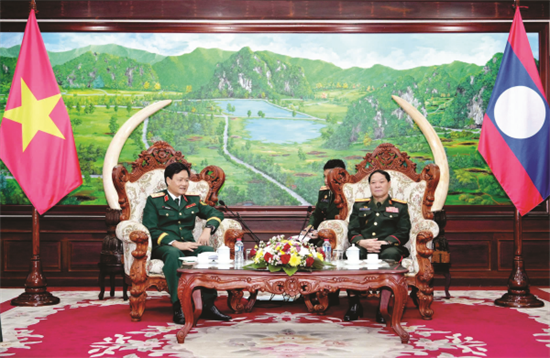 |
| Leader of the Department of Propaganda and Training meets with Lieutenant General Vongsone Inpanphim, Deputy Minister of National Defence of Laos and Chief of the General Political Department of Lao People's Army |
Second, to renew the content and methods of propaganda and training work in association with digital transformation and the requirements of tasks in the new context. In response to the demands of the Fourth Industrial Revolution and the national digital transformation process, the Department of Propaganda and Training and the Military Propaganda and Training sector should continue to innovate in both content and methods, creating clear improvements in quality and effectiveness. The focus should be on advising leadership at all levels to enhance the awareness and responsibility of cadres and soldiers regarding the nature, characteristics, development trends, as well as the opportunities, challenges, and impacts of digital transformation on national development, Army building, national defence consolidation, and the safeguarding of the Fatherland.
At the same time, efforts should be intensified in communication, education, and training to improve digital awareness, knowledge, and skills for cadres and soldiers, enabling them to effectively harness the achievements of digital transformation in task performance. Scientific seminars and training courses on digital skills for various groups should be regularly organised. Concurrently, the advantages of digital technology, the internet, and social media should be leveraged to innovate the forms and methods of conducting propaganda and training work, ensuring they remain vivid, timely, and aligned with practical realities.
Due attention should be paid to the dissemination and education of legal knowledge, especially regulations on information security, and the protection of state and military secrets. Greater emphasis should be placed on internal political protection, with close management of cadres’ and soldiers’ use of the internet and participation in social media. At the same time, through various forms of political and legal education and daily unit activities, it is necessary to further enhance theoretical competence and the ability to discern right from wrong, and positive from negative, in the face of multidimensional information in cyberspace. This will help consolidate troops’ confidence in weapons and equipment, as well as in the Army’s combat readiness, while heightening vigilance against the schemes and tactics of hostile forces.
Third, to actively innovate and improve the quality and effectiveness of political education, as well as education in the social sciences and humanities. Priority should be given to equipping cadres and soldiers with fundamental knowledge of Marxism–Leninism, Ho Chi Minh’s ideology, the Party’s guidelines, lines, and viewpoints, and the State’s policies and laws; as well as an understanding of the revolutionary situation and tasks, military and defence tasks, the safeguarding of the Fatherland, and the missions of their respective agencies and units. Due attention should be paid to educating on the nation’s traditions of patriotism and resistance against foreign aggression, and the Army’s tradition of determination to fight and to win. In this regard, it is necessary to thoroughly grasp strategies on military affairs, national defence, and the safeguarding of the Fatherland, especially the Strategy for Safeguarding the Fatherland in the new context; to clarify the nature, schemes, and new tactics of hostile forces; and to develop a correct understanding of partners and adversaries. It is also important to continue effectively implementing Directive No. 2423-CT/QUTW, dated 9 November 2023, of the Standing Board of the Central Military Commission on “renewing and improving the quality of political education in the new period”. Measures to promote the study and following of Ho Chi Minh’s ideology, morality, and style should be diversified, in association with the implementation of Resolution No. 847-NQ/QUTW, dated 28 December 2021, of the Central Military Commission on promoting the qualities of “Uncle Ho’s Soldiers” and resolutely combating individualism in the new context.
Further efforts should be made to concretise programmes and plans for implementing projects and schemes on education and training, particularly Resolution No. 290-NQ/QUTW, dated 7 January 2026, of the Central Military Commission on breakthrough development in education and training in the Army, and the project on “Renewing education in the social sciences and humanities in military schools”. It is necessary to review, develop, and implement social sciences and humanities education programmes tailored to different target groups in accordance with the project on renewing training processes and programmes for cadres at all levels in the Army. At the same time, the digitisation of curricula, syllabi, and instructional materials should be carried out, alongside the development of shared digital learning resources across military academies and schools. Teaching materials and training documents should be standardised and modernised to ensure consistency between institutional instruction and unit-level training. Priority should also be given to enhancing skills in the reception and application of science and technology in teaching and scientific research.
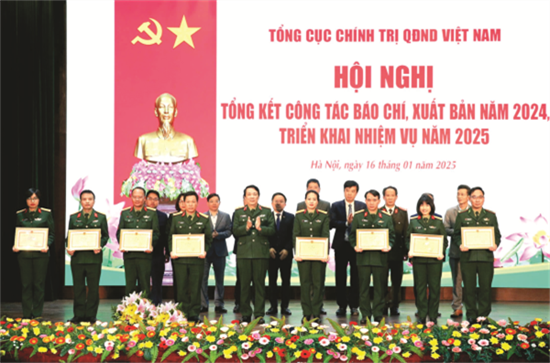 |
| Leader of the Department of Propaganda and Training awards outstanding individuals and collectives in press and publication work in 2024 |
Fourth, to intensify the Determination-to-Win Emulation Movement, enhance the effectiveness of cultural, literary, and artistic activities, and improve the quality of communication on major national and military anniversaries. The Department of Propaganda and Training and the Army’s Propaganda and Training sector should focus on advising, guiding, and directing the effective organisation of the Determination-to-Win Emulation Movement and peak emulation campaigns, ensuring they are practical, effective, and closely aligned with the political tasks of each agency and unit. Through these emulation movements, it is essential to unify awareness, inspire a strong sense of responsibility, and foster the determination to successfully accomplish all assigned tasks. At the same time, new models, innovative approaches, and exemplary role models should be identified, nurtured, and widely replicated, thereby creating strong motivation and widespread influence throughout the Army. This will contribute to building a strong and modern all-people national defence and firmly safeguarding the Fatherland under all circumstances.
Proactive efforts should be made to advise and closely coordinate with ministries, sectors, and localities in effectively organising communication and commemorative activities for major national and military anniversaries. Priority should be given to organising contests on learning about traditions and propaganda skills; launching campaigns for the creation and promotion of literary, artistic, and journalistic works; developing the contingent of rapporteurs; compiling, publishing, and disseminating materials and publications for communication orientation; and producing documentary and television films to serve educational and communication purposes.
At the same time, cultural, literary, artistic, physical training, and sports activities should be organised effectively. The role of cultural institutions within the Army should be brought into full play, contributing to the improvement of troops’ spiritual life, encouraging patriotic emulation movements, and fostering a vibrant emulation atmosphere, thereby contributing to the successful fulfilment of the tasks of building and safeguarding the Fatherland.
Fifth, to improve the quality and effectiveness of safeguarding the Party’s ideological foundation within the Military. It is necessary to continue renewing thinking, content, and methods in this work; proactively grasp developments and promptly advise party committees and commanders at all levels on appropriate policies and solutions. The core role of Steering Committees 35 and Force 47 at all levels should be brought into full play; positive information should be widely disseminated, while resolute efforts must be made to refute wrongful and hostile viewpoints, prevent manifestations of “self-evolution” and “self-transformation”, and firmly maintain the Party’s ideological front within the Army.
Synchronous and flexible forms of struggle should be implemented across the ideological and theoretical front, especially in cyberspace; close integration should be ensured between theoretical research and practical review, and between communication, orientation, and refutation of hostile schemes and tactics. At the same time, scientific research should be promoted, with the development of theoretical, journalistic, and cultural products of strong orientational value; coordination with relevant agencies in information management and handling should be strengthened. The Political Essay Contest on protecting the Party’s ideological foundation should be effectively organised, thereby contributing to enhancing political steadfastness and ideological struggle capacity among cadres and soldiers, meeting the requirements of firmly safeguarding the Party’s ideological foundation in the new context.
Upholding the proud tradition of “steadfastness, proactiveness, acuity, creativity, solidarity, and determination to win”, the Department of Propaganda and Training and the Military Propaganda and Training sector will continue to innovate and improve the quality and effectiveness of propaganda and training work, thereby contributing to building a revolutionary, regular, elite, and modern Vietnam People’s Army capable of meeting the requirements of building and safeguarding the Fatherland in the new revolutionary stage.
Lieutenant General NGUYEN VAN DUC, Director of the Department of Propaganda and Training