Today, cyberspace is a strategic environment, a new battlefield without gunfire but marked by intense confrontation, directly impacting our country’s defence, security, and development. In that context, improving cyberspace combat training and exercises as well as combat capabilities in the digital environment is an urgent requirement to protect the Fatherland early and from afar in cyberspace under new conditions.
Grasping and implementing Resolution 29-NQ/TW, dated 25 July 2018, by the 12th Politburo on the Strategy for Fatherland Protection in Cyberspace, over the years, the Central Military Commission (CMC) and the Ministry of National Defence (MND) have proactively given advice to the Party and State and adopted various solutions to build and develop forces, modernise equipment and means, research and develop theories and art of cyberspace warfare, and intensify cyberspace combat training and exercises, thereby obtaining significant results in this work.
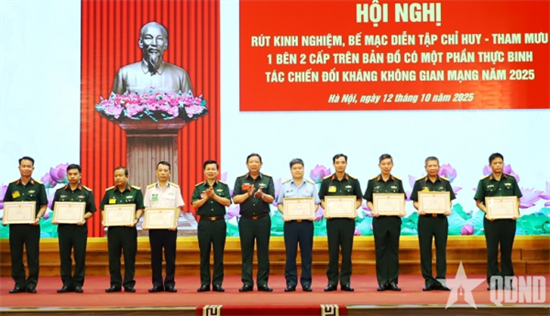 |
| Sr. Lt. Gen. Huynh Chien Thang and Lt. Gen. Do Xuan Tung gives certificates of merit to offices and units with brilliant accomplishments in a cyberspace combat exercise (photo: qdnd.vn) |
Notably, awareness and a sense of responsibility among party committees, commands, cadres, and soldiers across the Vietnam People’s Army (VPA) towards cyberspace combat training and exercises have been raised. Leadership, direction, and management of training and exercises have been close, synchronous, and suitable to each group of troops and task requirements. Training and exercise programs, content, and methods have been renewed, thus enabling offices and units to constantly improve their incident response capacity, rapidly shift from passive defence to proactive, early detection of risks and threats, effectively respond to situations in cyberspace, promptly prevent, repel, and thwart hostile forces’ plots and tactics of using cyberspace to sabotage the cause of building and defending the Socialist Vietnamese Fatherland.
It is worth noting that in October 2025, the MND directed Command 86 and 16 information technology (IT) departments of offices and units to successfully organise ĐK-25 Exercise. This is an extremely important exercise as the entire Party, VPA, and people are preparing for the 14th National Party Congress. The exercise has several new aspects in organisation, command, and control methods, with the participation of many specialised forces. Its outcomes are of importance to clarifying theoretical and practical issues related to building all-people national defence posture in association with the people’s security posture in cyberspace, laying a crucial foundation for further supplementing and completing combat documents, consolidating and enhancing the cyberspace combat capacity of offices and units across the VPA.
However, alongside the recorded results, cyberspace combat training and exercises have not fully kept pace with the evolving situation or the requirements of VPA building and Fatherland protection in the new situation. Certain procedures, programs, and content remain unsuitable; coordination among forces in training and exercises is still ineffective; research, assessment, and forecasting of hostile forces’ plots and artifices in cyberspace have yet to be thorough.
In the coming time, the situation on global and regional scales is forecast to remain complex, with increasing risks of cyber war. Domestically, hostile forces will intensify sabotage activities across all fields; such adversarial activities continue to take place daily and hourly in cyberspace, causing serious harm to our economic development, political stability, social order, and foreign relations, posing severe threats to national defence and security, undermining our country’s independence, sovereignty, unity, territorial integrity, and interests. To avoid passivity and surprise, effectively respond to all situations, and maintain vigilance against adversarial activities in cyberspace, all offices and units across the VPA, particularly the cyberspace combat force, should continue grasping and adopting synchronous solutions to constantly raise the quality of cyberspace combat training and exercises in all operational conditions and environments.
First, strengthening the leadership and direction of all-level party committees and commands over cyberspace combat training and exercises. It is the fundamental solution for improving the quality of this important work. Accordingly, the entire VPA, with Command 86 as the core force, should continue grasping the Strategy for Fatherland Protection in Cyberspace and higher echelons’ resolutions, directives, and guidance on training and exercises, identifying cyberspace combat training and exercises as a long-term and short-term strategic mission. Based on those documents, specialised resolutions and action plans should be developed, with objectives, targets, requirements, and measures appropriate to the particularities of each office and unit. Immediate attention should be paid to reviewing and supplementing content and measures in action plans/programs for Resolution 1659-NQ/QUTW, dated 20 December 2022, by the CMC on “raising the quality of training for the period of 2023 - 2030 and beyond”, as well as for the MND’s projects and plans on cyberspace combat training and exercises in accordance with practical conditions and task requirements. Cybersecurity and information safety should be incorporated into education and training programs across the VPA, particularly in military schools.
To make a solid, comprehensive, breakthrough change in the quality of training and exercises, offices and units should follow higher echelons’ orientations, uphold political resolve, promote the spirit of daring to think, daring to do, daring to take responsibility, and daring to be innovative, and actively formulate breakthrough measures for training and exercises. Leadership, direction, inspection, and supervision of all-level party committees and commands should be strengthened to promptly detect and rectify shortcomings, and prevent subjectivity or formality. Forces’ synergy should be promoted to ensure substantial, sustainable progress in cyberspace combat training and exercises.
Second, carrying out a breakthrough reform in training and exercises to improve the cyberspace combat force’s capabilities. Grounded on the recorded results and experiences, all-level party committees and commands, especially the cyberspace combat force, should continue giving advice on adjusting, supplementing, completing, and standardising training and exercise content and programs in accordance with cyberspace combat requirements and technological developments. Difficulties, such as a lack of “cyber training grounds”, dispersion of units, and simultaneous training and operational duties should be thoroughly addressed to ensure sufficient preparation of personnel, infrastructure, and materials for training work.
In addition to regular military training and political education, specialised personnel should receive in-depth training in cybersecurity, information safety, cyberspace warfare, command and staff work, and incident response. Training on mastery of existing weapons and technical equipment should be strengthened, while forces’ skills in IT, information safety, and cyberspace warfare, especially at tactical level, should be improved.
Offices and units across the VPA should develop training and exercise plans in accordance with each development stage of the cyberspace combat force; importance should be attached to increasing practice and specialised training time, designing cyber scenarios properly, integrating training with tasks, i.e. monitoring and reconnaissance in cyberspace, and organising training courses based on projects for national sovereignty protection in cyberspace. Notably, it is necessary to accelerate the development of virtual training networks and digital battlefield simulation systems, while AI, big data analysis, and cloud computing should be applied in training and exercises. Combat exercises at all levels across the VPA and joint exercises between the cyberspace combat force of the VPA and cybersecurity units of ministries, sectors, and localities should be increased.
Third, developing and applying cyberspace combat art in training and exercises. Offices and units across the VPA, especially competent agencies, should enhance coordination in researching and developing the art and methods of information warfare and cyberspace warfare, with a focus on studying cyberspace combat in recent wars, military conflicts, and cyberattacks worldwide as the basis for developing cyberspace combat art and tactics in accordance with the Strategy for Fatherland Protection in the New Situation and the Strategy for Fatherland Protection in Cyberspace.
Emphasis should be placed on enhancing cyber defence capacity for unit headquarters at tactical level and specialised forces. It is essential to research into methods of reconnaissance, intelligence gathering, and early detection of adversarial cyber weapons and activities as well as into measures to deploy and protect our modern weapon systems and cyberspace operations, opportunely launch counterattacks, and neutralise hostile forces’ sabotage efforts and hi-tech attacks in cyberspace. Moreover, the scope, subjects, and regions of cyberspace combat exercises (such as joint exercises between the VPA, public security forces, ministries, departments, sectors, and political - social organisations) should be expanded to conduct comprehensive assessments and improve information safety and cybersecurity for the systems under the VPA’s management.
Specialised forces, particularly Command 86, should closely coordinate with other offices and units across the VPA to assess, identify, and forecast hostile forces’ plots and tactics in cyberspace, perfect and issue Cyberspace Combat Regulations, Cyberspace Combat Staff Work Regulations, IT Work Regulations, and documentation on cyberspace combat art at tactical, operational, and strategic levels. The project on “enhancing cyberspace combat capability to meet the requirements of Fatherland protection in the new situation” should be implemented effectively to strengthen the cyberspace combat force’s fighting power. Mechanisms for coordination between specialised bodies of the MND, especially Command 86, General Department II, Signal Corps, Department of Operations, Department of Military Security Protection, and Viettel Group, should be established to monitor and protect military - defence IT systems, hi-tech weapon control systems, and key national communications systems. Furthermore, proposals should be made to supplement the tasks, actions, and structure of duty teams at Command 86 in all combat readiness states; technical support methods for the IT Sector in cyberspace combat should be perfected to facilitate cyberspace combat training and exercises.
Fourth, ensuring comprehensive, effective support for cyberspace combat training and exercises. Prior to training and exercises, offices and units should properly assess and forecast the cyber operational environment and adversarial activities to develop training intentions, tasks, and scenarios suitable for practical cyberspace combat as well as their organisational structure and mission requirements. Exercise plans, content, and programs should be clearly defined, while coordination between forces, especially between military units and cybersecurity forces of ministries, sectors, and localities in handling situations during exercises, should be effectively maintained. Comprehensive preparation of personnel, weapons, equipment, cyber infrastructure, training platforms, and other facilities should be ensured in a scientific, strict, practical manner.
Offices and units across the VPA should effectively maintain, closely manage, and optimise the existing weapons and technical equipment to ensure their best operational condition and absolute safety in training and exercises. At the same time, investments in synchronously modernising weapons, technical equipment, and cyber infrastructure, particularly tactical-level cyber training grounds, should be considered and proposed. Software solutions for command and control over wireless transmission networks should be expanded. Collaboration with both military and civilian enterprises should be strengthened to provide technological equipment, apply IT, and develop software systems for command and operation work and for cyber tactical exercises on digital maps, towards the building of a digital government within the MND.
Fifth, effectively conducting preliminary and final reviews, drawing lessons after cyberspace combat training and exercises. To keep raising the quality of training and exercises, all-level party committees and commands should seriously carry out reviews and assessments, identify shortcomings and causes, and clarify responsibilities of each collective and individual at every stage and level as well as the entire process of training and exercises, thereby drawing lessons and proposing solutions to settle weaknesses in each phase of training and exercises. Due regard should be paid to detecting, commending, and multiplying typical collectives and individuals to encourage cadres and soldiers to fulfil their assigned tasks in training and exercises. Simultaneously, incorrect perceptions or formalism in performing training and exercise tasks shown by collectives and individuals must be decisively corrected.
Improving the quality of cyberspace combat training and exercises is a mission of strategic importance and urgency. The entire VPA, particularly specialised forces, should continue raising their awareness and sense of responsibility, overcoming difficulties, and promoting innovation to further enhance the quality of cyberspace combat training and exercises, ensure cybersecurity, safeguard national sovereignty in cyberspace, and firmly protect the Fatherland in the new situation.
Sr. Lt. Gen. HUYNH CHIEN THANG
Member of the Party Central Committee
Member of the CMC
Deputy Chief of the General Staff of the VPA