Following President Ho Chi Minh's teachings, Defence Industry College improves the quality of training to meet mission requirements
Imbued with Ho Chi Minh's thought on education linked to practice, the Defence Industry College has deployed many comprehensive solutions to improve the quality of training, contributing to the successful achievement of the goal of building and developing a self-reliant, self-sufficient, dual-use, and modern defence industry.
During his lifetime, President Ho Chi Minh always valued the role of education, training, and the technical staff, considering this one of the decisive factors in the cause of national construction and defence strengthening. Imbued with President Ho Chi Minh's profound teachings, the Defence Industry College always focuses on effectively carrying out the task of training technical professionals for the defence industry and the cause of industrialisation and modernisation of the country.
In particular, thoroughly researching Resolution No. 08-NQ/TW, dated 26 January 2022, of the Politburo on promoting the development of the defence industry until 2030 and beyond, along with resolutions and directives of the Central Military Commission, the Ministry of National Defence, and the General Department of Defence Industry (GDDI) on education and training, the College’s Party Committee and Board of Directors have implemented many policies and solutions synchronously and decisively to innovate and improve the quality of training, linking training goals and requirements with the implementation of the policy of building and developing a self-reliant, self-sufficient, dual-use, and modern defence industry.
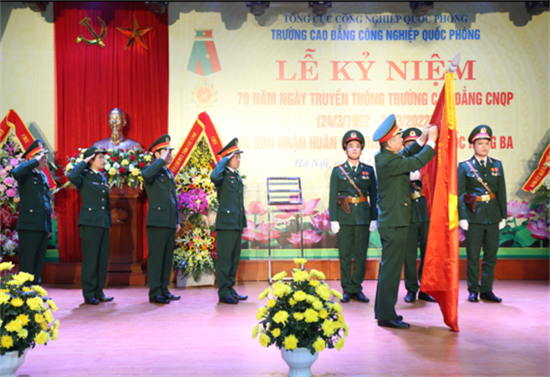 |
| The College holds ceremony to celebrate its 70th anniversary of foundation and receive the Third-class Fatherland defence order |
To realise that goal, the key issue for the College is to foster the teaching and educational management staff so that they can meet the requirements of tasks in the new situation. Deeply understanding President Ho Chi Minh's teachings: “Cadres are the root of all work”, and “...without teachers, there is no education”, the College always focuses on building a team of teachers and educational administrators with all-round qualities and capabilities, truly “both red and expert”. To implement this, along with maintaining the regularity of training on professional skills, management capabilities, and pedagogical methods for teachers and educational administrators to meet the goals and requirements of training human resources directly serving the production, repair, improvement, and modernisation of weapons and technical equipment, the College focuses on planning, developing, training, and supplementing its teaching staff in specialised fields of defence industry, such as: manufacturing; weapons and ammunition; propellants and explosives; guided weapons, etc., to meet the development requirements of the industry's key sectors.
Bearing in mind President Ho Chi Minh's profound instruction: “Practice gives rise to knowledge, knowledge leads to theory, theory guides practice”, and to link training with practical production and research, the Party Committee and Board of Directors of the College resolutely require to send its cadres and lecturers to practical training at factories and research institutes to update new technologies and production processes, thereby adjusting the content and methods of teaching to closely match the requirements of defence industry in the new situation. Simultaneously, it regularly cooperates closely with reputable training and research institutions inside and outside the Army to send cadres and lecturers for joint training, and advanced skills development, etc. Emphasis is placed on holding professional emulation activities, such as: the teaching contests at the grassroots level, the vocational skills competition at various levels, etc. Simultaneously, it promotes the training of foreign languages, information technology, and managerial skills for its teaching staff and educational administrators. The goal is that, by 2030, 96% of its teachers and educational administrators hold postgraduate degrees; over 70% of staff members reach B1 level or equivalent in English; and 100% of its teaching and administrating staff is proficient in basic information technology, meeting the requirements of teaching and management in a digital environment.
Along with developing its teachers and educational administrators, the College promotes innovation in the content, curriculum, and methods of education, closely linking training with the requirements of modernising the defence industry. In recent years, the school has proactively conducted a comprehensive review, adjustment, and supplementation of training content and programmes towards a modern, practical approach, suitable to the specific characteristics of defence industry production. Emphasis is placed on adjusting the training programmes for college-level majors in Industrial Automation, Electrical and Electronic Engineering, and Information Technology according to the standards applied in defence industry; developing new training programmes for technical specialists; and opening new majors to ensure that the training content closely aligns with modern production lines and technological processes.
 |
| Leader of GDDI visits and checks training work at the College |
In addition, the College emphasises integrating the digital transformation contents of the General Department of Defence Industry into its Information Technology major to build a technical workforce capable of quickly adapting to digitalised and automated production models. Furthermore, it focuses on developing in-depth training programmes on digital transformation, artificial intelligence, enterprise resource planning (ERP), manufacturing execution systems (MES), and holding training, retraining, and knowledge updates for officials and technicians at factories within the General Department. This will directly contribute to improving management and production operation capabilities, modernising management models, and effectively utilising equipment and technology lines throughout the entire industry.
In each subject and field of study, it consistently adhere to the motto of “reducing theory, increasing practice”, increasing the time spent on skills training and workshop internships, and linking professional knowledge with the specific technological processes and production lines of defence factories and enterprises. To concretise this motto and leverage its advantage as the only training institution of the General Department of Defence Industry – which boasts numerous defence factories and production facilities – the College directs its agencies to closely monitor practical needs and technological development orientations to develop output standards and training programmes for each major. Simultaneously, it actively collaborates and holds field trips and internships for its students to consolidate theory, hone practical skills, especially industrial working style, sense of self-discipline, and professional ethics.
Together with innovations in content and curriculum, the College prioritises the innovation of teaching methods to promote the proactive and creative participation of learners. Following the directives of its Board of Directors, its faculties and staffs have actively applied interactive teaching methods such as flipped classrooms, project-based learning, and mind mapping. Simultaneously, they have researched and flexibly implemented online training (E-learning) methods, harmoniously combined traditional and modern teaching methods to ensure effectiveness, discipline, and quality. Furthermore, adhering to the motto “Training quality of the schools is the combat readiness level of the units”, the College focuses on strengthening examination and quality assurance in education and training in an objective, transparent, and practical manner. Emphasis is placed on gathering feedback from learners, units, factories, and employers as a measure of training quality and effectiveness, allowing for timely adjustments to content, programmes, and methods to meet the requirements of building and developing the defence industry in the new era.
The modernisation of the defence industry has a dialectical relationship, closely linked to science, technology, innovation, and digital transformation. Understanding this and imbued with President Ho Chi Minh's teachings that: “Determined to delve into science, technology, and professional skills; promote creativity, the enterprise in thinking and action; strive to learn and effectively apply advanced initiatives and experiences to improve labour productivity and combat effectiveness”, the College is applying breakthrough solutions synchronously and decisively to promote scientific research associated with training and digital transformation. Accordingly, its Board of Directors is resolutely directing scientific research activities to focus on solving practical problems in training technical human resources, improving processes, technologies, and equipment serving the production and repair of weapons and technical equipment. Besides, it promotes the application of information technology in scientific research, management, and teaching; actively employs training management software, scientific management software, digital libraries, and electronic learning materials, etc., to improve management efficiency, save time and effort, and create a favourable environment for teachers and students to access and share knowledge.
In the process of promoting digital transformation, the College places particular emphasis on ensuring information security and cybersecurity; strictly maintaining regulations and rules on the security and confidentiality of information systems, especially for data and documents related to national defence and security. At the same time, it continues to purchase and supplement IT equipment that is synchronised, modern, and suitable to practical conditions with an aim to build a “Smart School” model following a solid and effective roadmap. In particular, based on the GDDI's policy of acquiring and equipping “smart and dual-use production” lines, it proactively builds a mechanism for synchronously managing and exploiting between training and production, and integrates this content into the curriculum, using practical technological processes as “living material” in which students are involved directly in appropriate production stages; and research and technical improvements are promoted, contributing to improving the quality of training and the efficiency of defence production.
Promoting the achievements gained, the Defence Industry College continues to promote the studying and following of Ho Chi Minh's thought, ethics, and style, identifying it as an important mental force to successfully implement the task of innovation, quality improvement, meeting the requirements of developing the defence industry in the new period.
Colonel, PhD. VU QUANG BACH, Rector of the College