Building strong, modern all-people national defence is a new strategic guideline supplemented and developed by the 14th National Party Congress, aimed at promoting the combined strength of all forces and enhancing defence capability to firmly safeguard the Fatherland in the new era. To successfully accomplish this important task, it is necessary to clearly identify key priorities and encourage the participation of all sectors, the entire political system, and the whole people, with the armed forces as the core.
Building strong all-people national defence is a strategic, consistent guideline of our Party and State in the cause of Fatherland construction and protection, aimed at bringing into play the combined strength of the entire population and strengthening defence capability to firmly protect the Fatherland under all circumstances.
After nearly 40 years of renewal, the building of all-people national defence has achieved many significant results, contributing to strengthening defence power in terms of potential, force, and posture, and firmly protecting the Socialist Vietnamese Fatherland. At present, the global and regional situation is evolving rapidly, complexly, unpredictably. Conflicts, wars, and arms races are taking place in many parts of the world, with the emergence and increasing use of new, modern weapons, significantly changing methods of warfare.
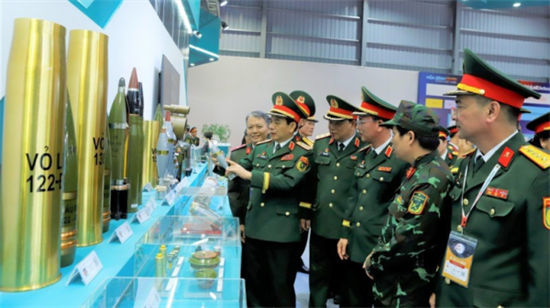 |
| Gen. Phan Van Giang at Vietnam International Defence Expo 2024 (photo: nhandan.vn) |
That context has imposed very high requirements on defence consolidation and Fatherland protection and necessitated building all-people national defence that is not only strong but also modern. Hence, the 14th National Party Congress identified the task of building strong, modern national defence for firmly safeguarding the Fatherland in the new situation. This is a correct guideline, reflecting our Party’s strategic vision for defence consolidation and Fatherland protection in the new era.
In order to build strong and modern all-people national defence in the new era, it is necessary to focus on the following key priorities.
First, maintaining and strengthening the Party’s leadership over the building of all-people national defence. Practice has proven that the Party’s leadership is the decisive factor in all victories of the Vietnamese revolution: a strong Party leads to a strong country and strong all-people national defence. In the new era, our Party continues to affirm that Party building is the key task; accordingly, the Party must be built to be politically strong and steadfast on the chosen path towards socialism; political mettle must be maintained under all circumstances. Under that guideline, emphasis should be placed on building an ideologically strong Party, steadfastly and creatively applying Marxism - Leninism, Ho Chi Minh Thought, and theories of renewal, enhancing the leadership capacity and combativeness of Party organisations and members. Importance should be attached to building a strong Party in terms of morality, organisation, and personnel and developing typically, comprehensively strong and clean Party organisations. Mass mobilisation should be enhanced to deepen the close-knit bond between the Party and the people, for the country, the nation, and the people; it is vital to rely on the people to build the Party. The restructuring of the State apparatus within the political system to ensure effective, efficient operation and improve services for the people is also one of the key priorities.
At the same time, due attention should be paid to adhering to the line of all-people national defence and people’s war and exercising leadership and direction over the building of comprehensive, strong, modern all-people national defence compatible with new administrative units of the country; that process must not disrupt the building of strong all-people national defence, and it must help strengthen the power of modern all-people national defence.
Second, building a firm “people’s hearts and minds posture”. Along with Party building, building the “people’s hearts and minds posture” is one of the fundamental, routine tasks determining defence strength of all-people national defence. In particular, the “people factor” in all-people national defence is the most fundamental, acting as a distinctive feature, representing the basic difference between Vietnam’s national defence and that of some other countries. In the new period, the building of “people’s hearts and minds posture” is of critical importance to the building of strong all-people national defence. The 14th National Party Congress determined to strengthen national potential and synergy, build and consolidate all-people national defence, all-people national defence posture, people’s security, and people’s security posture in association with “people’s hearts and minds posture”, and construct firm defensive zones. Thus, “people’s hearts and minds posture” is defined with a new position and role, relatively independent from all-people national defence and people’s security, yet closely linked with the building of all-people national defence and people’s security.
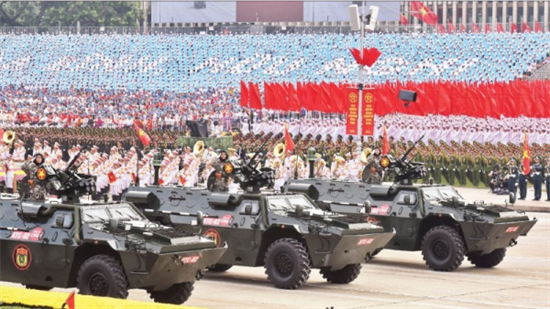 |
| Infantry fighting vehicles at the Parade to celebrate the 80th Anniversary of the August Revolution (photo: nhandan.vn) |
“People’s hearts and minds” refers to the spiritual state, trust, and consensus of the people towards the political regime within society. Building a “people’s hearts and minds posture” means arousing patriotism, resilience, indomitability, solidarity, cohesion, fighting spirit, obligation, and responsibility of the whole population towards the nation, mobilising and maximising these factors to form a firm political foundation and national synergy to realise revolutionary goals. “People’s hearts and minds posture” is a special posture formed from the internal strength of the entire population towards the nation. Its essence is building trust and consensus between the people and the Party, State, and political system, and inspiring aspirations to develop a prosperous, powerful country. To that end, the Party must stay truly close to the people, continuously improve the people’s material and mental life, and bring tangible benefits to the people so that they will protect the Fatherland and their own interests. Grass-roots democracy regulations must be brought into play, while proper mechanisms must be established to enable people to participate in national construction and development. A firm “people’s hearts and minds posture” is the fundamental driving force for developing strong all-people national defence and a prerequisite for building modern all-people national defence.
Third, building all-people national defence in economic terms. The economy is the material foundation of national defence; strong, modern national defence must be based on a strongly developed, modern economy. The level of economic modernity reflects the level of modernity of all-people national defence, especially national industrial capacity. Hence, in the new era, it is necessary to “promote industrialisation, modernisation, and urbanisation, build and modernise a strong national industry, take science, technology, innovation, and digital transformation as the main driving force”. New thinking is required to “promote breakthroughs in developing autonomous, self-reliant, resilient, dual-use, modern defence and security industries”. Defence industry development must be regarded as a breakthrough in the new era, together with enhancing the country’s science, technology, and innovation capacity to reach advanced levels in the key fields. Emphasis should be placed on applying achievements of modern science and technology in military science, and transforming advanced economic accomplishments into the strength of all-people national defence. It is vital to closely, effectively combine socio-economic development with defence and security consolidation to create an abundant material foundation for national defence. Autonomy in research and manufacture of defence equipment must be emphasised to create leapfrog development in human resources and modern weapons and equipment, especially new strategic systems.
Fourth, building strong, modern defence forces. Defence forces of all-people national defence comprise the entire population and the people’s armed forces, in which the entire people constitute the fundamental force and the key factor shaping the distinctive nature of all-people national defence. It is an extensive on-the-spot force that handles defence and security situations in the most timely and effective manner. In the new era, this force must be built on the basis of a modern national industry. This refers to a new generation characterised by modern industrial discipline, equipped with basic defence and security knowledge, especially advanced military, defence, and security knowledge. The core of this force is the militia and self-defence force; it must be equipped with modern weapons and technical equipment, even low-range missiles to shoot down enemy cruise missiles and unmanned systems, and utilise our own unmanned systems to strike the enemy. Ministries, sectors, and organisations, from central to local levels, and the people must actively participate in military and defence activities; preparations must be made carefully in peacetime to maintain readiness for mobilisation in wartime; the universal arming of the population must be conducted, while the State’s military strength under all defence states must be enhanced.
Building the people’s armed forces and particularly a revolutionary, regular, elite, modern Vietnam People’s Army (VPA) must be a priority. This is the core force expressing the military strength of all-people national defence, the State’s military power, and the country’s synergy for protecting the Fatherland. First of all, the VPA must be politically strong, especially in terms of political mettle under all defence and security situations; it must always remain a loyal and reliable force of the Party, State, and people. In the new situation, attention should be paid to building a modern VPA according to criteria set by the Central Military Commission and the Ministry of National Defence regarding organisational structure, training and education, development of military and defence theories, international integration and defence diplomacy, and logistics and technical work. It is necessary to keep streamlining the VPA and equipping the VPA with modern weapons and technical equipment.
Recent conflicts and wars worldwide have shown that belligerent parties have employed highly modern weapons, especially long-range, ballistic, hypersonic missiles and unmanned systems at operational and strategic levels. For Vietnam, in a war to defend the Fatherland (if it occurred), regardless of type or scale, the enemy would use long-range missiles and unmanned systems to strike deep inland targets. Therefore, apart from the existing modern weapons, the VPA must be equipped with long-range modern weapons to create a leap in counter-strike capability from points of origin, intercept enemy missiles and unmanned systems, and enhance sustainable defence of strategic national targets. Priority should be given to human resources and technical equipment, “developing high-quality human resources for the armed forces”. Adequate investment should be made to research into people’s war military art theories, with a “focus on developing and applying military science, security science, and achievements of modern science and technology”. Traditional combat theories must not be neglected; however, in the new situation, science research into modern combat theories suited to Vietnam’s conditions is required to meet the requirements of Fatherland protection in the new development era.
Fifth, building soft power of all-people national defence. Soft power is a very important component of all-people national defence; together with hard (military) power, it forms national synergy for firmly safeguarding the Fatherland. Unlike hard power based on coercion, soft power relies on attraction, diffusion, and persuasion, encouraging other people to voluntarily follow. It is a source of power capable of preventing conflicts and wars in peacetime and maintaining peace and stability for national development. Soft power in building strong all-people national defence includes maximising national political values, socialist regime superiority, and values from a socialist-oriented market economy, from an advanced culture imbued with national identity, and from Vietnam’s foreign affairs. At the same time, it is important to develop cultural industries and services to better meet the people’s cultural needs. Cooperation to spread the image of Vietnamese country, people, and cultural essence worldwide must be proactively promoted. All of these things aim to strengthen national cohesion, cement great national unity, attract and persuade international friends to come to Vietnam and support our country; that is an extremely important component in building strong, modern all-people national defence.
Sixth, building an interconnected, firm national defence posture. Posture building is a basic part of the building of all-people national defence, comprising political, economic, and military posture building, Party and State building, “people’s hearts and minds posture” building, economic development, industrialisation and modernisation, defence industry development, population restructuring, strategic deployment of the armed forces, and construction of national defence works at sea, on islands, and along the border. In the current context, building strong, modern all-people national defence is centred on constructing key national defence works, special economic and political hubs, and vital military - defence targets, ensuring solid structures protected by effective electromagnetic shielding and strong air defence systems capable of intercepting missiles and unmanned systems with high efficiency. The building of all-people national defence posture must be closely linked with people’s security posture in force organisation, posture deployment, and military - defence and national security protection activities.
Within the overall building of strong, modern all-people national defence, continued research is needed to improve mechanisms of leadership and direction and modernise command and control systems, especially as modern all-people national defence renders old operating systems obsolete. The general direction is automation: automated early detection of enemies and targets, automated transition of all-people national defence into defence states, automated activation of the VPA’s modern weapon and equipment systems, automated use of appropriate weapons to intercept enemy missiles and unmanned systems before they reach targets, and automated transition of all-people national defence into people’s war posture and other operational command activities in the event of a war.
Lt. Gen., Associate Prof. TRAN THAI BINH, PhD