The now An Giang province (after merging with Kien Giang province) has 102 communes and wards, 3 special zones (Phu Quoc, Kien Hai, and Tho Chau) with an area of over 9,800 square kilometres, a population of roughly 5 million people, holding a strategic position in the defence posture on the Southwestern direction of Military Region 9 and the whole country.
For the past years, the Party Committee, government, military, and people of the entire province have strived to achieve many important results in politics, economics, culture, and social affairs. National defence and security have been safeguarded. However, there remain many difficulties in lives of the locals, especially those living in remote areas, border regions, and islands; illegal religious practices have yet to be completely resolved in some areas. The situation of smuggling, drug trafficking, and illegal border crossing seems to be on the rising trend. Reactionary organisations and hostile forces are intensifying their subversive activities, undermining the national unity, especially in areas with large ethnic minority and religious populations.
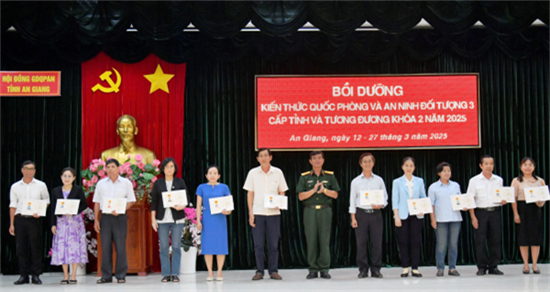 |
| Class-3 cadres receive defence and security certificate |
Facing the situation, together with promoting socio-economic development, implementing administrative unit restructuring and the two-tier local government system, developing science and technology, innovation, and accelerating digital transformation, the province always attaches importance to strengthening national defence and security, especially defence and security education which has been identified as a fundamental and continuous task to maintain political stability, social order and safety, and to create a favourable environment for the province's rapid and sustainable development, becoming a new growth pole of the Mekong Delta region.
As the operational capacity of the councils for defence and security education at all levels is a crucial prerequisite, deciding the quality and effectiveness of this important work, the Provincial Military Command - the Standing Office of the Provincial Council for Defence and Security Education - has thoroughly studied the Law on Defence and Security Education and guiding documents issued by higher echelons, and coordinated with departments and agencies to research and advise the Provincial Party Committee and the Provincial People's Committee to promptly issue decisions on consolidating the Provincial Council for Defence and Security Education, its Standing Committee, Secretariat, and operational regulations. The establishment of the commune-level councils for defence and security education has also been recommended, ensuring the sound and suitable composition as prescribed.
To enhance operational efficiency, the Provincial Military Command advises the Provincial Party Committee and the Provincial People's Committee to direct councils at all levels, based on their functions, tasks, and the specific characteristics of the target groups and localities, to review and perfect their operational regulations to strengthen the leadership of the Party committees and the management of the local government, with clear responsibilities of each member. At the same time, it conducts training to help the defence and security education councils of communes, wards, and special zones to effectively perform their advisory and proposal functions to the Party committees and governments on policies and measures for reviewing and identifying the number of target groups, and developing and implementing plans for defence and security education according to their authority.
Fostering defence and security knowledge for target groups represents a key task in defence and security education. Therefore, the Provincial Council for Defence and Security Education directs agencies, units, and localities to focus on improving the pedagogical level and method of teachers and reporters; prepare adequate equipment, lesson plans, and lectures; and to proactively update and renew contents of training. In addition to the prescribed topics, the Province requires the supplementation of extra topics relevant to the socio-economic and defence and security situations and tasks of the locality; update new information on the border, sea, and island situations; the sabotage schemes and tactics of hostile forces in the area and in cyberspace; the issues of ethnicity, religion, democracy, and human rights, etc.
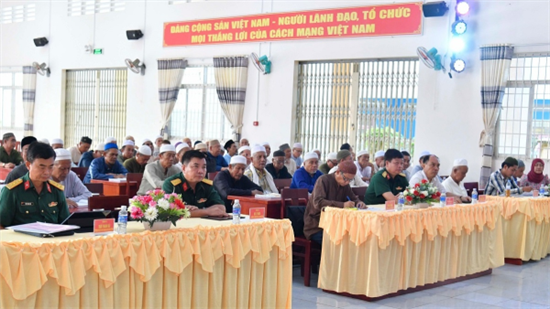 |
| Conducting defence and security training for relogious dignitaries |
To connect theory with practice, localities conduct field trips for learners to defence zone exercises; forest fire prevention and control exercises, forest protection exercises, and search and rescue exercises. In 2025, along with sending 4 Class-1 cadres and 20 Class-2 cadres to defence and security training courses as allowed by the Central Council for Defence and Security Education and that of Military Region 9, the Provincial Military Command also successfully held 69 training courses to update national defence and security knowledge for 5,850 cadres, Party members, religious dignitaries, completing 102.22% of the plan. After the courses, all participants developed a correct and deeper understanding of the Party's viewpoints and guidelines, and the State's policies and laws. They have grasped the principles and mechanisms of Party committee leadership and government administration regarding national defence and security tasks. They have also demonstrated a high sense of responsibility in leadership, direction, management, and participation in defence and security tasks at the local and grassroots levels.
Students, as a large force and future owners of the country, should nurture a correct understanding of their responsibilities towards the cause of national defence. At the same time, they must possess high “resistance” and “immunity” against the negative impacts of social evils, the dark side of the market economy, and the incitement and manipulation of hostile forces. An Giang province currently has 124 educational institutions, including: 106 high schools; 9 vocational schools; 6 colleges; 2 universities and the Provincial Political School, with about 126,000 students. The Provincial Military Command closely coordinates with the Department of Education and Training to direct these institutions to strengthen defence and security education for their students. In the process, they are required to collaborate with the Can Tho Defence and Security Education Centre to implement the programmes. As for Kien Giang University, An Giang University, and the Provincial Political School, they are free to do in their own way.
For high schools, the province directs the deliver of the entire academic year's curriculum according to regulations and selects additional content suitable for the students. Simultaneously, they are also required to hold visits to historical sites and defence and security sports competitions for their students. Doing this will help students grasp the basic content and understand the Party's military guidelines, the State's policies and laws on national defence and security; the nation's war history, foster patriotism and national pride; recognise the conspiracies and subversive tactics of hostile forces; develop necessary military knowledge and skills, and a disciplined lifestyle. Moreover, this is also a chance of career guidance for high school students to enroll in military schools and fulfil military service, contributing to the cause of national construction and defence in the new situation.
The province pays special attention to the dissemination of knowledge on national defence and security to the entire population, considering it a crucial task that determines the building of solid political and spiritual potentials for the defensive areas. To make it effective, the Province directs military commands at all levels to coordinate with local forces and civil and military press agencies to develop plans and issues special column on national defence and security. By 2025, over 2,000 articles have been published on the province's military, defence, and security work. The province also directed localities, agencies, and units to integrate the dissemination of laws on national defence and security into nearly 1,600 events with over 50,000 participants; the number of propagandists reached 1,645.
Last but not least, the Provincial Military Command directs its units to effectively implement the 4-together motto, namely: “eating together, living together, working together, speaking ethnic language together”; actively participate in hunger eradication, poverty alleviation, and new-style-rural development; and carry out “Gratitude Repayment” activities; assist local people in disaster prevention and control, rescue and relief; propagate and mobilise the people to strictly abide by the Party's guidelines and policies, and the State's laws. Doing this helps strengthen the people’s trust in the leadership and guidance of Party committees and governments at all levels, consolidate military-civilian solidarity, and build a solid “people's heart and mind posture” from the grassroots level.
By means of effective and comprehensive implementation of the above solutions, coupled with the strengthened inspection and supervision, defence and security education work of An Giang province has achieved increasingly substantive results, contributing to building a solid defence zone and firmly protecting the Fatherland “early and from afar”.
Major General NGUYEN VAN NGANH, Member of the Standing Committee of the Provincial Party Committee, Commander of the Provincial Military Command, and Permanent Vice Chairman of the Provincial Council for Defence and Security Education