Ho Chi Minh’s thought on Party discipline and its application to the Military Party Organisation today
One of President Ho Chi Minh’s foundational and enduring viewpoints - serving as the cornerstone of our Party’s ideology, theory, and methodological approach to building a pure and strong Party - is that “the strength of the Party lies in its unity and iron discipline”. In the current context, applying this thought to the building of the Military Party Organisation (MPO) is a matter of practical and urgent significance, aimed at continuously enhancing leadership capacity and combat strength to meet the increasingly demanding requirements of building the Vietnam People’s Army (VPA), strengthening national defence, and protecting the Fatherland in the new era.
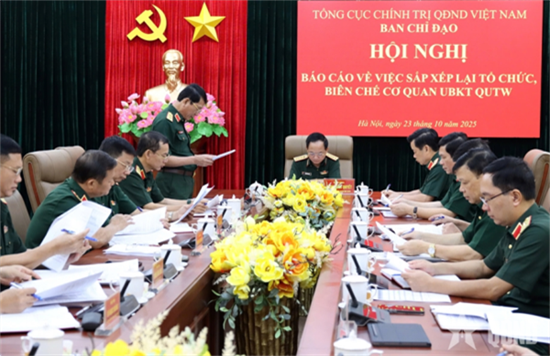 |
| A conference on reorganising the Central Military Commission’s Inspection Committee (photo: qdnd.vn) |
1. Ho Chi Minh’s thought on Party discipline
Faithfully inheriting and creatively applying V.I. Lenin’s thought on Party building, President Ho Chi Minh emphasised that in order to achieve victory, our Party must not only formulate correct guidelines, but also strictly implement them and “must maintain strict discipline from the highest to lowest levels”. Discipline, in his view, is the foundation for achieving unity of will, action, and the combat strength of the entire Party.
The purpose of Party discipline is to maintain solidarity and unity of will and action within the Party, while preventing and rectifying manifestations of division, disunity, and degeneration. President Ho Chi Minh pointed out that Party discipline is a key means by which Party organisations train, manage, and educate cadres and Party members. He cautioned that without strict discipline, Party organisations would inevitably become lax, viewpoints would be fragmented, resolutions would be poorly implemented, and the Party would be increasingly detached from the masses. Even minor violations, such as unilateral actions, disregard for principles, or failure to obey orders, would erode the Party’s prestige and therefore must be resolutely corrected.
Party discipline is characterised by unity, self-consciousness, and strictness, based on the principles of democratic centralism, openness, and transparency. President Ho Chi Minh stated that “our discipline is iron discipline, meaning it is both strict and self-conscious”. Such discipline, far from being a form of mechanical coercion from external forces, stems from profound political awareness and the convergence of the interests of the Party, the nation, and each Party member. Party discipline is more than mere obedience to orders; it reflects voluntary compliance stemming from a strong sense of responsibility among cadres and Party members towards the revolutionary cause. This self-consciousness generates the Party’s enduring strength, as discipline is maintained by faith and ideals rather than compulsion. As Ho Chi Minh stressed, “this discipline derives from Party members’ self-awareness of their duties for the Party”. Accordingly, Party discipline is both strict and imbued with revolutionary ethics, serving as a driving force that encourages cadres and Party members to place collective interests above personal ones, thus reinforcing the Party’s strength.
Intra-Party discipline not only reflects its strong organisation, but also vividly represents its combativeness - two fundamental attributes that define the Party’s revolutionary nature. It demonstrates the role of a revolutionary political party rooted in the working class and tasked with governing. It is the maintenance of discipline that enables the Party to build and preserve unity in political, ideological, and organisational terms: “This discipline requires unity in thought and action” so that “our Party acts as one despite our large numbers of members”. That is the manifestation of collective strength derived from a spirit of voluntary, strict discipline and close solidarity in every specific action of all Party members.
Strict observance of Party discipline is imperative for all Party organisations and every cadre and Party member. According to President Ho Chi Minh, every Party organisation and each cadre or Party member, regardless of the conditions or circumstances, must absolutely adhere to discipline. He stressed that: “Discipline must be firmly implemented, that is, individuals must submit to the organisation; the minority must submit to the majority; subordinates must submit to superiors; and localities must submit to the central authority”. This is the foundation for maintaining unity of will and action across the Party. He repeatedly reminded Party members to “always uphold discipline and always be worthy of being a cadre and a Party member”.
Thus, maintaining strict Party discipline is a matter of vital importance that decisively impacts the Party’s leadership capacity, combat strength, and prestige. In practice, tasks are consistently executed effectively and Party organisations are strong wherever and whenever Party organisations or individual cadres truly internalises Ho Chi Minh’s thought and stringently observes Party discipline. Conversely, loss of orientation and moral degradation among cadres and Party members are likely to arise wherever and whenever discipline is neglected or loosened, thereby seriously eroding the Party’s exemplary role and leadership position in the hearts of the people.
2. Applying Ho Chi Minh’s thought on Party discipline to the MPO today
In recent years, the MPO has always attached importance to disciplinary work, studying and creatively applying President Ho Chi Minh’s thought in Party building. This has helped maintain discipline and order, enhance the leadership capacity and combat strength of Party committees and Party organisations, and build a strong contingent of cadres and Party members.
At present, in the face of the increasingly demanding requirements of building the Party, developing the VPA, strengthening national defence, and safeguarding the Fatherland in the new era, the application of Ho Chi Minh’s thought on Party discipline to the MPO needs to focus on effectively implementing several key solutions as follows:
Intensifying political and ideological education to imbue cadres and Party members with Ho Chi Minh’s thought on Party discipline. This forms the foundation for developing self-conscious compliance with discipline, closely linked to revolutionary ideals and organisational responsibility. Such education should be further promoted throughout the MPO, clearly highlight the vital role and significance of discipline, and analyse real-life violations to draw cautionary lessons and inspire self-discipline. Educational content must be profound and delivered through diverse forms that combine traditional methods with the application of information technology and modern media products to enhance effectiveness. Party committees, commands, and political agencies at all levels must serve as core forces in educating and disseminating Ho Chi Minh’s thought on discipline, thereby contributing to the building of a pool of cadres and Party members who are politically steadfast, morally upright, and absolutely loyal to the Party, Fatherland, and people.
Promoting the exemplary role of cadres and Party members, especially heads of Party committees and organisations, in observing and upholding discipline. President Ho Chi Minh clearly stated that “to guide the people, we must set an example for them to follow”. Within the MPO, discipline serves as a measure of the qualities, honour, and character of Party members and revolutionary soldiers. Accordingly, key cadres and heads of units must take the lead in strictly implementing resolutions, laws, and orders, and resolutely fight all manifestations of misconduct and indiscipline. Actions must match words to build prestige, enhance persuasiveness, and spread the spirit of discipline throughout units. The fulfilment of exemplary responsibility must be considered one of the criteria for evaluating cadres and Party members, particularly those holding leadership positions.
Strengthening inspection and supervision, and strictly handling violations of Party discipline. Inspection and supervision are integral components of Party building and play a particularly important role in opportunely detecting and preventing politically ideological and ethical degradation as well as disciplinary violations. Therefore, it is necessary to regularly consolidate organisational structures and improve the quality of Party inspection committees at all levels. Emphasis should be placed on increasing thematic and ad hoc inspections in areas prone to violations. All violations must be stringently dealt with, targeting the right individuals and offences with “no forbidden zones”, thereby solidifying discipline and the prestige of Party organisations. At the same time, the supervisory role of mass organisations, cadres, and soldiers should be fully promoted, alongside the application of digital technologies for early warning and prevention, to maintain discipline and order.
Strictly adhering to the principles of Party organisation and activities, and enhancing self-criticism and criticism in a constructive manner. Party discipline is always closely linked to the principles of organisation, especially democratic centralism and self-criticism and criticism - the pillars that ensure the unity, combat strength, and purity of the Party. However, in recent years, the implementation of this principle, particularly self-criticism and criticism, has at times lacked genuine effectiveness, with low educational and fighting spirit. Therefore, Party committees and organisations at all levels must strictly implement the principles of Party organisation and activities, especially democratic centralism, while placing great emphasis on criticism and self-criticism. Self-criticism and criticism must aim to consolidate pure and strong Party organisations, improve the quality of cadres and Party members, and strengthen unity and solidarity, while absolutely avoiding misuse for personal attacks or superficial performance. Moreover, the quality of Party committee and Party cell meetings must be further improved in a substantive manner, creating a democratic environment where Party members dare to acknowledge their shortcomings, frankly offer criticism, and elevate their responsibility for self-reflection, self-correction, and their sense of discipline.
Closely combining “building” and “combating” in Party disciplinary work. According to President Ho Chi Minh, “building” involves nurturing ideals, ethics, and virtues and creating a healthy environment, while “combating” entails resolutely struggling against and handling violations, thereby keeping the Party pure and strong. Within the MPO, discipline means strength; therefore, the combination of these two aspects is especially significant, ensuring solidarity, and enhancing the combat strength of Party organisations. Regarding the “building” side, it is necessary to continue perfecting the system of Party disciplinary regulations and rules to align with task requirements in the new situation, especially under the influence of science, technology, and the cyber environment. Concurrently, efforts must be intensified in education and propagation, role models must be promoted, and timely commendations must be given to generate a positive ripple effect. Regarding the “combating” side, all violations must be resolutely handled, without tolerance or cover-up, including expelling degraded and corrupted cadres and Party members from the Party, thereby maintaining the Party’s prestige within the VPA.
Strengthening discipline within the MPO according to Ho Chi Minh’s thought is an urgent requirement of building a pure and strong Party, and a revolutionary, regular, elite, modern VPA. Every cadre and Party member must recognise that discipline is an expression of revolutionary self-consciousness and absolute loyalty to the Party, Fatherland, and people. Strictly maintaining Party discipline is, in essence, preserving the honour and political will of Party members and revolutionary soldiers.
Col. NGUYEN TUNG LAM, PhD