Chemical Corps steps up international integration and defence diplomacy in the new situation
International integration and defence diplomacy constitute a strategic policy of the Party, State, and Ministry of National Defence (MND), aiming to maintain peace and stability for national development and protect the Fatherland early and from afar. Hence, Chemical Corps’ Party Committee and Command have been synchronously adopting solutions to perform this important work according to their functions and missions.
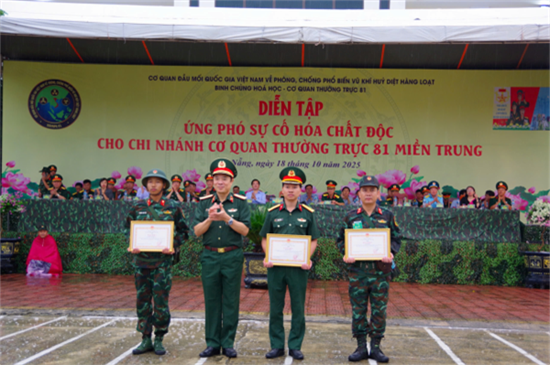 |
| The Corps Command gives rewards to collectives with outstanding achievements in DC-25 exercise |
Under the leadership and direction from the Party and State, directly from the Central Military Commission (CMC) and MND, over the years, alongside the successful performance of their central political task of training and combat readiness, the Chemical Corps’ Party Committee and Command have grasped and effectively implemented resolutions, conclusions, and directives by the Party, State, CMC, and MND on international integration and defence diplomacy, achieving many positive results.
Effectively fulfilling the role of national focal agency in specialised fields
As the standing office of the national focal agency for preventing proliferation of weapons of mass destruction (WMD), the Corps has regularly conducted situational research, forecast, and assessment, particularly regarding WMD and chemical, biological, radiological, nuclear (CBRN), and environmental incidents, giving timely advice to the CMC, MND, and State on policies and solutions to promote international cooperation in executing international conventions and treaties on prohibiting WMD to which Vietnam is a signatory.
The Corps has organised and participated in international cooperation activities; it has coordinated with the US Department of State’s Export Control and Border Security Program (EXBS), European Union’s Partner-to-Partner Export Control Program for Dual-Use Goods in Southeast Asia (EU P2P), the European Union (EU), and the Network of ASEAN Chemical, Biological, and Radiological Defence Experts to hold seminars and refresher courses on preventing and countering WMD proliferation and the financing of WMD proliferation, combating money laundering, controlling export of dual-use goods, exchanging information and experiences in force organisation and human resource training for responding to CBRN incidents as well as developing Vietnam’s legal framework on preventing WMD proliferation. It has taken part in training courses on responding to CBRN incidents and perfecting legal systems, held by the Organisation for the Prohibition of Chemical Weapons (OPCW), the International Atomic Energy Agency (IAEA), the EU, and UN agencies. Those efforts demonstrate Vietnam’s responsibility for preventing WMD proliferation and ensuring global security.
Effective cooperation in settling the consequences of toxic chemicals/dioxin
This is one of the Corps’ highlights, showcasing the humanitarian significance and effectiveness of defence diplomacy work performed by Chemical Troops. The Corps has proactively advised the Government, CMC, and MND on working with international organisations to settle the consequences of post-war toxic chemicals, seeking funding and cooperation from international organisations and the US Government in remediation efforts, closely coordinating with Shimizu Corporation (Japan) to test dioxin-contaminated soil treatment technologies, and collaborating with Haemers Technologies (Belgium) to test thermal desorption technology for dioxin-contaminated soil treatment at Bien Hoa Airport.
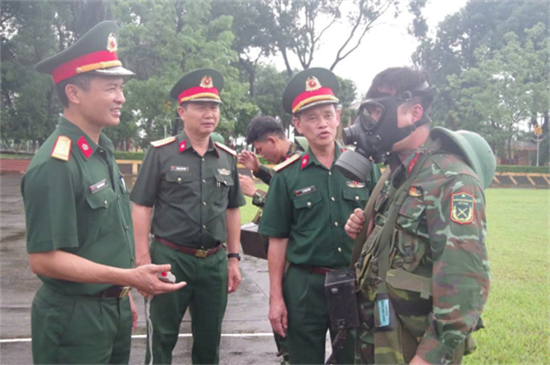 |
| The Corps Command inspects education and training work at Chemical Officer College |
Besides, the Corps has effectively implemented the Project on receiving equipment for dioxin and environmental analysis funded by the Japanese Government, facilitating researches in dioxin and persistent organic pollutant (POP) analysis; it has always well executed the Project on improving living standards for persons with disabilities caused by Agent Orange (Inclusion Project), funded by the US Government in eight provinces and cities, namely Quang Tri, Thua Thien Hue, Da Nang, Gia Lai, Quang Ngai, Dong Nai, Kon Tum, and Binh Dinh. It has continued working with the US to expand the Project to Ca Mau and Quang Ngai for the period of 2025 - 2030, while negotiating with partners from Belgium, Japan, and South Korea to develop a project on dioxin treatment at Phu Cat airport.
Developing bilateral, multilateral cooperation and participating in global-level missions
Under the leadership and direction of the CMC and MND, the Corps has actively implemented protocols on cooperation in chemical defence with the Lao People’s Army and the Royal Cambodian Armed Forces in the fields of personnel training and capacity building, while sending its experts to assist those countries in developing forces, upgrading and building technical facilities, and providing chemical defence equipment. These efforts contribute to cementing the traditional friendship between Vietnam and Laos as well as between Vietnam and Cambodia.
Multilaterally, the Corps has actively exchanged information related to CBRN issues with ASEAN countries, holding and taking part in ASEAN Regional Disaster Emergency Response Simulation Exercise (ARDEX), humanitarian assistance and disaster relief drills, as well as training and delegation exchange on search and rescue with the US.
Furthermore, the Corps has proactively prepared forces and equipment, organised professional training, and deployed its cadres to UN peacekeeping operations; it has organised delegation exchanges and sent its cadres to attend international conferences and seminars. It has taken advantage of international cooperation mechanisms and support from international organisations and partners to promote scientific and technological development, modernise its technical equipment, significantly improve self-sufficiency in materials, incident response capacity, and environmental remediation, and assist the people in disasters, thereby affirming its position, prestige, and capability in addressing international issues.
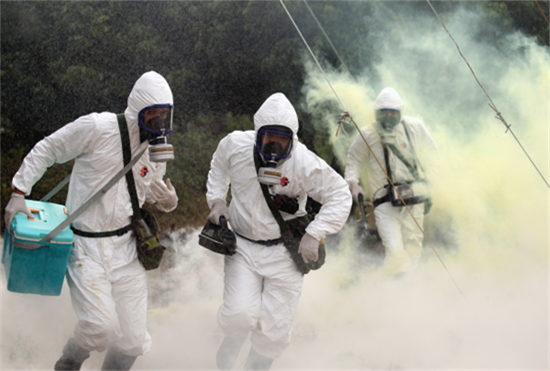 |
| Conducting reconnaissance during a civil defence exercise on environmental incident response |
The positive results in international integration and defence diplomacy by the Chemical Corps are significant but only initial. To effectively address non-traditional security challenges, risks of CBRN incidents, and the consequences of post-war toxic chemicals, the Corps will continue implementing tasks and solutions synchronously for raising the quality and effectiveness of international integration and defence diplomacy, strengthening internal capacity, meeting its task requirements in the new situation, contributing to ensuring a peaceful, stable environment, preventing risks of conflict and war, firmly defending the Fatherland early and from afar by peaceful means.
First, the Corps will continue to thoroughly grasp and realise viewpoints and lines of the Party, State, CMC, and MND on international integration and defence diplomacy in the new situation. Emphasis will be placed on Conclusion 53-KL/TW, dated 28 April 2023, by the Politburo, and Resolution 2662-NQ/QUTW, dated 26 February 2024, by the CMC, on international integration and defence diplomacy towards 2030 and beyond. The Corps will attach great value to improving its situational research, forecast, analysis, and assessment, especially regarding the conditions and development trends of WMD, means and equipment, anti-WMD activities of nations and international organisations, non-traditional security challenges, advantages and difficulties directly impacting national defence and security, and its own foreign affairs missions. It will give advice to the CMC and MND on policies and solutions for international cooperation in modernising the chemical force, performing the function of state management in prevention of WMD proliferation, civil defence, CBRN incident response, post-war toxic chemical remediation, and response to climate change and environmental disasters. It will also develop and perfect the system of documents on defence international cooperation.
Second, seriously, effectively implementing defence diplomacy and international cooperation missions assigned by the MND. In the immediate future, in addition to actively taking part in delegation exchanges and defence exchanges, organising training and refresher courses for the Lao People’s Army and the Royal Cambodian Armed Forces, the Corps will proactively, responsibly participate in dialogue mechanisms and multilateral forums, such as ASEAN Regional Forum (ARF), ASEAN Committee on Disaster Management (ACDM), Network of ASEAN Chemical, Biological, and Radiological Defence Experts, ASEAN Agreement on Disaster Management and Emergency Response (AADMER), and Global Atomic Forum. It will be ready to send its cadres to UN peacekeeping missions when required.
Additionally, the Corps will continue expanding cooperation with partners in equipment procurement, technology transfer, and chemical defence equipment manufacture and repair, particularly in artificial intelligence, semiconductor, biotechnology, and quantum technology, promoting a research - development - production - application chain for its political tasks.
Third, strengthening defence diplomacy in state management in prevention of WMD proliferation and CBRN incident response. Bringing into play its achieved results, the Corps will continue advising the Government and MND on international cooperation in preventing WMD proliferation and the financing of WMD proliferation, signing agreements with foreign partners on executing international conventions and treaties relating to the prevention of WMD proliferation and CBRN issues. It will closely work with relevant competent agencies to review, amend, supplement, and complete Vietnam’s legal documents and international mechanisms that Vietnam has joined regarding the prevention of WMD proliferation and financing of WMD proliferation. It will organise and participate in international conferences, workshops, and training courses on preventing WMD proliferation and the financing of WMD proliferation, controlling dual-use goods export, detecting signs of financing WMD proliferation, making preparations for CBRN incident response within ASEAN, raising awareness and capacity, and fulfilling the requirements of UN Security Council Resolution 1540 (28 April 2004). It will develop and implement bilateral and multilateral cooperation programs with nations and international organisations on responding to national-level environmental incidents. In the process of cooperation, it will adhere to the principles of independence and self-reliance, while ensuring national interests, without detriment to national defence, security, or to the image and reputation of our country and Military.
Fourth, maximising international resources in settling the consequences of post-war toxic chemicals. This is a political task of humanitarian significance requiring vast resources, including human, technological, and financial ones. To that end, the Corps will step up international cooperation to mobilise financial resources, equipment, technology, and personnel training to accelerate dioxin remediation. In the immediate term, it will focus on seeking support from foreign governments and international organisations for dioxin treatment at Phu Cat and Bien Hoa airports (second phase). It will closely coordinate with the US Department of State and partners to effectively implement the expanded Inclusion Project, for the sake of the improved quality of life of dioxin/toxic chemical victims. It will enhance cooperation in testing, evaluating, selecting, and eventually mastering dioxin treatment technologies suitable for Vietnam.
Fifth, raising the quality of human resources for foreign affairs and enhancing information and internal political protection work. Based on its functions and missions, the Corps will work with competent agencies to review, assess, and develop a pool of highly qualified, professional cadres in charge of international integration and defence diplomacy with comprehensive knowledge, strong capacity, firm political stance, and absolute loyalty to the Party, Fatherland, and people. It will remain vigilance, strictly ensure internal political management, actively combat and refute wrongful, hostile viewpoints, prevent hostile forces from exploiting international integration and defence diplomacy activities to implement their “peaceful evolution” strategies or promote “self-evolution” and “self-transformation” from within.
Sixth, promoting international cooperation in scientific and technological development, investing in equipment in a substantive, selective, effective manner. Emphasis will be placed on cooperation in research, specialised training, and technology transfer in key areas, such as monitoring and early warning of CBRN agents, simulation technology for training and exercises, toxic chemical treatment technologies, new materials and sensors, and application of artificial intelligence and big data to automated command and control. At the same time, it will strengthen cooperation in procurement, reception, and transfer of equipment, technologies, and production lines, aiming to gradually master foundational and core technologies, increase localisation, enhance the capability to manufacture and repair specialised equipment, and contribute to rapidly, synchronously, sustainably modernising the Chemical Force and meeting the requirements of preventing WMD, responding to CBRN incidents, and settling the consequences of post-war toxic chemicals in the new situation.
Maj. Gen. NGUYEN DINH HIEN
Commander of the Chemical Corps