The art of countering enemy shift in attack direction during the Plain of Jars - Xieng Khouang Defensive Campaign of 1972
In the Plain of Jars - Xieng Khouang Defensive Campaign of 1972, Vietnamese volunteer soldiers, together with the military and people of Laos, coordinated their combat efforts to defeat a strategic offensive launched by the US and its proxies aimed at retaking the Plain of Jars, thereby firmly protecting the liberated zones of the Lao revolution. Victory of the Campaign not only created a significant turning point on the battlefield, contributing to the failure of the enemy’s strategic plan, but also marked the development of the art of defensive campaigns, most notably the art of countering enemy shift in attack direction.
Following victory of the 1971 - 1972 dry season offensive campaign, the Vietnamese volunteer army and the Lao armed forces liberated and took control of the strategic Plain of Jars - Xieng Khouang area, establishing an advantageous posture that directly threatened enemy bases in Sam Thong and Long Cheng. Faced with this situation, the US and its proxy forces made every effort to encroach, attempting to push our forces further away by transferring troops from elsewhere to reinforce their defence in Long Cheng - Sam Thong, Tom Tieng - Pa Dong, Buon Long, and Sala Phou Khoun. This created a springboard to launch a large-scale offensive to recapture the Plain of Jars, retake the initiative on the battlefield, and create an advantage at the negotiating table.
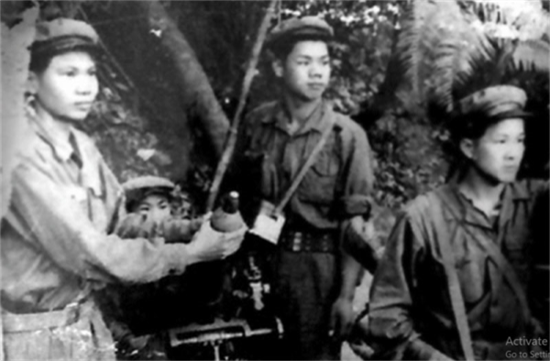 |
| An 82 mm mortar battery during the Plain of Jars - Xieng Khouang Defensive Campaign of 1972 (file photo) |
On our side, adhering to the directive of the Central Military Commission that immediately following the end of the offensive campaign, “a defensive campaign in the Plain of Jars must be organised from the 1972 rainy season”, the Campaign Command directed its units to coordinate closely with the Lao revolutionary armed forces to urgently make preparations and build a defensive posture in the Plain of Jars - Xieng Khouang area. Over nearly six months of combat, the Vietnam - Laos allied forces highly promoted the will to fight and win, a noble international spirit, and the creative application of Vietnamese military art. They gradually defeated the enemy’s large-scale, strategic offensive, firmly safeguarding the liberated zones of the Lao revolution. Notably, during this Campaign, the Vietnam - Laos allied forces proactively detected and correctly predicted the enemy’s intentions, promptly adjusted the defensive posture, and organised forces to completely thwart a shift in the enemy’s main attack direction. This contributed to supplementing and developing the theory of the art of countering enemy shift in attack direction in a defensive campaign regarding the following issues.
First, accurately assessing the enemy situation and organising an appropriate defensive posture. Shifting the main direction of attack is a combat stratagem frequently employed by the enemy when their initial axis of assault fails to achieve its objective or encounters strong resistance, aiming to create sudden changes and surprise, thereby rapidly breaking our defensive posture. Therefore, correctly anticipating the possibility of an enemy shift in attack direction is a prerequisite for organising a solid defensive posture and maintaining the initiative throughout the combat process.
On the basis of correctly assessing the enemy situation and the terrain, the Campaign Command determined that the South and South-West would be the enemy’s initial main direction of attack. At the same time, it predicted that if we held the intermediate zone (Hin Tang), the enemy might shift their main attack direction to the West or North-West. This was an area featuring numerous high mountain ranges and dense forests, favourable for mobile groups (GMs) and the Lao puppet troops (who were highly familiar with the terrain) to conduct deep infiltration into, outflank, and bypass our defensive clusters. Furthermore, in this direction lay a number of large fields, such as Na Luong and Ban Duc, which were convenient for the enemy to reinforce or transport troops by air. These factors allowed the enemy to rapidly shift their main direction of attack in an attempt to achieve surprise.
Consequently, the Campaign Command selected the form of area defence combined with mobile counter-attacks, dividing the campaign theatre - the quadrilateral area of Muang Sui - Nong Pet - Xieng Khouang provincial capital - Tham Lung, 60 km in length and 50 km in width - into 5 zones, creating a “circular” defensive posture. Within this, the main defensive zone was the centre of the Plain of Jars; the intermediate zone (Hin Tang) served as the primary forward defensive zone to engage the enemy attacking from the South-West; Nong Pet was the secondary defensive zone to engage the enemy attacking from the North-East; Muang Sui and Xieng Khouang town were two coordinating zones, engaging the enemy from afar to protect the central zone when the enemy attacked from the North-West and the East. With such organisation of defensive positions, the Vietnam - Laos allied forces created an interconnected, solid, in-depth defensive posture. Such a posture enabled our forces to manoeuvre flexibly across a vast space to reinforce and support one another among the defensive zones, and possess the capability to hold their ground for extended periods to combat enemy attacks from multiple directions, whether frontally, on the flanks, or via deep thrusts.
Concurrently, the Campaign Command directed the organisation of robust strongpoints across the defensive zones. The central zone was formed into 4 strongpoint clusters, the intermediate zone into 3 strongpoint clusters, and the Nong Pet zone into 2 strongpoint clusters, with fully prepared manoeuvre routes for specialised units to cross streams and mountain passes. For non-critical zones and areas where conditions were not yet suitable to build combat positions, we chose to prepare selected “focal strongpoints”, with the aim of gradually halting, wearing down, and weakening the enemy before they could advance into the main defensive zone. As a result, in all instances of enemy shift in main attack direction, to the North-West (Phase 2), the West (Phase 3), and the South (Phase 4), Vietnamese and Lao units were able to rely upon a solid fortification system to promote the strength of combined arms coordination and proactively transform the combat posture to crush the enemy’s large-scale offensives, thus successfully holding the defensive zones.
Second, conducting rational force organisation and employment, establishing an active and proactive defensive posture. Thoroughly grasping the offensive mindset in defensive operations, and maintaining reserve forces ready to respond to newly developing situations, the Campaign Command organised its troops into two primary elements: the defensive force and the mobile force. Within each regiment and battalion tasked with defence, a mobile component was retained to enhance tactical initiative. Accordingly, out of the initial four regiments participating in the Campaign, the Campaign Command assigned two regiments (174 and 866), along with one-third of the tanks and armoured vehicles, and one-quarter of the campaign artillery, to assume the defensive role. They were tasked with organising strongpoints and strongpoint clusters to pin down the enemy, thereby creating conditions for the Campaign’s mobile forces to launch counter-attacks and fight key battles. The other two regiments (148 and 335), later reinforced by Regiment 88 (Division 308C) and a number of specialised units, served as the mobile force. Their mission was to coordinate with the defensive force to mount counter-attacks, engage the enemy from afar, and break every spearhead and wave of the enemy offensive. This marked the first time that we and our allied forces had organised a comprehensive defensive campaign, possessing both defensive and mobile forces from the outset in roughly equal proportions. Furthermore, to proactively engage the enemy from a distance and strike their flanks and rear to disrupt their offensive posture, we deployed Commando Battalion 41, assembled at Na Bau (North-East of Xieng Khouang), to attack key targets in Long Cheng, Tom Tieng, and elsewhere.
Previously, we had organised only defensive battles at tactical level, configuring forces into a defensive element and a reserve element; in such cases, the defensive element typically constituted the vast majority of the force, rendering the defence somewhat passive and inflexible. By the time of the Plain of Jars - Xieng Khouang Defensive Campaign, with the organisation and deployment of defensive and mobile forces in roughly equal numbers, we had transitioned from passive defence to a more proactive defensive posture, employing offensive action to defend ourselves and utilising a solid defence as the prerequisite for mobile offensives. Consequently, we maintained both a defensive force anchored upon robust strongpoints and strongpoint clusters, and a formidable mobile force capable of proactively launching counter-attacks and ready to handle various contingencies, especially when the enemy shifted their main direction of attack. In practice, when the enemy shifted their main axis of attack to the North-West (Phase 2), Regiment 335, acting as the mobile force, coordinated closely with Regiment 866 to execute a counter-attack, wiping out and capturing hundreds of enemy troops, firmly securing the area.
Third, closely monitoring the signs of enemy shift in attack direction, promptly transforming defensive posture, maintaining the initiative in combat. In order to shift their main direction of attack, the enemy must manoeuvre forces, adjust their deployment posture, and capture ground to create a new springboard. Hence, their offensive momentum on the prior axis will suddenly decrease, artillery fire will shift, and so forth. Fully understanding this, the Campaign Command directed agencies and units to closely monitor operational developments and changes as a basis for evaluating the enemy’s subsequent intentions, particularly the signs of a shift in the main attack direction.
During Phase 2 of the Campaign, the enemy unexpectedly mobilised over 40 battalions to launch an offensive into the main defensive zone of the Plain of Jars. Prior to the assault, they employed tactical aviation and B-52 bombers to strike strongpoints, warehouses, and stations in Ban Ton, Lat Huong, Nong Pet, and areas suspected of harbouring our assembled forces. Concurrently, they utilised 4 GMs to seize springboards, move forces close to objectives, and launch massive attacks. Faced with these sudden enemy actions, the Campaign Command assessed: the aforementioned signs indicated that “the enemy’s offensive has truly begun, but they have only deployed 4 GMs on 3 axes, while the other 3 GMs have yet to appear; it is necessary to prepare for the possibility of a surprise attack direction”. This was a perfectly accurate assessment, demonstrating the sharp military acumen of the Campaign Command and its agencies. If the enemy only attacked along the three identified axes (West, South, and North-East), they could not possibly hold back nearly half of their available GMs, especially the two elite mobile groups, GM 21 and GM 26. In addition, tactical air and artillery fire was both shifted to several new areas in the North-West direction - clear signs of a shift in the enemy’s main axis of attack.
Exactly as assessed, in the North-West direction, the enemy unexpectedly used helicopters to land GM 21 and GM 26 in the North-East of Phou Keng, forming a new main attack direction, planning to execute a lethal deep thrust into the central Plain of Jars. The Campaign Command made the resolve to order Regiment 335 and Battalion 3 (Regiment 148) to act as the reserve force, ready to strike the enemy once they had clearly formed their new main attack direction. Thanks to firmly grasping the signs of an enemy shift in the main attack direction, we promptly adjusted our forces, transforming and establishing a new defensive posture, decimating GM 21 and GM 26, thereby defeating the enemy’s “surprise” move to shift their main axis of attack.
The war has long since concluded, but the lessons on the art of countering enemy shift in attack direction during the Plain of Jars - Xieng Khouang Defensive Campaign in 1972 remain as valuable as ever. They require continued deep, thorough research and creative application in modern warfare.
Sr. Col. NGUYEN TRONG HAI, PhD
Faculty of Infantry Combat Techniques
Infantry Officer College No.1