Throughout the course of the Vietnamese revolution, independence and self-reliance have always been consistent principles, serving as the foundation and strategic orientation for the formulation and implementation of our Party’s foreign policy. This is not only historical lessons drawn from the practical struggle to gain and safeguard sovereignty, but also a guiding compass for foreign activities in the context of globalisation and deep international integration today.
Based on an accurate assessment of the regional and global situations and a clear awareness of the role and significance of foreign affairs in the cause of national construction and defence in the new era, the Resolution of the 14th National Party Congress affirmed: “Consistently implement the foreign policy of independence, self-reliance, self-strengthening, peace, friendship, cooperation and development; multilateralise and diversify foreign relations; proactively and actively engage in comprehensive, deep, and effective international integration”.
This is a consistent viewpoint of our Party in foreign relations. At the same time, it is also a message clearly expressing the spirit that Vietnam is a friend, a reliable partner, and a responsible member of the international community, serving the national interests and making active contributions to world peace, friendship, cooperation, and development. The Party’s above viewpoint on foreign relations comprises multiple elements, among which the fundamental and overarching elements are independence and self-reliance. So, what are the new aspects of this viewpoint? Why does our Party continue to affirm and emphasise the principle of independence and self-reliance amid the current deepening international integration?
First of all, it must be affirmed that this is a consistent viewpoint of the Party in foreign relations. Consistency means an unwavering stance. This consistency is demonstrated throughout the course of revolution, as our Party has always remained steadfast in its stance of independence and self-reliance in foreign relations. However, consistency does not mean being static; rather, it is constantly supplemented and developed to align with the new context.
The new point of the current viewpoint is that it does not only stop at affirming the importance of maintaining independence and self-reliance, but also emphasises that this is the supreme national interest and a fundamental principle of Vietnam in international relations. And since it’s a principle, it cannot be violated or compromised in any form. Vietnam is always a friend and a reliable partner to other countries, desiring equal and mutually beneficial cooperation, and non-interference in each other’s internal affairs. With this mindset, Vietnam always considers protecting national interests as a matter of course; but at the same time, it always respects and considers the interests of its partners as its own, maintaining “trustworthiness” in relationships and cooperation. For “trustworthiness” is the foundation of trust; only with trust can cooperative relations be forged, and without trust, such relations are impossible - “one breach of trust breeds countless suspicions”, and “losing trust means losing everything”. This is not merely a matter of mutually beneficial “business” cooperation with partners, but rather reflects the traditional diplomatic qualities and style of the Vietnamese people.
For Vietnam, trust is the foundation and a crucial element ensuring sustainability in international relations. On this basis, Vietnam expects that countries engaging in relations and cooperation with it will also respect its legitimate interests, the supreme of which are independence, sovereignty, unity, and territorial integrity of the Fatherland. Vietnam rejects any schemes or actions that infringe upon the independence, sovereignty, unity, and territorial integrity of the Fatherland. This is an “immutable” principle in Vietnam’s foreign policy.
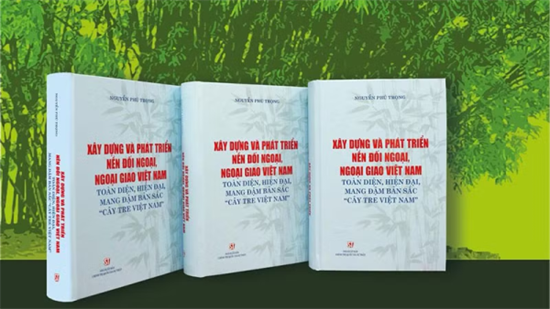 |
| An illustrative photo |
Regarding this issue, there may be concerns: in the context of current international relations, is the Party’s viewpoint too “rigid”? Does it cause disadvantages in foreign relations? The answer is no! The Party’s viewpoint of independence and self-reliance in foreign relations is not only not “rigid”, but also entirely correct and appropriate to the current complex, sensitive, and interest intertwined environment of international relations. Vietnam clearly awares that frankness, transparency, and consistency in stance are crucial elements for building trust and establishing and maintaining long-term, stable, and sustainable cooperative relations. The Vietnamese proverb, “Better to displease before than please after”, rings true in this regard. Therefore, it does not cause any disadvantage in foreign relations; on the contrary, it actually creates advantages, as it eliminates the need to waste time calculating and considering whether or not to engage in relations and cooperation. Those who share the same viewpoint and have the goodwill to engage and cooperate with us are our partners. As for those who are insincere in their engagement or merely exploit relations and cooperation for impure motives, they are certainly not partners; furthermore, if they scheme and act to infringe independence, sovereignty, unity, territorial integrity, they are adversaries. Thus, the viewpoint that upholding national independence is an inviolable “red line” in Vietnam’s foreign relations, making it easier for both ourselves and others (partners and adversaries alike) to decide on relations and cooperation. For us and our partners, this is self-evident and requires no further elaboration; for adversaries, it forces them to carefully weigh the consequences and be wary of the price they must pay if their purpose is sabotage.
In the Party’s foreign policy, the dimension of “independence” goes beyond the independence of objectives and national ultimate interests; it is also manifested in independence in thinking and the formulation of foreign policy. Our Party proactively analyses global and regional situations based on Vietnam’s specific conditions, without copying models or relying on the perspectives of any other country; maintaining an independent stance allows us to have our own voice, preventing us from being swept by external trends or pressures. Vietnam proactively selects its partners, cooperation forms, and the level of integration that align with its capabilities and interests. Independence is also reflected in the resolve to keep the stance in handling international issues; in multilateral forums, Vietnam steadfastly upholds the fundamental principles of international law, such as: respecting sovereignty, not interfering in internal affairs, resolving disputes by peaceful means,... simultaneously, showing clear, consistent views before complex issues, refusing to be dominated, etc.
Regarding the concept of “self-reliance” in international relations. This is a key element for Vietnam, as well as for other nations in international relations. A nation’s right to self-reliance is closely linked to its national independence. Only by firmly upholding self-reliance across all fields in relations and cooperation with partners can national independence be safeguarded. Failure to maintain autonomy equates to losing the initiative, becoming dependent on foreign powers, and falling into a passive position in implementing national policies. Once autonomy is lost, a nation loses itself. In that scenario, our country would become a mere pawn on the geopolitical chessboard, subjected to the manipulation and dictation of external forces; we would have no role to play in international affairs, and consequently, our national independence would be threatened. In the military field and armed struggle, self-reliance means holding the initiative, the most critical of which is the combat initiative. At different scopes, whether the combat initiative is maintained or lost will yield corresponding outcomes. At the tactical and operational levels, making mistakes that lead to the loss of the combat initiative may result in losing a few battles. But at the strategic level, losing the strategic combat initiative would be an irreparable mistake, making defeat in the entire war inevitable. Strategic autonomy in foreign relations operates in much the same way.
In the current complex context of international relations where interests are intertwined, fields such as economics, politics, culture, society, defence, and security... are closely interconnected, mutually influencing and conditioning one another; moreover, in relations and cooperation, partners and adversaries are intertwined and transform into one another, making identification not always clear. Therefore, we need to be extremely alert and cautious, avoiding the situation of only seeing immediate benefits without paying attention to long-term benefits or only looking at one side, one dimension without holistic thinking. For instance, in economic and trade relations and cooperation, we must avoid falling into the “trap” of major powers, leading to economic dependence as some countries have experienced. This is a very clear and precious lesson for our country. Because economic dependence easily leads to political dependence. And once there is political dependence, it is very difficult to maintain the regime and protect the independence, sovereignty, unity, and territorial integrity of the Fatherland. Therefore, in relations and cooperation with foreign countries, regardless of the field, we must always firmly uphold strategic self-reliance. Of course, to uphold self-reliance, we must be strong and self-strengthening. If we are weak, dependent, or reliant on foreign countries, it will be very difficult to maintain self-reliance. Just like the issue of national independence, upholding self-reliance in foreign relations is a principle and a consistent viewpoint of our Party.
The global situation is currently undergoing complex, rapid, and unpredictable changes. Notably, conflicts and wars in several regions remain unresolved; major powers are competing fiercely for power, making strategic adjustments, and luring and gathering forces in disregard of international law... which negatively impacts the globe and international relations in many aspects. In this context, Vietnam remains steadfast in its consistent foreign policy, proactively engaging in relations, cooperation, and international integration to generate resources and momentum for national development and the defence of the Fatherland. To date, we have established diplomatic relations with 195 countries, including 42 strategic and comprehensive partners; among these, 15 are comprehensive strategic partners, encompassing all five permanent members of the United Nations Security Council; we also maintain economic, trade, and investment relations with over 200 markets across continents and have signed and participated in hundreds of bilateral and multilateral agreements. Alongside this, Vietnam strives to be an active and highly responsible member of the international community, proactively and effectively participating in United Nations peacekeeping operations, as well as in addressing the consequences of natural disasters, epidemics, search and rescue operations, etc.
The above results stem from the Party’s correct foreign policy, the core of which is the viewpoint of independence, self-reliance, self-strengthening, multilateralisation, and diversification in foreign relations; thereby affirming Vietnam’s increasing potential, position, and prestige in the international arena. This is also the solid basis and foundation for building a comprehensive and modern diplomacy imbued with the identity of “Ho Chi Minh diplomacy” with three pillars: Party diplomacy, State diplomacy, and people-to-people diplomacy, practically contributing to the cause of national construction and development and the protection of the Fatherland in the new era.
Major General NGUYEN MANH HUNG, Former Editor-in-Chief of the National Defence Journal