Party Committee of the Army Academy upholds its core leadership role in the new period
The Army Academy is a central institution for the education and training of mid- and senior-level command and staff officers, as well as the leading centre for military science research of the Army. Fully aware of this role, the Academy’s Party Executive Committee has been focusing its leadership on building clean and strong party committees and party organisations at all levels through a range of guidelines and solutions, thereby effectively promoting their role as the core of comprehensive leadership and meeting the requirements and tasks of the new period.
During the 2020–2025 term, alongside leading the successful fulfilment of all targets and tasks in education, training, and scientific research, the Party Executive Committee and party committees and organisations at all levels within the Army Academy’s Party Committee have thoroughly studied, implemented, and strictly carried out the resolutions, directives, and guidance of higher-level authorities concerning Party-building work.
The resolutions, directives, and conclusions of the Central Committee, the Central Military Commission, and the Ministry of National Defence have been thoroughly studied, concretised, and strictly implemented in close alignment with the practical conditions of each office, faculty, and unit, firmly upholding the principle of the Party’s leadership across all areas of activity. Party committees and party organisations at all levels have been regularly consolidated and strengthened, operating in accordance with their prescribed functions and responsibilities; organisational principles, working regulations, and operating routines have been rigorously maintained; and leadership methods at all levels have seen considerable renewal and creativity in a more scientific and democratic direction, closely grounded in reality “close to the grassroots, aligned with missions, and deeply engaged with people.” The leadership style, methods, and working ethos of party committees, party organisations, and key leaders at all levels have shown positive changes, becoming more grassroots-oriented; the role-modelling responsibility of cadres and party members has been given due emphasis. Inspection, supervision, self-criticism, and criticism have been conducted in a serious manner. As a result, the leadership capacity and combat effectiveness of party committees and party organisations, as well as the quality of cadres and party members, have been continuously enhanced, providing a solid foundation for building clean and strong party organisations at all levels, truly serving as the core of leadership in the successful fulfilment of all assigned tasks.
In the time ahead, the Academy has been designated as a key institution for education, training, and scientific research across the entire Army, striving to become a smart and modern academy by 2030, “exemplary and outstanding.” Accordingly, its missions in education, training, and scientific research are expected to witness strong development, giving rise to new issues and increasingly demanding requirements. To meet the tasks and requirements of the new period, the Academy’s Party Executive Committee will focus on exercising comprehensive leadership over all areas of work, particularly education, training, and scientific research, through a range of synchronised and effective measures and solutions. Among these, building and promoting the role of party committees and party organisations at all levels as the core of leadership within the Academy’s Party Committee is the foremost priority and the decisive factor in developing the Academy into one of the major, reputable centres of education, training, and scientific research of the Army and the nation.
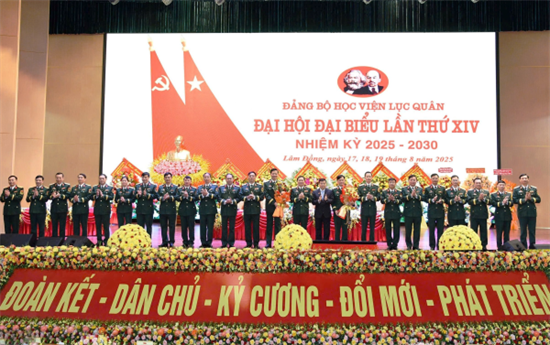 |
| General Nguyen Tan Cuong, Chief of the General Staff, congratulates the Party Committee of the Army Academy of the 2025 - 2030 term |
The decisive content and solutions to ensure that the core leadership role of the Academy’s Party Committee is brought into full, effective, and efficient play lie in paying close attention to building clean and strong grassroots party organisations with comprehensive leadership capacity and high combat effectiveness. Accordingly, the Academy’s Party Executive Committee, together with party committees and party organisations at all levels, will continue to thoroughly grasp and implement the resolutions and directives of the Party and the Central Military Commission on Party-building work. Emphasis will be placed on improving the quality of drafting and promulgating resolutions in a more practical and feasible manner; strictly observing the Party’s organisational and operational principles, especially democratic centralism, collective leadership with individual accountability, and self-criticism and criticism; and promoting democracy in tandem with strengthening discipline and order. At the same time, efforts will be made to actively renew leadership thinking and style, adopt scientific and democratic leadership methods, and cultivate a working ethos that is close to reality, specific, and closely aligned with political tasks; to bring into play collective wisdom; and to emphasise the responsibility of key leaders in organising implementation in the spirit of the “seven dare” principle. Due attention will be paid to effectively handling working relationships, particularly between the collective and the individual, and between leadership and management and command, ensuring that internal unity and cohesion are always firmly maintained.
In parallel, party committees and party organisations at all levels will continue to review, promptly revise and supplement, and strictly and effectively implement working regulations and leadership regulations governing key areas of work. Focus will be placed on renewing and improving the quality of meetings of party committees and grassroots party cells, ensuring the effective exercise of leadership across all areas of activity. Party committees and party organisations at all levels will be promptly consolidated and adjusted in line with organisational restructuring of offices and units, while linking the building of clean and strong party committees with the development of a corps of key leaders capable of formulating and implementing resolutions in close alignment with reality. Each party committee member and key leader will be required to consistently demonstrate firm political resolve, a strong sense of responsibility, and organisational capability, truly serving as a centre of unity and a shining example in moral integrity, lifestyle, and working conduct.
Party committees and party organisations at all levels provide effective leadership over the education, management, and training of party members; intensify education and cultivation of moral integrity, lifestyle, and working style; and strictly implement regulations on the standards of revolutionary ethics for cadres and party members, the rules on prohibited acts for party members, and the requirements for party members to participate in activities and fulfil civic obligations at their places of residence. Resolute efforts are made to combat and prevent manifestations of degeneration in political ideology, morality, and lifestyle, as well as “self-evolution” and “self-transformation”; party members who no longer meet the required standards are promptly reviewed, screened, and removed from the Party. Targets are set for the annual classification of party organisations and party members: 100% of party committees, party organisations, and party members to fulfil assigned tasks or above, with over 90% rated as fulfilling tasks well or excellently; and 100% of party committee members to be rated as fulfilling tasks well or above, truly serving as the core of leadership and unity within their offices and units.
Priority is given to leading the development of a contingent of cadres and lecturers commensurate with mission requirements, truly serving as the nucleus for promoting the core leadership role. In implementing this content and these solutions, the Academy’s Party Executive Committee requires party committees and party organisations at all levels to appropriately recognise the particularly important role of the contingent of cadres and cadre work in enhancing the core leadership role within offices and units. On that basis, breakthrough guidelines and measures are to be identified to build a contingent of exemplary cadres and lecturers with strong moral qualities and firm professional competence, capable of meeting the requirements of innovation and of improving the quality of the Academy’s education, training, and scientific research.
To realise this objective, party committees and party organisations at all levels proactively develop, supplement, revise, and promulgate new regulations and rules to ensure rigorous and practical leadership over cadre work; priority is given to promoting decentralisation and delegation of authority in conjunction with strengthened inspection and supervision of the performance of duties and responsibilities. Proactive measures are taken to address staffing requirements and to build a contingent of cadres, especially key leaders in sufficient numbers and with assured quality, capable of meeting the demands of building a smart and modern Academy, avoiding any decline in task performance due to shortages of cadres or lecturers.
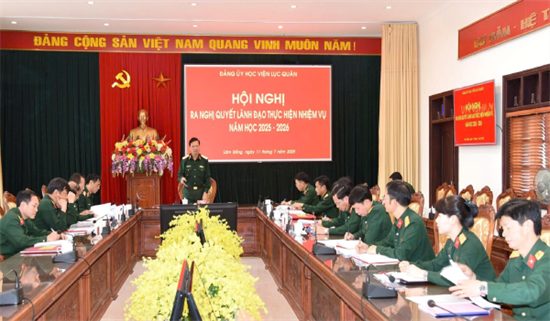 |
| Making leadership resolution for the 2025-2026 academic year |
Focus is placed on improving the quality of all stages and procedures of cadre work. Party committees and party organisations at all levels conduct cadre assessment in a comprehensive, continuous, and multi-dimensional manner, with clear criteria and concrete outputs; regularly review and promptly adjust and supplement cadre planning to ensure scientific soundness, rationality, continuity, and development, in line with practical conditions and mission requirements. Effective implementation of the Scheme on “Policies to attract and utilise talent for the Vietnam People’s Army to 2030, with a vision to 2050,” with rigorous, regulation-compliant policies for attracting, recruiting, and selecting cadres, taking work performance and criteria as fundamental benchmarks and prioritising candidates with expertise in technology and digital transformation. Cadre rotation and appointment are carried out effectively; cadres and lecturers with outstanding qualities, capabilities, and potential are proactively identified for appointment to key positions, including fast-track promotions to create a cadre pipeline; attention is paid to identifying and nurturing young cadres and female cadres. Policies are adopted to encourage and protect cadres who dare to think, dare to act, and dare to take responsibility, dynamic and innovative individuals acting for the common good; at the same time, cadres with limited capacity, violations, or poor task performance are promptly relieved, replaced, or reassigned without waiting for the end of their term or appointment tenure.
In parallel, due attention is given to effectively implementing training, professional development, and practical rotation for cadres and lecturers in line with needs, criteria, and standards. High requirements are set to hone the contingent of cadres and lecturers, closely combining professional qualifications and competencies with moral integrity, lifestyle, attitudes, a strong sense of responsibility for work, and strict observance of law and discipline. Emphasis is placed on identifying and nurturing young cadres with innovative thinking and leadership, research, and teaching capabilities in high-technology environments, meeting the requirements of building a smart and modern Academy. Continuous care is devoted to cadre policies and support for cadres’ families, creating favourable conditions for cadres and lecturers to work with peace of mind, remain committed, and contribute to the long-term development of the Academy.
To ensure that the core leadership role is brought into full and genuinely effective play across all areas of activity, the Academy’s Party Committee places strong emphasis on renewing and improving the quality of inspection and supervision work, while strictly maintaining Party discipline. Accordingly, party committees and party organisations at all levels intensify inspection and supervision of compliance with organisational principles and Party life, working regulations, and leadership regulations governing key areas of work, as well as the implementation of regulations of the Party, the Central Military Commission, and the Ministry of National Defence, particularly in areas prone to violations. Attention is also paid to inspecting and supervising the rectification of violations and shortcomings following inspection and supervision conclusions; leading and directing efforts to prevent and combat corruption, negativity, and wastefulness; and exercising control over assets and income in accordance with regulations. The quality of grasping, managing, and resolving internal political situations is enhanced; resolute struggle is waged against manifestations of degeneration, localism, factionalism, group interests, and distortive or divisive narratives that undermine internal unity. Party organisations and party members are proactively inspected when there are signs of violations; cases are handled resolutely in line with the principle of being “fair, accurate, and timely”; and difficulties and obstacles are addressed promptly at the grassroots level, fostering consensus throughout the entire Party Committee.
Promoting the core leadership role of the Army Academy’s Party Committee in the new period is not only an objective requirement but also a pivotal task and a solid foundation for leading the Academy to become comprehensively strong, “exemplary and typical”, smart and modern, capable of successfully fulfilling its missions, training outstanding command and staff officers, and contributing to the building of a revolutionary, regular, elite, and modern Army, firmly safeguarding the Fatherland in the new era.
Lieutenant General TRAN DANH KHAI, Political Commissar of the Academy