Thoroughly grasping the Party’s lines and policies on defence and security tasks, Cao Bang province has been focusing its leadership and direction on well performing these tasks, creating a favourable environment for socio-economic development and contributing to firmly protecting the Fatherland in the new situation.
Cao Bang is a mountainous, border province - the “frontier shield” in the country’s Northeast, the “cradle” of the Vietnamese revolution, holding a strategic position in terms of politics, defence, security, and diplomacy. Fully aware of its potential and advantages, over the years, while fostering socio-economic development and foreign affairs, the province has attached importance to leading, directing, and effectively implementing defence and military tasks via various measures, thus achieving many significant results.
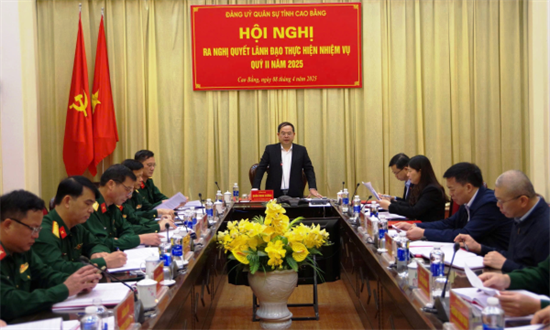 |
| Cao Bang Provincial Military Party Committee issues resolution for its missions in the third quarter of 2025 |
Notably, awareness and a sense of responsibility among all sectors, forces, and people towards Fatherland building and protection have been raised; the provincial defensive zone’s potential and posture, especially the military posture in key and border areas, have been consolidated; all-people national defence and posture of all-people national defence associated with the people’s security posture and “people’s hearts and minds posture” have been strengthened. The province’s armed forces have been built comprehensively, and they have promoted their core role in performing defence and military tasks, managing and firmly protecting national border sovereignty, ensuring political security and social order and safety as a solid foundation for the province’s socio-economic development and the people’s improved living standards.
In the upcoming time, the province’s security and political situation is forecast to remain stable; socio-economic development will continue to be sustainable; national defence, security, and foreign affairs will be consolidated and enhanced. However, security in rural, remote, extremely difficult areas still faces risks of instability; illegal immigration, smuggling, and trade frauds remain complicated; hostile forces continue to intensify their sabotage activities aimed at “depoliticising the Military”, dividing the Military from the people, and undermining great national unity, thus greatly affecting Fatherland construction and protection. The adoption of a two-tier local government system imposes new demanding requirements on defence and military work, while the capacity of commune-level military command cadres is still limited.
Against that backdrop, Cao Bang will concentrate its leadership and direction on effectively performing defence and military tasks, maintaining political stability, and creating favourable conditions for its rapid, sustainable, comprehensive development via the following key solutions.
First, strengthening the leadership and direction of all-level Party committees and Party organisations over defence and military work. Effectively implementing this measure will help raise the quality of the province’s defence and military tasks. Thus, the province will direct all-level Party committees to continue grasping resolutions and directives of the Party, State, Central Military Commission, Ministry of National Defence, Military Region 1, and the province itself on defence and military work, with emphasis on the Resolution of the 13th Party Central Committee’s 8th Plenum on the Strategy for Fatherland Protection in the New Situation. Doing so will help maintain and strengthen the Party’s leadership, and enhance the capacity of local authorities in managing defence and military work and proactively developing resolutions and action programs appropriate to local characteristics and their assigned tasks.
Party committees and Party organisations at all levels will strictly comply with principles and mechanisms of Party activities, especially the principle of democratic centralism, regularly renew leadership methods, and uphold self-criticism and criticism. Attention will be paid to improving the capacity of cadres and Party members comprehensively, clearly defining the roles and duties of heads of all-level Party committees, dealing with signs of neglecting or loosening leadership over defence and military work. Inspection and supervision by Party committees at all levels in defence and military tasks will be stepped up to promptly detect shortcomings and formulate appropriate corrective measures. Road map and plans will be developed to gradually increase the proportion of commune-level military cadres joining local Party committees, particularly in border and key areas of defence and security.
Second, raising the quality of defence and security education to make a strong change in awareness and a sense of responsibility among cadres, Party members, and citizens towards defence and military tasks. The province will consolidate all-level Defence and Security Education Councils after the 20th Provincial Party Congress and the election of deputies to all-level People's Councils for 2026 - 2031 tenure. It will systematically manage those who must attend defence and security education courses, especially cadres joining all-level Party committees for their first time. Plans will be developed to educate target groups under regulations and expanded groups; educational content and programs will be updated and renewed appropriately for each target group and locality, with a focus on the Party's viewpoints and lines and the State’s policies and laws on defence and military work, the building of all-people national defence and the people’s security, national border sovereignty, legal normative documents on defence and security work, and hostile forces’ plots and tactics.
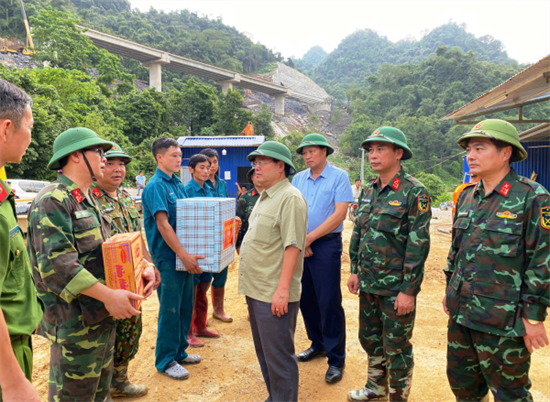 |
| Comrade Quan Minh Cuong gives encouragement to search and rescue forces during their mission in Duc Long commune |
In the process, basic education and in-person classes will be combined with the improved operational effectiveness of political - social organisations, while the role of mass media, social networks, village elders, community leaders, and religious dignitaries will be promoted. The fundamentals of resolutions, directives, and guiding documents on defence and security tasks will be integrated into cultural and artistic activities, local traditional festivals, and community activities, especially in remote, isolated, and border areas. Doing so will contribute to cementing the people's trust in the Party’s leadership, building a firm “posture of people’s hearts and minds”, and promoting the combined strength of the entire political system, great national unity, and local armed forces, bringing into play the province’s revolutionary tradition, and effectively executing Fatherland construction and protection missions right at grass-roots level.
Third, fostering socio-economic development in association with defence and security consolidation. Based on the Politburo’s Resolution 11-NQ/TW, dated 10 February 2022, on socio-economic development orientations and defence and security consolidation in the Northern Midland and Mountainous Region towards 2030, with a vision towards 2045, Cao Bang Provincial Planning for the period of 2021 - 2030 with a vision towards 2050, and the results of commune-level administrative boundary adjustments, the province will review and adjust its socio-economic development master planning in line with strengthening its defensive zone’s potential and military posture. Priority will be given to investing in scientific and technological development and dual-use economic sectors, ensuring that each socio-economic development step will be a step forward in defence and security consolidation. Plans and projects of socio-economic development will be appraised carefully, scientifically in compliance with local characteristics and strengths, especially for projects in border and key areas of defence and security.
To promptly achieve the targets set by the 20th Provincial Party Congress, the province will concentrate all efforts on implementing three key programs, effectively, sustainably exploiting its available potential and advantages, especially the two international border gates of Tra Linh and Ta Lung, resolutely realising three breakthroughs, striving to quickly complete and put into use Dong Dang - Tra Linh Expressway, clearing the “bottleneck” in transport infrastructure, expanding development space, and connecting Cao Bang with the entire region and country. The Provincial Military Command will be directed to coordinate with economic - defence units in projects for poverty reduction and elimination of temporary and dilapidated houses, thus fostering socio-economic development, improving the people’s living standards, building a solid all-people national defence posture in the province's border areas.
Fourth, building strong armed forces as the core in performing defence and military tasks. The province will exercise its leadership over the building of strong armed forces in terms of politics, ideology, morality, organisation, and personnel, with great synergy and combat readiness capacity, as reliable political and absolutely loyal combat forces of local Party committees, authorities, and people. All-level military agencies will seriously implement Resolution 866-NQ/QUTW, dated 14 June 2025, by the Central Military Commission on continuing to reorganise local military forces in a “compact, strong” manner to meet their task requirements in the new situation. Consideration will be given to building a “powerful”, high-quality reserve force and a “strong, extensive” militia and self-defence force. Emphasis will be placed on developing standing border militia units suitable for each locality, improving the capacity of commune-level military command cadres, contributing to raising the quality of defence and military tasks. The Public Security Force will be built to be “comprehensive at provincial level, strong at commune level”, and capable of ensuring security and social order for the people’s peace and happiness.
Due regard will be paid to ensuring adequate facilities and policies for members of the armed forces, raising the quality of training, strictly maintaining combat readiness routines, improving coordination between forces, opportunely addressing non-traditional security challenges, and strengthening civil defence capabilities. The Provincial Military Command will closely coordinate with departments, agencies, sectors, and localities to actively prepare for and successfully organise defensive zone exercises as the basis for drawing lessons, supplementing and perfecting theoretical frameworks, building an increasingly inter-connected, solid provincial defensive zone, and firmly protecting the Fatherland in the new situation.
With great political resolve, creative methods, and prudent, flexible, steady steps, Cao Bang will strive to overcome all difficulties and effectively perform defence and military tasks to build a more prosperous, civilised province.
QUAN MINH CUONG, PhD
Former Secretary of the Provincial Party Committee