Building Political Officer College on par with its mission requirements in the new era
Over the past 50 years of construction, combat, and growth, Political Officer College has firmly established itself as a centre for training political officers at grass-roots level (battalion level and below), contributing to building a politically strong Vietnam People’s Army (VPA) and ensuring the Party’s absolute, direct leadership over the Military in all aspects. In the new stage of development, the College continues promoting its glorious tradition and a robust reform to meet the requirements of building a revolutionary, regular, elite, modern VPA.
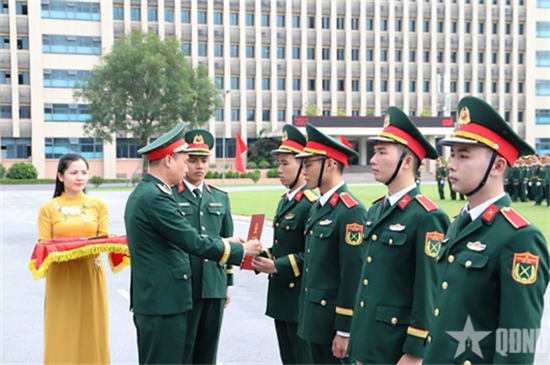 |
| Presenting certificate of graduation to cadets of the College (photo: qdnd.vn) |
Following the historic Spring Victory of 1975, in response to the urgent requirements of the building of a politically strong VPA, national defence consolidation, and Fatherland protection, on 14 January 1976, Political Officer College was established with a special mission of training junior political commissars - the force in charge of party and political work across the Military.
The foundation of the College marked a strategic milestone, reflecting the vision of the Party, the Central Military Commission (CMC), and the Ministry of National Defence (MND) for the development of a pool of political officers to give advice on and conduct party and political work at grass-roots level, contributing to ensuring the VPA’s working-class nature, internal unity, discipline, and combat strength. Throughout its stages of development and restructuring to meet the requirements of VPA building in each historical period, the College has consistently upheld the goal of comprehensive education, placing the cultivation of political steadfastness, ethics, organisational competence, and working styles among political cadres at its core, closely integrating theory with military and defence activities.
In the early years of Fatherland construction and protection, the College not only served as a training centre for political officers for the entire VPA, but also directly engaged in combat under the guiding principle: “cadets must strive to graduate from the College, from the training ground, and from the battlefield”, thereby training, testing, and affirming the political and revolutionary qualities of its officers and cadets. Those efforts have helped shape and develop the College’s distinctive training model of integrating political theory with military operations, combining education in Marxist - Leninist theory and social sciences with military training, taking the effectiveness of party and political work at grass-roots units as the benchmark for evaluating the College’s training quality. Tens of thousands of political officers from the College have directly taken part in building and consolidating grass-roots Party organisations, maintaining political and ideological stability within their units, greatly contributing to successfully fulfilling all military missions, even in difficult, complex periods.
In line with the developments of VPA building in peacetime, the College has continuously adjusted and refined its training goals, curricula, and methods in an increasingly fundamental, comprehensive, and specialised manner. As a Party school within the Military, gradually evolving into a Political University with postgraduate programs and expanding its role in political training for cadres from both inside and outside the VPA, the College has clearly affirmed its training mission, scale, quality, and goals. The achievements in education, training, and scientific research have enabled the College to fully meet the requirements of providing political officers and instructors in social sciences and humanities for building the VPA, all-people national defence, and the people’s security, defending the Socialist Vietnamese Fatherland, and participating in training human resources for national industrialisation and modernisation and international cooperation.
In the process of development, the College has changed its name several times according to the MND’s decisions. Nevertheless, it has consistently maintained its role as a centre for researching, developing, applying, and disseminating knowledge of party and political work across the VPA. Through its teaching, scientific research, and practical review activities, it has contributed to clarifying a range of important theoretical and practical issues on building a politically strong VPA, on the mechanism of Party leadership over the VPA, and on methods of conducting party and political work in the new conditions.
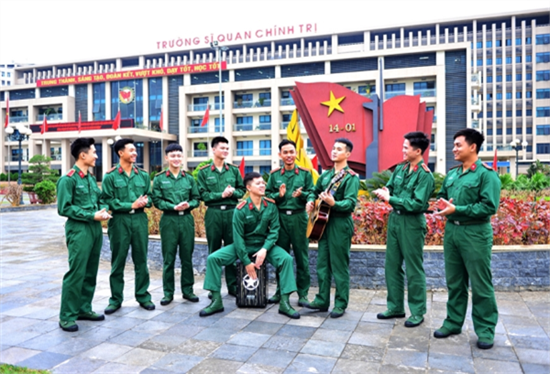 |
| Art performance by cadets of the College |
Amid globalisation, deep and wide international integration, and developments of science and technology, the College has continued to affirm its pioneering role in training political officers with political steadfastness, sharp theoretical thinking, and great organisational competence, and scientific working style. By renewing its curricula and training methods in line with units’ realities, it has directly contributed to raising the quality of ideological work across the entire Military. It has effectively taken part in the task of countering wrong, hostile viewpoints, thereby protecting the Party’s ideological foundation, maintaining political, ideological, and organisational unity within the Military, meeting the requirements of VPA building in the new era.
The achievements in the past 50 years are the result of political steadfastness, collective intellect, unity, resilience, and tireless efforts of generations of the College’s cadres, lecturers, cadets, employees, and soldiers. The title of “Hero of the People’s Armed Forces” (in 2024) and numerous other high distinctions have been evidence for the College’s brilliant accomplishments in training and education, VPA building, defence consolidation, and national construction and protection, confirming its role and prestige within the national education system as a typical and exemplary “Party and Youth Union School” in the Military and the whole country. Those achievements have laid a solid foundation for the College to continue promoting its tradition, pursuing a comprehensive reform, and improving the quality of education, training, and scientific research in the new era.
At present, rapid changes on global and regional scales, robust developments in science, technology, digital transformation, and cyberspace, hostile forces’ sabotage efforts in ideological field, and the building of a revolutionary, regular, elite, modern VPA are imposing new requirements on party and political work at grass-roots level, necessitating a fundamental reform in curricula and training methods for political officers towards standardisation, modernisation, and relevance to realities. To that end, the College will focus on the following key tasks.
First, thoroughly grasping the Party’s lines and viewpoints and upholding the College’s educational doctrine. The College’s Party Committee and Board of Directors and all-level Party committees and commands will effectively, creatively implement the Party’s viewpoints, the State’s laws, and the guidelines of the CMC and MND on education, training, and scientific research in accordance with the College’s conditions. Priority will be given to realising the 13th Politburo’s Resolution 71-NQ/TW, dated 22 August 2025, on breakthroughs in education and training and the CMC’s Resolution 1657-NQ/QUTW, dated 20 December 2022, on renewing education and training to meet the requirements of VPA building in the new context. The College will continue developing necessary qualities and competencies for cadets in line with its training goals, program outcome standards, and educational doctrine, while accelerating digital transformation and the building of a smart, modern school.
Second, effectively integrating theory and practice in the procedures of education, training, and scientific research. The College will closely monitor the practical developments of the VPA, society, and especially party and political work as well as emerging issues on military - defence affairs, VPA building, and Fatherland protection to refine and standardise its training curricula, methods, goals, and outcome standards. It will continue following the motto: “The training quality of the College is the combat readiness capacity of the unit”, strengthening cooperation with grass-roots units to evaluate its training outcomes and equip its cadets with critical thinking and methods to address new and complex practical challenges.
The College will also promote scientific research and closely integrate basic and applied studies. It will continue sharpening key theoretical and practical issues and giving advice to the CMC, the MND, and the General Department of Politics on building a politically strong VPA, raising the effectiveness of party and political work, developing the “posture of people’s hearts and minds”, strengthening the Party’s leadership over military and defence tasks.
Third, developing human resources as the decisive factor in the College’s education and training quality. To that end, the College will focus on building a contingent of lecturers and educational managers with political steadfastness and absolute loyalty to the Fatherland, Party, State, and people, as the core force in protecting the ideological foundation right in classes. Its contingent of cadres will be standardised towards a balanced structure, streamlined organisation, and specialisation.
The College will give priority to improving the professional, pedagogical, research, and practical review capabilities of its lecturers and educational managers, considering this as a key step to raise the quality of training and cultivate political officers in the new situation. Moreover, it will focus on planning, professional development, and effective utilisation of top lecturers and experts and closely integrate training within itself with deployment of its teaching staff to grass-roots units to enhance their practical competence, persuasiveness, and theoretical depth in lectures. Those efforts will enable the College to build a corps of “both red and expert” lecturers and educational managers with aspirations to devote themselves and resolve to overcome challenges, and meet the requirements of training political officers and building a revolutionary, regular, elite, modern VPA.
Fourth, building a pure, strong Party Organisation and an “exemplarily, typically” comprehensively strong, smart, modern College. The College Party Organisation will keep renewing its leadership style, enhancing its leadership capacity and combativeness, promoting democracy and collective intellect, matching words with action, clearly delegating responsibilities within each party committee and command, and well implementing the motto: “superiors set a good example for subordinates to follow”. It will promote its vanguard role in countering “peaceful evolution”, “self-evolution”, “self-transformation”, and wrong, hostile viewpoints, with “the entire College being a combat force, every cadre and party member being a frontline soldier”.
The College will keep renewing and improving the work of training, combat readiness, regularity building, discipline management, and military administrative reform to achieve a huge positive change in a sense of responsibility, motivation, and determination among all staff members. It will focus on building a digital database, stepping up digital transformation in command, management, education, training, and scientific research, upgrading information technology infrastructure, and adopting a smart monitoring system.
Bringing into play the tradition of “loyalty, creativity, unity, resilience, good teaching, good learning”, the College will continue pursuing a comprehensive reform to deserve to be a reputable centre for education, training, and research in social sciences and humanities and make significant contributions to the cause of Fatherland construction and protection in the new era.
Maj. Gen., Associate Prof. LUONG THANH HAN, PhD
Rector of the College