Preliminary studies on modern operational art in the war to defend the Fatherland
Should a war to defend the Fatherland occur in the future, it will be a modern war characterised by the extensive employment of high-tech weapons and conducted across multiple operational domains. Therefore, researching and developing modern operational art in the war to defend the Fatherland is an urgent requirement.
Modern operations are an objective requirement for countries that have attained a high level of industrialisation and modernisation and possess armed forces equipped with modern high-tech weapons, equipment and technical means.
In modern warfare, belligerents will employ new-generation weapon systems featuring high speed, long strike ranges, great destructive power, high precision and strong penetration capability. These include ballistic, cruise and hypersonic missiles, unmanned systems, military satellites, combat robots, artificial intelligence (AI) systems, multiple-launch rocket systems, new-generation tanks, precision-guided artillery, smart munitions, automated command, control and early-warning systems, as well as electronic warfare and cyber warfare capabilities on a broad scale. In addition, military operations will be closely integrated with non-traditional security factors. Importance will also be attached to attracting allies, mobilising forces, intensifying intelligence activities, inciting subversion and armed insurgency, imposing blockades and sanctions to weaken an adversary economically, attacking critical infrastructure and key facilities, and employing non-contact and asymmetric methods of operations.
Should war break out in Viet Nam, the enemy would employ long-range missiles and unmanned systems to strike key targets throughout our national territory. Regardless of the forms or scale of aggression employed, or the sophistication of its weapons and equipment, the enemy would not be able to subdue the Vietnamese people who are supported by the all-people national defence policy, the posture of the people’s war and, in particular, the operational art of the Vietnamese people’s war, which closely combines traditional operations with modern operations. Nevertheless, despite the wealth of experience accumulated through the wars of national liberation and the wars to defend the Fatherland, we still face certain limitations in military theory in responding to the development of modern warfare, especially warfare employing high-tech weapons and multi-domain operations. It is therefore necessary to conduct further research and provide orientations on modern operations although these remain initial studies.
Within the scope of this article, the author presents several preliminary observations on modern operational art in the people’s war to defend the Fatherland.
First, countering enemy fire strikes. Several recent armed conflicts and wars have demonstrated that fire strikes play an increasingly important role and have undergone significant development in terms of their means, forms and methods of employment. Should Viet Nam become the target of aggression, the enemy would undoubtedly launch large-scale fire strikes from the outset and sustain them throughout the course of operations by employing diverse and flexible methods and tactics. Such attacks would no longer rely primarily on manned air power; instead, they would mainly employ modern missile systems and unmanned platforms.
When countering enemy fire strikes, it is necessary to combine closely the traditional methods of operations of the Vietnamese people’s war with modern methods of operations. In particular, it is essential to foster among officers, soldiers and the people a strong determination to fight, ensuring that they remain steadfast and are not intimidated by the enemy’s firepower and high-tech weapons. Enemy attacks should be repelled to the greatest possible extent while giving the highest priority to preserving forces, maintaining the operational posture, and sustaining effective command, control and coordination capabilities under enemy fire. At the same time, protective measures, including dispersal, evacuation, deception, camouflage, force dispersion, manoeuvre, movement and flexible redeployment, should be implemented in a coordinated manner. Equal attention should be devoted to the early detection and engagement of enemy fire-strike assets in order to reduce their operational effectiveness. Research should also be intensified into methods of intercepting and neutralising enemy missiles and unmanned systems through the employment of modern weapons, equipment and technical means, thereby enabling focused retaliatory strikes against enemy fire-strike assets, including those deployed within enemy territory and at enemy bases at sea and on islands. Greater investment should be devoted to procuring and producing modern weapons and equipment, and advanced air defence weapons capable of effectively intercepting enemy missiles and aircraft. At the same time, a layered air defence system should be established to strengthen self-protection against enemy fire strikes, while permanent defensive works should be constructed in key areas and around important objectives. In addition, special and elite forces should covertly deploy unmanned systems close to enemy positions in order to conduct close-range and surprise attacks whenever opportunities arise. The militia and self-defence forces should also be equipped with modern short-range anti-aircraft guns, artillery and missile systems to conduct widespread operations against enemy cruise missiles and UAVs.
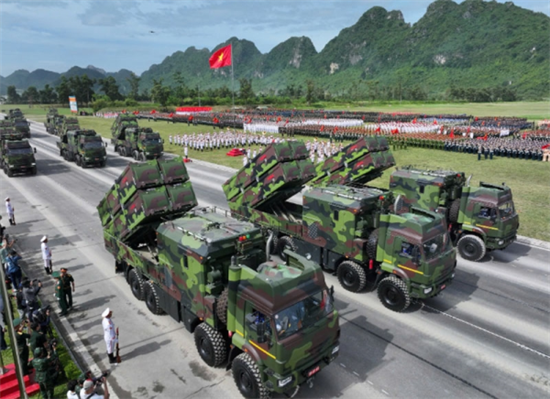 |
| Truong Son missile complex developed by the Military Industry and Telecoms Group (Viettel) |
Second, countering enemy amphibious landings. Viet Nam is a littoral state; therefore, the maritime direction will constitute the enemy’s principal axis of attack. The enemy may combine fire strikes launched from the sea with maritime blockade and sea control operations while conducting amphibious landing campaigns against key objectives and strategically important areas. As Viet Nam’s comprehensive national strength continues to grow and the People’s Army is increasingly modernised, the traditional perception that our capability to provide comprehensive support for operations will remain limited is no longer appropriate. Should war break out, we must direct our operational strength towards the maritime direction and coastal areas, make full use of the advantages of the people’s war to defend the Fatherland, and bring into full play the strengths of traditional methods of operations. At the same time, due attention should be paid to studying modern methods of operations in the maritime direction and coastal areas.
Accordingly, it is necessary to detect and monitor the enemy proactively at an early stage and from a distance; employ long-range missiles and unmanned systems to conduct focused strikes against enemy forces while they are manoeuvring at sea; and employ sufficiently strong forces to inflict heavy losses on enemy landing forces as they move from ship-to-shore transfer areas to the coast through coordinated strikes by the naval, air, artillery, missile and unmanned forces. Combat power should be concentrated to deliver decisive blows at the water’s edge, including the shoreline and immediate coastal belt, through powerful assaults by infantry and armoured forces. Close coordination should be maintained between naval operations and local armed forces in organising battles and campaigns with the determination to inflict heavy losses on, or even defeat, enemy forces after they have landed ashore or conducted airborne assaults in support of amphibious landing operations. Further research should be undertaken to develop and refine new methods of operations relating to combined arms operations, joint operations, combined operations, defensive campaigns and coastal defence operations. Additional research should also be conducted to further develop the theory governing infantry divisions in coastal defence operations. Throughout the people’s war to defend the Fatherland, the combined strength of personnel together with modern weapons and equipment in the maritime direction should be brought into full play.
Third, countering enemy ground offensive operations. In the war to defend the Fatherland, operations against enemy ground offensives provide favourable conditions for bringing into full play the valuable methods and experience accumulated through traditional operations. Accordingly, we should maintain close contact with the enemy, interlock with its forces, and conduct close-range, surprise, widespread, flank and rear attacks through battles and campaigns of appropriate scale and form. Under the new conditions, it is necessary to study and develop methods of operations to meet the requirements of modern warfare, with emphasis on developing and refining combined arms operations to a modern standard in the following areas.
Defensive operations. When conducting ground offensives, the enemy will continue to advance along operational axes, particularly major and strategically important lines of communication, making full use of its superior mobility and employing flexible combat methods, especially mechanised infantry attacks to bypass strongpoints and airborne assaults. Therefore, we should take the initiative in establishing strong campaign strongpoints in selected key and strategically important terrain along operational axes, particularly major lines of communication, in accordance with the newly adjusted administrative boundaries. These campaign strongpoints should serve as the nucleus for conducting divisional defensive battles and organising defensive campaigns. The firepower of artillery, missile forces and unmanned systems should be brought into full play to deliver concentrated strikes against key objectives, inflict heavy casualties on enemy forces and compel them to halt their advance. At the same time, close coordination should be maintained between infantry and armoured units of the main-force formations and local armed forces in conducting battles and campaigns aimed at destroying a significant portion of the enemy’s forces. Defensive operations should not be prolonged in order to avoid excessive casualties caused by enemy firepower. At the appropriate time, they should rapidly transition to offensive operations centred on the campaign strongpoints.
Counter-offensive and offensive operations. Counter-offensive and offensive operations constitute the fundamental form of operations and play the decisive role in fundamentally changing the battlefield situation and bringing the war to a successful conclusion, particularly at the strategic level. At the strategic and campaign levels, counter-offensive and offensive operations provide favourable conditions for the effective application of the fundamental principles of modern operational art. They also make it possible to employ long-range firepower and unmanned systems to launch powerful pre-emptive strikes, concentrating high-density fire against enemy airborne assault forces, forces temporarily halted, forces occupying temporary defensive positions, and forces in established defensive positions at an appropriate moment, thereby creating favourable conditions for infantry and armoured forces to launch assault operations. When conducting counter-offensive and offensive operations, particular importance should be attached to bringing into full play the mobility of tanks and armoured vehicles, together with fire support provided by the air force, artillery and unmanned aerial systems, in order to engage enemy forces while they are manoeuvring or conducting airborne assaults.
Fourth, operational command. At present, our operational command system continues to perform effectively in traditional operations; however, it has yet to keep pace with the requirements of modern warfare. To meet the demands of operational command in modern warfare, it is necessary to automate the command system through the application of information technology and computer networks to collect and process intelligence data, and to develop a comprehensive picture of the battlefield in support of commanders in making rapid and accurate decisions and coordinating operational activities more effectively. The automated command system should replace, or at least partially supplement, traditional methods of command, thereby enhancing the speed and accuracy of military activities, particularly in the command of the air defence, air force, and naval and electronic warfare forces. Priority should be given to investing in and equipping the services and arms with automated command systems, focusing on such components as UAVs, electro-optical systems, radar and satellites; high-speed, real-time information transmission and communication systems; and intelligent, high-capacity information-processing systems. These capabilities will provide commanders and soldiers with timely and accurate information, enabling them to make rapid, timely and well-informed decisions. Additionally, greater investment should be devoted to the research, development and integrated fielding of modern high-tech weapon systems. Overall, the automated command system should be capable of automatically detecting and identifying targets at an early stage and from long range, automatically tracking them, and automatically activating engagement and interception systems.
Alongside the continued application of traditional methods of operations, research into and the development of the theory of modern operational art in the war to defend the Fatherland are both important and necessary. This is an important factor contributing to the firm safeguarding of the Fatherland in the new period.
Lieutenant General, Associate Professor, PhD TRAN THAI BINH, Former Director General, Viet Nam Institute for Defence Strategy