Unveiling the distortions of socio-economic development goals in the Documents of the 14th National Congress of the Party
The socio-economic development goals set by the Resolution of the 14th National Congress of the Communist Party of Vietnam for 2030, with a vision to 2045 - marking the 100th anniversaries of the Party’s founding and the nation’s establishment - demonstrate the Party’s strategic thinking and vision; while also reflect the development aspirations of our nation in the new era and have received the consensus, support, determination, and confidence of the people during the implementation of the Resolution. These development goals are grounded in solid scientific and practical foundations, however, hostile forces continue to deny and distort them in an attempt to undermine the confidence of officials, Party members, and the people in the Party’s leadership. Therefore, it is necessary to resolutely combat and refute such claims.
The Resolution of the 14th National Congress of the Party clearly affirms the determination of our entire Party, people, and army to: “Maintain a peaceful and stable environment; to achieve rapid and sustainable national development while steadfastly safeguarding the Fatherland; to comprehensively improve and enhance the living standards of the people; to uphold strategic autonomy, self-reliance, and self-confidence to advance strongly in the new era of the nation; to successfully achieve the goal of becoming a developing country with modern industry and upper-middle income by 2030; and to actualise the vision of becoming a developed, high-income country by 2045, for a Vietnam that is peaceful, independent, democratic, strong, prosperous, civilised, and happy, steadily advancing toward socialism”.
The Resolution also sets out specific socio-economic development goals for the 2026-2030 period, including: striving for an average annual gross domestic product (GDP) growth rate of 10% or higher; achieving a GDP per capita of approximately 8.500 USD by 2030. The Human Development Index (HDI) is targeted to reach around 0,8 (high group), and average life expectancy at birth is to reach approximately 75,5 years. Vietnam also aims to rank among the top 40 countries with the highest levels of happiness. These specific socio-economic development goals are considered highly ambitious, reflecting the aspirations of the entire nation in the new era, yet they are entirely feasible as they are grounded in solid scientific and practical foundations.
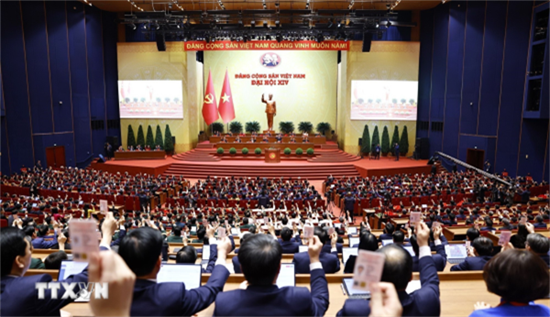 |
| Voting to approve the Resolution of the 14th National Party Congress (Photo: VNA) |
Distorted narratives by hostile forces in cyberspace
Similar to previous congresses, hostile forces have continued to exploit social media platforms to launch attacks and distortions against the outcomes of the 14th National Congress, targeting both guidelines and personnel of the 14th-tenure Central Committee, the Political Bureau, and the Secretariat. Regarding the socio-economic development goals for the 2026-2030 period and the vision toward 2045 as outlined in the Documents of the 14th National Congress, they dismiss them as “whimsical and unrealistic objectives”, “lacking basis for implementation”, and “mere symbolic targets”(!). Taking advantage of current domestic and international difficulties and challenges, they make allegations that “the Party’s development goals are far from reality and lack scientific grounding”(!); at the same time, they assert that “Vietnam cannot achieve rapid growth or breakthroughs in the new era under the leadership of the Communist Party”(!). Consequently, they “recommend” that the Communist Party of Vietnam should hand over the country’s leadership to another political force so that the Vietnamese nation can achieve breakthroughs in socio-economic development and realise the stated development goals(!), etc..
The underlying purpose of the aforementioned distortions is to undermine the stature and significance of the 14th National Congress; to erode the confidence of cadres, Party members, and all strata of the people in the Party’s leadership; to sow pessimism among cadres, Party members, and the people regarding the implementation of the Resolution of the 14th National Congress, ultimately aiming to deny the leadership role of the Communist Party of Vietnam in the new era; and at the same time, to propagate, call for, and incite the adoption of a “multi-party, pluralistic” regime in Vietnam. Such distorted narratives are insidious and completely wrong.
Solid scientific and practical foundations serve as compelling evidence to refute all distortion schemes.
Firstly, the socio-economic development goals for 2030, with a vision toward 2045, as defined in the Documents of the 14th National Congress of the Party, represent a continuation of the development goals previously adopted at the 13th National Congress. Accordingly, the 13th National Congress set out the targets for 2025: striving to become a developing country with modern-oriented industry, surpassing the lower-middle-income level; by 2030: becoming a developing country with modern industry and upper-middle income; and by 2045: striving to become a developed, high-income country, following a socialist orientation. Up to now, the socio-economic development goals for the 2021-2025 period have been successfully completed, with numerous important achievements and milestones. Economic growth in 2025 reached 8,02%, creating a solid foundation for a growth target of 10% or more from 2026 and subsequent years. The GDP size in 2025 exceeded USD 514 billion, 1,48 times higher than in 2020, while GDP per capita reached USD 5.026 (compared to the target of USD 4.700–5.000 set by the 13th National Congress), thereby joining the group of upper-middle-income countries. HDI rose by 14 places to 0,766, placing the country in the high human development category. In 2025, the happiness index ranked 46th out of 143 countries, an increase of 33 places compared to 2021. Building on this foundation, the country continues to implement the socio-economic development goals for 2030, with a vision toward 2045, as set out by the 13th National Congress.
It should be reiterated that the contents of the documents of the 13th National Congress in general, and the socio-economic development goals for 2030 and 2045 in particular, were discussed and appraised through numerous seminars, conferences, and forums. These documents underwent 23 rounds of revision after incorporating valid opinions from organisations, scientists, intellectuals, public figures, domestic and international experts; Party cadres and members; as well as all strata of people at home and overseas Vietnamese communities, therefore, the socio-economic development goals for 2030, with a vision toward 2045, have been rigorously appraised, ensuring both scientific validity and feasibility. During the preparation of the documents for the 14th National Congress, the socio-economic development goals for 2030, with a vision towards 2045 were once again thoroughly reviewed in parallel with the drafting process of the Congress documents. The Subcommittee for the Documents of the 14th National Congress mobilised and brought together thousands of scientists and experts from research institutes, universities, and mass organisations; it held numerous workshops, seminars, and consultations on specific issues; including the socio-economic development goals for the 2026-2030 period, with a vision to 2045. Notably, after one month of public consultation on the draft documents submitted to the 14th National Congress, there were 5 million visits, generating nearly 14 million constructive opinions. This reality demonstrates that the development goals for 2030, with a vision toward 2045 were prepared meticulously, systematically, and scientifically, undergoing multiple rounds of rigorous and careful evaluation. Therefore, the development goals set forth by the 14th National Congress cannot be considered “whimsical” or “unrealistic”, as the hostile forces falsely claim and distort.
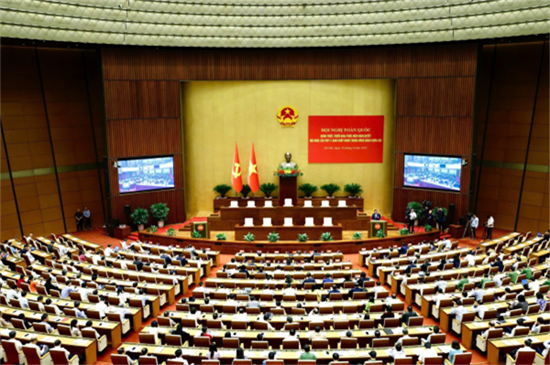 |
| Nation-wide briefing of the Party's 14th National Congress Resolution |
Secondly, the socio-economic development goals for 2030, with a vision toward 2045, outlined by the 14th Congress Document, are formulated in close alignment with the Party’s breakthrough strategic policies aimed at promoting rapid and sustainable growth, on the basis of fully leveraging the achievements of the Fourth Industrial Revolution. In the context of the Fourth Industrial Revolution, science, technology, and innovation have become decisive factors in determining national competitiveness, comprehensive strength, and the position of each country within the global system. The growth model that relied on resource exploitation, cheap labour, and investment capital - as previously observed in our country - is gradually exhausting its potential and is no longer compatible with the requirements for rapid and sustainable development. Many countries have successfully transitioned to growth models driven by science, technology, and innovation, thereby achieving remarkable outcomes.
Based on that reality and in response to the requirements of achieving socio-economic development goals for 2030, with a vision toward 2045, the Resolution of the 14th National Congress of the Party has put forward breakthrough policies: identifying the development of science, technology, innovation, and national digital transformation as the central driving force and a new growth engine; as a factor to renew traditional growth drivers; and as the key to realising the aspiration for rapid and sustainable development in the new era. On that basis, the 14th National Congress advocates a fundamental transformation of the growth model from extensive to intensive development, from one largely reliant on input expansion to a new growth model aimed at improving productivity, quality, efficiency, added value, and competitiveness of the economy; taking science, technology, innovation, and digital transformation as the primary driving forces; generating new high-quality production forces and methods, with a focus on the data economy, digital economy, green economy, and circular economy; promoting digital transformation, green transformation, energy transformation, the restructuring and quality enhancement of human resources; and considering that “the private sector is the most important driver of the national economy”.
Along with that, the feasibility of the socio-economic development goals for 2030, with a vision toward 2045, is also closely associated with 9 strategic resolutions issued by the Political Bureau from late 2024 to early 2026, creating the momentum for rapid and sustainable development and for realising the aspiration of a prosperous Vietnam by 2045, rather than being merely “symbolic targets” as distorted by hostile forces.
Thirdly, the country’s capabilities after 40 years of renovation enable us not only to have aspirations, but also to possess the room for breakthrough and the potential for rapid and sustainable development, thereby realising the socio-economic development goals for 2030, with a vision toward 2045. This is reflected in the maintenance of macroeconomic stability amid a highly volatile global context, clearly demonstrating the resilience of the economy. During the 2021-2025 period, inflation was kept under 3,6% (3,3% in 2025); major economic balances were ensured; and public debt and budget deficits were maintained within safe limits (public debt fell to 36% of GDP in 2025, compared to the 60% ceiling permitted by the National Assembly); the multidimensional poverty rate declined rapidly, reaching just 1,3% in 2025. GDP growth remained stable, with many years placing Vietnam among the leading countries in the ASEAN region. For the 2021-2025 period, average growth rate reached 6,3%, among the highest in the region and globally, with 2025 recording 8,02%. Notably, six localities achieved breakthrough growth rates exceeding 10%, namely Quang Ninh (11,89%), Hai Phong (11,81%), Ninh Binh (10,65%), Phu Tho (10,52%), Bac Ninh (10,27%), and Quang Ngai (10,12%). The size of the economy has continuously expanded over the years, significantly narrowing the gap with other countries in the region. In 2010, Indonesia’s GDP was 5,13 times Vietnam’s GDP, Thailand’s was 2,32 times larger, Malaysia’s 1,73 times, Singapore’s 1,63 times, and the Philippines’ 1,42 times. However, by 2024, with GDP reaching USD 476,3 billion, Vietnam’s GDP has surpassed Malaysia (1,13 times larger) and the Philippines (1,03 times larger); Indonesia’s GDP was only 2,93 times that of Vietnam, Thailand’s 1,11 times, and Singapore’s 1,15 times. With an economic size exceeding USD 514 billion in 2025, Vietnam ranked fourth in Southeast Asia and 32nd globally. The country’s total import-export turnover in 2025 surpassed USD 930 billion, maintaining a trade surplus for 10 consecutive years, in 2025 alone, the surplus exceeded USD 21 billion, affirming Vietnam’s position among the world’s top 15 largest trading economies.
Vietnam’s foreign relations have continued to expand, contributing to the maintenance of a peaceful and stable environment while broadening the country’s development space. To date, Vietnam has established diplomatic relations with 195 countries (including 193 member states of the United Nations); among them are 42 strategic and comprehensive partners, with 15 being comprehensive strategic partners (countries), this group includes all 5 permanent members of the United Nations Security Council and many major economies, clearly reflecting the foreign policy guideline of independence, self-reliance, multilateralisation, and diversification appropriate to the country’s development requirements in the new context.
Our country’s economy has also integrated deeply and widely into the global economy. To date, Vietnam has established economic and trade relations with 230 countries and territories, signed 16 Free Trade Agreements (FTAs), including several new-generation FTAs; and is a member of numerous major international economic organizations and forums, such as the World Trade Organisation (WTO), the International Monetary Fund (IMF), the World Bank (WB), the Asian Development Bank (ADB), the Asia-Pacific Economic Cooperation (APEC) forum, the Asia-Europe Meeting (ASEM), etc. This deep and wide integration has created favourable conditions for attracting resources, expanding markets, enhancing the resilience of the economy, and minimising risks in the context of global trade uncertainty.
The above-mentioned achievements of the 40 years of renovation serve as a solid foundation for our Party to set higher development goals in the new era; at the same time, they are a vivid reality that refutes all distortions by hostile forces claiming that the socio-economic development goals of the 14th National Congress “lack feasibility and are unrealistic”(!).
Fourthly, to realise the socio-economic development goals for 2030, with a vision toward 2045, the Documents of the 14th National Congress of the Party not only stop at setting out visions and target orientations but also closely link with concrete action programmes, feasible solutions, and a very high level of political determination to implement 12 major orientations, 6 key tasks, and 3 strategic breakthroughs. All tasks are required to follow the principle of “choose wisely - implement fast - deliver fully - measure by results”; along with a strong shift from “talk to action”, from awareness to activities, driven by the determination to “act swiftly and decisively, not wasting a single day or delaying a single week”, thereby overcoming the “persistent weakness in the implementation stage”. The implementation of 3 strategic breakthroughs regarding institutions, infrastructure, and human resources during the 2026-2030 period will create fundamental changes in the new development model.
Accordingly, the 14th National Congress advocates continuing to accelerate the synchronisation of the socialist-oriented market economy institutions; focusing on removing bottlenecks and institutional shortcomings to unlock resources and improve the investment and business environment; creating a strong and substantive shift from a “management” mindset to a “development-enabling” mindset; expanding decentralisation and delegation of authority to provide greater decision-making space and greater responsibility for cadres and civil servants within the two-tier local government model, thereby reducing time and compliance costs for citizens and businesses, and creating more favourable conditions for the private sector to thrive, establish large private conglomerates, with sufficient capacity to participate in key and high technology infrastructure projects, and strategic sectors.
Regarding breakthroughs in infrastructure, the 14th National Congress of the Party identified the need to concentrate resources on strategic and breakthrough infrastructure projects, particularly national arterial transport, railways, seaports, airports, energy and digital infrastructure, with increasing participation from the private sector. Focusing on the implementation of these infrastructure projects serves as a powerful “demand stimulus” lever, making significant contribution to achieving double-digit economic growth in the new era.
Regarding breakthroughs in human resources, the 14th National Congress emphasises enhancing the implementation capacity of cadres, civil servants, and public employees in the context of decentralisation and empowerment under the two-tier local government model; strengthening the responsibility of leaders, tightening administrative discipline and order, eliminating the tendency to avoid responsibility, completing mechanisms for evaluating cadres, and promoting cadres with good capabilities. At the same time, focus on developing a highly skilled, high-quality workforce on the basis of implementing education-training strategies to meet the demand of labour market and key industries, while also concentrate on improving foundational skills, especially digital skills for the workforce.
The drastic implementation of the 12 major orientations, 6 key tasks, and 3 strategic breakthroughs will serve as a vital driving force to realise the socio-economic development goals for 2030, with a vision toward 2045. This demonstrates that the socio-economic development goals set by the 14th National Congress are secured by feasible breakthrough solutions, with high political determination of the entire Party, people, and army - contrary to the distortions and baseless claims by hostile forces that they are “groundless” (!).
With the accumulated internal strength; with the rising international position; with the high political determination of our entire Party, people, and army; and with the breakthrough, highly feasible solutions in implementing Resolution of the 14th National Congress of the Party, the socio-economic development goals for 2030, with a vision towards 2045 will certainly be achieved successfully; all distortions and subversive claims of hostile forces are baseless and will inevitably fail. Exactly as the recent writings by To Lam, General Secretary of the Central Committee of the Communist Party of Vietnam, have affirmed: “The historical responsibility placed upon our entire Party, people, and army is to realise those goals and aspirations into a vivid reality. Every Party organisation, every cadre, and party member – especially those in leadership positions – must promote a sense of responsibility, set an example in leading the implementation of the Resolution of the 14th National Congress, be proactive and creative, dare to think, dare to act, and dare to take responsibility” and “With firm confidence in the Party’s leadership and the strength of the People, Under the glorious flag of the Party, for the bright future of the nation, advance, and victory is certain”.
NGUYEN NGOC HOI