“Self-evolution” and “self-transformation” constitute an especially dangerous threat that occurs quietly within the internal system, weakening the Party’s leadership role and combat strength, and threatening the survival of the regime, national interests, and the happiness of the People. Therefore, correctly identifying this internal danger in order to adopt effective preventive and countermeasures from within each organisation is of particular importance.
The Party’s 4th Central Committee Resolution (11th and 12th tenure) has gradually identified the manifestations of “self-evolution” and “self-transformation”, while proposing solutions to prevent and counter these phenomena.
In the same spirit, Conclusion No. 21-KL/TW dated 25 October 2021 of the Party Central Committee (13th tenure) on intensifying the construction and rectification of the Party and the political system, and resolutely preventing, repelling, and strictly handling cadres and Party members who show degradation in political ideology, morality, and lifestyle, as well as manifestations of “self-evolution” and “self-transformation”, clearly affirms the objective: “Resolutely struggle against individualism; prevent, repel, and strictly deal with cadres and Party members who show degradation in political ideology, morality, and lifestyle, and manifestations of “self-evolution” and “self-transformation”; closely and harmoniously combine “building” and “combating”, in which building is the fundamental, strategic, and long-term task, while combating is an important, urgent, and regular task”.
Together with this spirit, the 14th National Congress of the Party continued to emphasise the requirement of building the Party to be clean and comprehensively strong, regarding the prevention and combat of “self-evolution” and “self-transformation” as a prerequisite for enhancing the Party’s leadership capacity and combat strength in the new era of development. “The Party must maintain constant vigilance, prevent and combat major threats, especially errors in guidelines, deviation from its path, economic lagging, bureaucracy, corruption, degradation, as well as “self-evolution” and “self-transformation” from within”. This is not only a struggle in terms of organisation and discipline, but also a struggle to affirm the political steadfastness, confidence, and responsibility of cadres and Party members before the Party and the People.
In the new context, manifestations of “self-evolution” and “self-transformation” have become increasingly sophisticated, often disguised under various covers such as “innovation”, “criticism”, or “acting for the common good”, etc. The most common manifestations that need to be properly identified can be summarised as follows: First, wavering and fading revolutionary goals and ideals; doubting the objective of national independence and socialism; making one-sided comparisons of development models and goals, thereby advocating the notion of “political pluralism and a multi-party system” and denying the Party’s leadership role. Second, abusing the banner of “criticism”, “suggestion”, or “feedback” to distort and misrepresent the Party’s guidelines and policies; speaking and acting inconsistently, or even contrary to the Party’s resolutions, thereby eroding the trust of cadres, Party members, and the People. Third, degradation in morality and lifestyle associated with the “disease” of individualism, pragmatism, and self-interest; placing personal or group interests above collective interests and national interests, which eventually leads to “self-transformation” in official and organisational behaviour. Fourth, negligence or disregard for Party organisational principles and Party activities; avoiding self-criticism and criticism; lacking a sense of responsibility in defending the Party’s ideological foundation; remaining silent before the truth and indifferent to wrongdoing. Fifth, intentionally or unintentionally assisting in the dissemination of false or negative information on cyberspace, thereby blurring the boundary between right and wrong, truth and falsehood, and creating a “fertile ground” for hostile and erroneous viewpoints to infiltrate and exert reverse influence within the internal ranks.
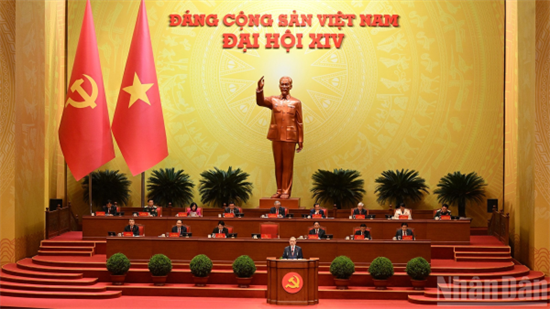 |
| The 14th National Congress of the Communist Party of Vietnam (Photo: nhandan.vn) |
In essence, “self-evolution” and “self-transformation” are processes of negative change from within; starting from degradation in political ideology, leading to deviations in perception and eventually transforming into attitudes, behaviours, and actions that are contrary to the Party’s goals and ideals, violating the principles of Party organisation and activities. This constitutes an internal threat closely associated with the deterioration of political ideology, morality, and lifestyle, as well as the rise of individualism.
“Self-evolution” and “self-transformation” are not random phenomena; rather, they have deep-rooted origins arising from both external and internal factors within each cadre and Party member, causing serious harm to the Party, the regime, and the individuals afflicted by this “malady” themselves. Driven primarily by objective causes such as the impact of globalisation, the Fourth Industrial Revolution, and digitalisation, all of which have introduced and shifted diverse values and lifestyles; therefore, cadres and Party members lacking political resilience are prone to vacillation, while also falling into the trap of making one-sided comparisons, overemphasising the negative aspects of alternative models, ultimately leading them to question the path chosen by the Party, President Ho Chi Minh, and the people. At the same time, the plots and schemes of “peaceful evolution” pursued by hostile forces have become increasingly sophisticated, focusing on undermining ideology, awareness, and confidence; exploiting issues related to democracy, human rights; fighting against corruption, wastefulness, and negative phenomena; or mistaking individual violations as the nature of the system, thereby inciting dissatisfaction and skepticism within Party organisations. Notably, the negative aspects of the market economy have also exacerbated the wealth gap, material temptations, and pragmatism. If management and educational efforts fail to keep pace with these developments, it may create a fertile environment for degradation and “self-transformation” to spread.
Regarding subjective causes, the breeding ground for “self-evolution” and “self-transformation” lies in a lack of political steadfastness, neglect of political theory, and an absence of self-discipline; when confronted with difficulties, conflicts of interest, or exposure to toxic information, such individuals easily waver in their ideology, paving the way for wrongful actions.
Moreover, the rise of individualism, the ambitions for power and material gain overshadow Party ideals and discipline; the mindset of “self-first” results in disregard for collective interests and Party organisational principles. Even more dangerous is the lack of exemplary conduct, self-criticism and criticism, and avoiding the fight against wrongdoings. Over time, this creates a mentality of “keeping the peace at all costs”, which erodes the fighting strength of the Party organisation and each Party member.
Regarding the harmful effects, drawing on the reality of Party building work, our Party affirms that “self-evolution” and “self-transformation” represent an exceptionally dangerous internal threat, because they arise not solely from external attacks but emerge, accumulate, and erupt from within the ranks of cadres, Party members, and organisations themselves. This threat requires early detection and fierce struggle right from within the Party organisation, and its root; starting from ideology, awareness, and political belief, eventually transforming into attitudes and behaviours that contravene the Party’s Platform, Charter, resolutions, and conclusions.
If political and ideological degradation acts as the “germ”, then “self-evolution” and “self-transformation” represent the dangerous outbreak of the disease, which can lead to a denial of the Party’s leadership role and the socialist path, or the distortion of the Party’s goals and ideals, thereby fracturing the unity in thought and action, disrupting the principle of democratic centralism, and weakening the combat strength of grassroots Party organisations.
More dangerously, “self-evolution” and “self-transformation” create an “internal foothold” for hostile forces to sabotage the Party and the State. These forces exploit degraded cadres and Party members to distort facts, incite unrest, and exaggerate errors, turning localised shortcomings into issues of the “regime’s nature”. From this perspective, the Party requires that these signs be identified immediately within internal ranks, starting from Party cell activities, from personnel work, criticism and self-criticism, from public statements and proposals, and considers this as a “line of defence from the root”, from early and afar to safeguard the Party’s ideological foundation and prestige.
From a legal perspective, “self-evolution” and “self-transformation” are not only ideological issues, but also carry the potential risk of turning into violations of the law. When cadres and Party members suffer from political and ideological degradation, prioritise personal interests over the common good, they will become prone to abuse of power, corruption, misconduct, violations of laws and discipline in public service. Once “self-transformation” takes hold, cadres may act against the law, exploiting institutional loopholes and hiding under “mechanisms”, “flexibility”, or “creativity” to legitimise wrongful acts. This causes not only material damage but also erodes the people’s trust in the law and the government apparatus. From a legal perspective, “self-evolution” and “self-transformation” are dangers that distort the goal of serving the nation and the people of state power, leading to the corruption and degeneration of power.
For the Vietnam People’s Army, “self-evolution” and “self-transformation” pose a direct threat to the working-class nature, the people’s character, and national identity; as well as the discipline and combat strength of the Military. The Military operates under absolute and direct leadership of the Party in all aspects; and the centralised and unified management of the State. Consequently, any deviation in politics, ideology, or lifestyle directly impacts combat readiness and absolute loyalty to the Fatherland, the Party, the State, and the People. “Self-evolution” in ideology can lead to wavering class stance and diminished fighting spirit, and consequently, “self-transformation” into disciplinary violations, disrupting unity and solidarity, and weakening military regular order. Military discipline is inherently self-disciplined and strict; if eroded from within, the consequences extend beyond individual violations to damage the prestige, position, and overall strength of both the unit and the entire military.
Therefore, from the perspective of military discipline, identifying “self-evolution” and “self-transformation” within Party organisations and command structures is a survival requirement to uphold the qualities and image of “Uncle Ho’s Soldiers”, ensuring the Army remains a political and fighting force that is absolutely loyal and reliable to the Party, State, and People.
Thus, across all three approaches: Party organisation, State law, and Military discipline, it can be affirmed that “self-evolution” and “self-transformation” are the most dangerous internal threats, because they sabotage the Party from within, weakening trust, discipline, and the political - legal - military strength of the regime, as well as the Army’s combat power. This is a persistent, long-term threat that undermines the Party’s ideological foundation, creates an “internal foothold” for hostile forces to sabotage, and erodes the people’s trust in the Party, State, and regime.
Early identification and timely response within Party organisations are not only requirements for Party building, but also conditions for ensuring the effectiveness of the law, maintaining military discipline, and ensuring socio-political stability. This is an extremely fierce “battle in peacetime”, requiring every Party organisation and every cadre and Party member to constantly self-reflect, self-correct, maintain a firm political stance, discipline, and revolutionary ethics to protect the Party, protect themselves, and protect the nation’s development path.
In a new era of development where opportunities are intertwined with challenges, “self-evolution” and “self-transformation” continue to be affected by new and more complex influences. The context of deep international integration and comprehensive digital transformation has intensified the integration of values and ideologies. Cyberspace has become an environment that directly and frequently shapes the awareness and beliefs of cadres, Party members, and the public; without political steadfastness and ideological “immunity”, individuals are easily controlled, leading to wavering in ideas and deviations from established standards. Furthermore, the drive for rapid, sustainable development and the push for institutional reform and strong decentralisation within the two-tier local government system could generate “gaps” in power control. If discipline and order are not maintained and kept up with reality, the rise of group interests and the pragmatic abuse of power becomes likely, creating “fertile ground” for “self-transformation”. Simultaneously, hostile forces are employing increasingly sophisticated and cunning schemes, focusing on “depoliticising” the Military and “de-ideologising” society, and exploiting internal issues to incite suspicion and division, aiming to erode trust from within.
Given this reality, it is essential to thoroughly grasp and strictly implement the requirement set by the 14th Party Congress to identify signs of “self-evolution” and “self-transformation” early, from afar, and at the root, while deploying synchronous and feasible solutions, closely linking the responsibility of Party committees and organisations with the self-awareness of each cadre and Party member. To this end, the following groups of solutions must be effectively implemented:
Firstly, strengthen Party building in politics, ideology, morality, organisation, and personnel. This is a fundamental, long-term solution. Party committees at all levels must continue to innovate and improve the quality of political theory study and thoroughly grasp the Resolution of the 14th Party Congress, avoiding formalism. They should make every cadre and Party member deeply internalise the Party’s revolutionary goals and ideals to build “immunity” against toxic information. Each cadre and Party member must proactively study and cultivate themselves, regarding the maintenance of political steadfastness and integrity as a responsibility and an honour.
Secondly, improve the quality of Party meetings and make self-criticism and criticism substantive. Party cell meetings must become a “space for early detection” of deviations in ideology, ethics, and lifestyle. Party committees and cell secretaries must dare to speak directly and honestly, without favouritism or evasion; Party members must dare to self-reflect and self-correct, hiding no shortcomings and refusing to “keep the peace at all costs”.
Thirdly, tighten discipline and order, control power in conjunction with the responsibility to set examples. Party committees, particularly leaders, must strictly adhere to the principles of democratic centralism, openness, and transparency in personnel work and financial and asset management. Violations must be resolutely addressed with no “forbidden zones” or “exceptions”, thereby preventing the risk of “self-transformation” driven by power and personal interest.
Fourthly, proactively safeguard the Party’s ideological foundation, effectively manage cyberspace, and strictly implement speech regulations. Party committees and organisations should enhance information guidance and promptly detect signs of deviation in statements and sharing posts on social media. Every cadre and Party member must be responsible for maintaining speech discipline, refraining from abetting the spread of toxic information, erroneous views, or negativity that contradicts the Party’s guidelines.
Fifthly, effectively promote the supervisory role of the People, the Fatherland Front, and socio-political organisations. Party committees must value feedback and social supervision; timely correcting signs of degradation at the grassroots level to prevent them from accumulating into ideological “hotspots”.
Preventing and combating “self-evolution” and “self-transformation” is the shared responsibility of the entire political system, however, the key lies with Party committees and organisations at all levels - led by their secretaries - and the self-awareness of cadres and Party members. When every Party organisation is clean and strong, and every cadre and Party member remains steadfast, these internal threats will be repelled right at the root.
Major General, Assoc. Prof., PhD, People’s Teacher NGUYEN BA DUONG