Global political–military landscape through the lens of the Munich Security Conference 2026
The Munich Security Conference 2026, held from 13 to 15 February 2026, took place against the backdrop of rapidly evolving, complex, and unpredictable global developments, posing a wide range of new challenges to international security. With a central message highlighting the disintegration of post–Cold War security structures, the Conference sketched a highly volatile picture of the global political and military landscape.
The Post–Cold War world order is being undermined
The Munich Security Conference 2026 brought together more than 100 heads of state, along with defence and foreign ministers from various countries. The Conference’s central report warned that recent policies of the administration of US President Donald Trump are contributing to the collapse of the unipolar world order established after the Cold War and eroding the international order formed in the aftermath of the Second World War. According to the report, the current US administration has disregarded core principles of international law, including territorial integrity and the prohibition of the threat or use of force. Specific actions, such as openly expressing intentions to control Greenland or applying military pressure in Iraq, Iran, Nigeria, Venezuela, and Yemen, have created a state of “commitment instability”. When a major power with significant influence over global institutions actively disrupts established rules, international trust is severely undermined.
The report further noted that the world has entered a phase in which the US-led unipolar order of the post–Cold War era is in decline. German Chancellor Friedrich Merz asserted that the old US-led world order has collapsed and no longer exists. He warned that the world is entering an era of “power politics” based on force, while calling on Europe to pursue greater defence autonomy and strengthen the role of NATO.
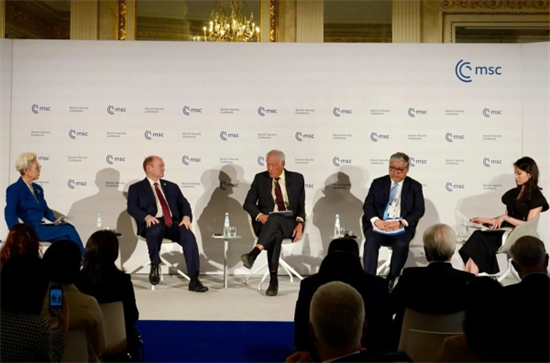 |
| Overview of the Munich Security Conference 2026 (Photo: MINDEF) |
Speakers at the Conference identified several causes behind the erosion of the US-led unipolar order. First, the rise of emerging powers is challenging US dominance. Over the past two decades, China has risen significantly to become one of the world’s major centres of power. Addressing the Conference, Chinese Foreign Minister Wang Yi emphasised: “The world should not return to Cold War logic. We need a fair multipolar international order for all nations.” In addition to China, countries such as Russia, India, Brazil, and Türkiye are also increasing their influence within the international system. Second, due to a series of missteps in both domestic and foreign policy, the United States is gradually losing its position as the world’s leading superpower. Although it remains a major power, it faces numerous strategic challenges. US Vice President James David Vance warned: “The West must face reality—the global balance of power is shifting rapidly.”
Transatlantic relations under severe strain
Speaking at the Conference, Chairman Wolfgang Ischinger highlighted significant signs of strain in transatlantic relations, as several European countries have begun questioning the extent of strategic cohesion between the United States and its allies. Discussions revealed growing scepticism over whether Western countries can still maintain the unity of strategic interests and political values that characterised the immediate post–Cold War period. Accordingly, Wolfgang Ischinger called on European nations to move beyond political declarations towards concrete actions aimed at strengthening defence capabilities and the continent’s security architecture. Europe, he argued, must take greater responsibility for its own security in an increasingly complex international environment, while also assuming a more prominent role in maintaining regional and global strategic stability.
Experts noted that the Conference discussions underscored increasingly divergent perspectives on the future world order. While some countries emphasise the need to preserve the unipolar order, the majority advocate its transformation towards a multipolar structure reflecting the evolving balance of power. This shift signals a transition from a relatively stable configuration of power to a more competitive and fragmented international system. Questions were also raised regarding whether the United States and Europe still share common values and strategic alignment. These doubts reflect deeper fractures in transatlantic relations, particularly as US policy shifts towards requiring Europe to assume greater responsibility for its own security rather than relying heavily on Washington. For its part, Europe is not seeking to abandon the alliance but is instead moving towards a more balanced model of cooperation based on clearer burden-sharing. The United States continues to reaffirm its commitment to alliances, albeit with increasing emphasis on conditionality—linking security cooperation with trade, standards, and defence contributions.
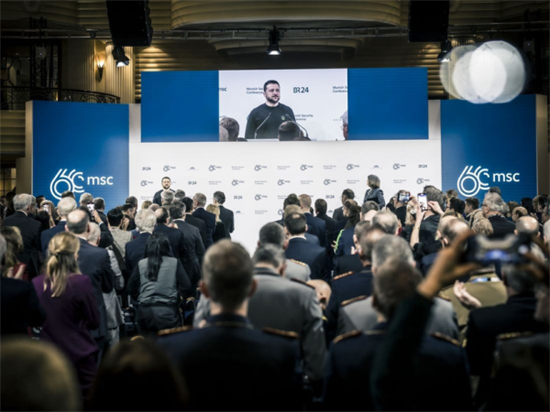 |
| Speech delivered by participant at the conference (Photo: MSC) |
The Russia–Ukraine conflict as a crucial test of Western unity
Beyond traditional security issues, the Conference devoted considerable attention to the Russia–Ukraine conflict, which was widely viewed as the most significant test of Western cohesion and effectiveness. Leaders examined its impact on European security from multiple dimensions.
First, regarding support for Ukraine, President Volodymyr Zelensky called on allies to sustain military aid and sanctions against Russia. He warned against repeating past concessions in negotiations and stressed the need for robust security guarantees, a large-scale post-war reconstruction package, and sustained pressure on Moscow. From Ukraine’s perspective, further concessions are unacceptable, even if negotiations resume, as Russia would not end the conflict without sufficient military and economic pressure.
Second, regarding deterrence and defence, NATO leaders reaffirmed their commitment to strengthening defences along the eastern flank to enhance deterrence against Russia. Twenty-six of the twenty-seven European Union member states issued a joint statement affirming the principle that “nothing about Ukraine can be negotiated without Ukraine” and pledged continued support for Kyiv until strategic objectives are achieved. Many European countries also emphasised the need to expand defence capabilities in the Baltic region, upgrade air forces, and increase military presence along eastern borders. Even traditionally neutral countries have begun adjusting their policies by reinstating conscription or increasing defence spending.
In addition to military concerns, the Conference addressed non-traditional security challenges. Europe’s energy crisis following the cessation of Russian gas imports, global food security (with Ukraine as a major grain supplier), and cybersecurity threats (including cyberattacks and hybrid warfare) were identified as urgent issues. Leaders emphasised the importance of diversifying energy supplies, maintaining strategic food reserves, and strengthening cyber defence as integral components of global security.
If the New START Treaty is not extended, the risk of nuclear proliferation could increase, potentially compelling Europe to accelerate its nuclear defence programmes. Notably, Germany announced for the first time its intention to develop nuclear deterrence capabilities within NATO in cooperation with France as part of Europe’s broader security architecture.
Overall, the Russia–Ukraine conflict has exposed structural limitations in the unipolar security order, particularly as the United States’ role in guaranteeing European security appears to be diminishing. In a context where US security commitments are no longer perceived as absolute and stable, many countries, especially NATO allies, are compelled to strengthen their own defence capabilities and strategic resilience.
Towards a multipolar world order
Discussions at the Conference indicate that the world is transitioning towards a multipolar order characterised by multiple centres of power, including the United States, China, the European Union, Russia, India, as well as groupings such as BRICS and the Shanghai Cooperation Organisation. In this emerging order, the Asia–Pacific region is becoming a focal point of global strategic competition, with hotspots including the South China Sea, the Taiwan Strait, and the Korean Peninsula. Looking ahead, experts outlined three possible scenarios for the future world order: (1) Cooperative multipolarity, where major powers compete but continue to cooperate on global issues; (2) Confrontational multipolarity, resembling Cold War–style bloc divisions; (3) Flexible multipolarity, characterised by issue-based and fluid alliances.
Many leaders and analysts agreed that the transition from a unipolar to a multipolar order will be marked by several key trends: intensifying great-power competition as a central feature of international relations; increasing difficulty for global governance mechanisms in addressing emerging challenges; and a growing emphasis among states on strengthening strategic autonomy, particularly in security and technology. At the Conference, United Nations Secretary-General Antonio Guterres warned that the global governance system is under unprecedented strain, characterised by (1). fragmented multipolarity, (2) the emergence of multiple power centres without effective coordination mechanisms, (3) intensifying technological competition in areas such as artificial intelligence, semiconductors, space technology, and cybersecurity, (4) the rising influence of middle powers such as Türkiye, Brazil, Saudi Arabia, and Indonesia.
According to international scholars, the Munich Security Conference 2026 has laid bare a stark reality: the unipolar world order of the post–Cold War era is disintegrating, while a stable multipolar order has yet to take shape. In this high-risk transitional period, the combination of traditional military strength with flexible diplomacy, alongside economic and technological capabilities, will determine each nation’s position.
LE THE MAU